
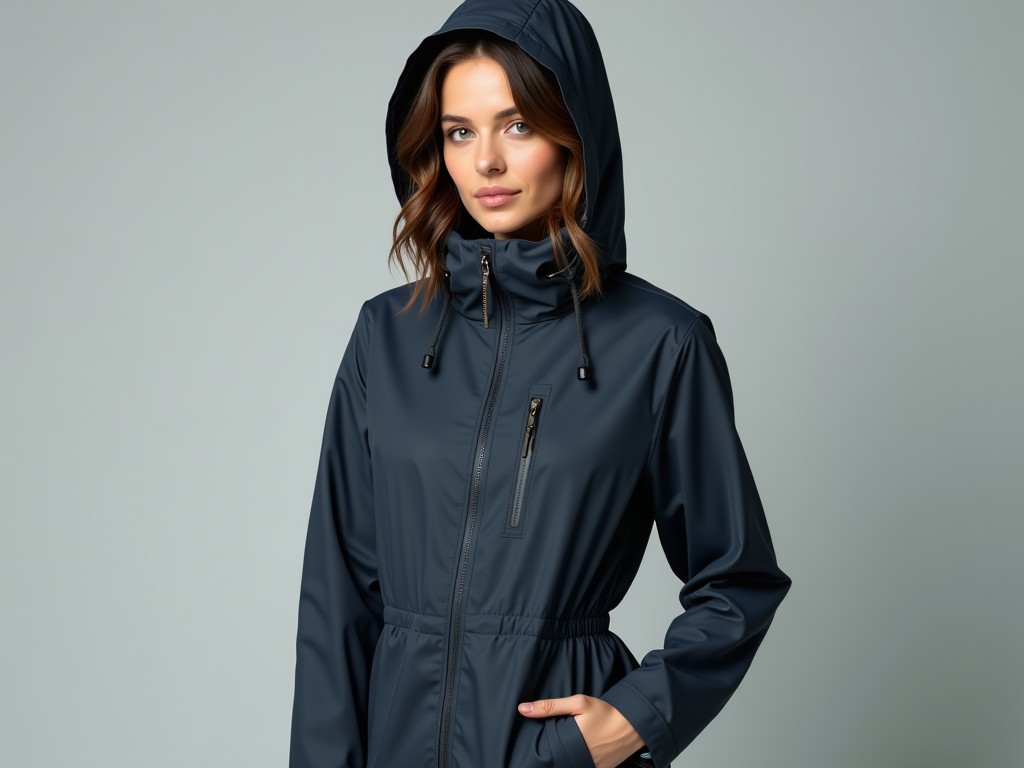
Womens Waterproof Rain Jackets Sale
Women's Waterproof Rain Jackets Sale
Waterproof performance in women's rain jackets depends on the synergy between membrane technology, seam sealing methods, and fabric construction—factors that directly impact breathability, durability, and suitability for prolonged outdoor use in wet conditions.
Membranes such as expanded polytetrafluoroethylene (ePTFE) or polyurethane (PU) coatings are evaluated by their hydrostatic head rating, measured in millimeters of water column (mmH₂O). A rating of 10,000 mmH₂O or higher indicates resistance to heavy rainfall and wind-driven moisture penetration, while values below 5,000 mmH₂O may fail under sustained exposure.
Seam integrity is critical; taped or welded seams prevent capillary leakage at stitch points. Fully taped seams, where waterproof tape is applied over all interior seams, offer the highest protection, whereas critically taped seams only cover high-stress areas like shoulders and hoods, leaving other seams vulnerable over time.
Material Composition and Layer Construction
The outer shell typically uses nylon or polyester with a denier (D) rating between 40D and 70D, balancing abrasion resistance with lightweight packability. Higher denier fabrics (e.g., 70D nylon) resist tearing from brush and gear but add weight; lower denier (40D polyester) improves compressibility for storage but may snag more easily.
A durable water repellent (DWR) finish is applied to the outer fabric to reduce surface wetting, maintaining breathability by preventing the outer layer from becoming saturated. DWR effectiveness diminishes with use and requires reactivation via heat (tumble drying on low) or reapplication; factory-applied DWR typically lasts 20–30 wash cycles before performance declines.
Layer construction defines performance trade-offs: 2-layer jackets bond the membrane to a separate liner, offering comfort and lower cost but bulk; 3-layer designs fuse membrane, outer shell, and inner scrim into a single laminate, reducing weight and improving durability while maintaining breathability—common in technical outdoor use.
Fit, Design Features, and Mobility Considerations
Women-specific patterns account for torso taper, shoulder width, and hip contour to reduce excess fabric that can flap in wind or restrict movement. Articulated elbows and gusseted underarms improve range of motion during activities like hiking or cycling, where arm elevation is frequent.
Adjustable hoods with laminated brims and rear volume adjusters ensure visibility and protection in heavy rain; storm flaps over zippers prevent water ingress through coil teeth, while water-resistant zippers (e.g., YKK AquaGuard®) use polyurethane-coated coils and flaps to resist penetration.
Ventilation zippers under the arms (pit zips) allow microclimate regulation without compromising waterproofing—critical during high-output activities where internal moisture buildup from sweat can reduce comfort even if the jacket blocks external rain.
Performance Comparison: Key Specifications
| Specification | Typical Range | Impact on Use Case |
|---|---|---|
| Hydrostatic Head | 5,000–20,000 mmH₂O | <10,000: light rain; ≥10,000: heavy rain/wind |
| Breathability (MVTR) | 5,000–20,000 g/m²/24h | Higher values reduce internal condensation during exertion |
| Fabric Denier | 40D–70D nylon/polyester | Lower D: packable; Higher D: abrasion resistant |
| Seam Treatment | Critically taped / Fully taped | Fully taped: continuous protection; Critical: cost-effective for intermittent use |
Breathability, measured as moisture vapor transmission rate (MVTR) in grams per square meter per 24 hours (g/m²/24h), indicates how effectively sweat escapes. Values above 10,000 g/m²/24h are recommended for active use; below 5,000 g/m²/24h may lead to dampness inside the jacket during prolonged exertion, even if the exterior remains dry.
Care, Maintenance, and Longevity Factors
Regular cleaning prevents dirt and oils from degrading the DWR finish and membrane performance. Use technical fabric cleaners (non-detergent, pH-neutral) and avoid fabric softeners, which leave hydrophilic residues that attract water and reduce breathability. Tumble drying on low heat for 20–30 minutes reactivates DWR by restoring the polymer chain alignment on the fabric surface.
Storage in a cool, dry place away from direct sunlight prevents UV degradation of nylon and polyurethane coatings. Long-term compression in tight sacks can cause creasing that may affect laminate integrity over time; hanging or loose storage is preferred for jackets not in immediate use.
Inspect seam tape and zippers periodically for delamination or corrosion. Peeling tape indicates loss of waterproof integrity and requires professional re-taping or replacement; corroded zipper sliders should be lubricated with silicone-based products to maintain smooth operation without attracting moisture.