
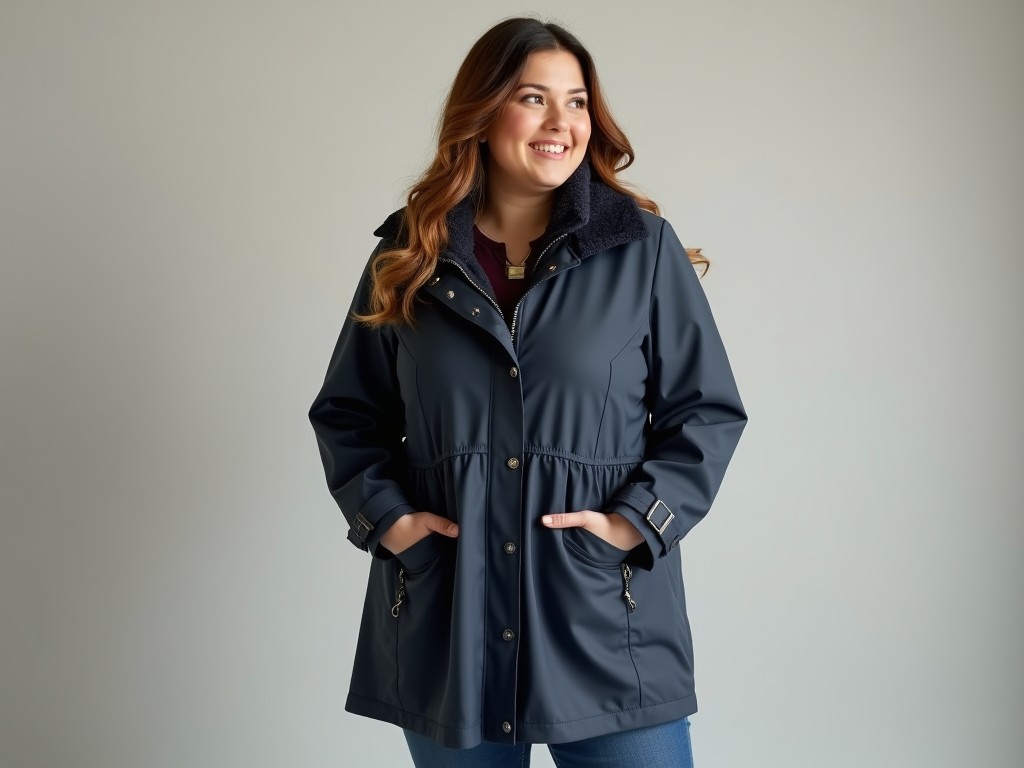
Womens Plus Size Lined Raincoats
Women's Plus Size Lined Raincoats
Industrial buyers evaluating women's plus size lined raincoats require technical clarity on construction, material performance, and fit consistency to minimize procurement risk. These garments serve as essential personal protective equipment in outdoor work environments where precipitation exposure is frequent and prolonged. Understanding the engineering behind seam sealing, liner integration, and sizing systems enables informed specification decisions that align with safety protocols and operational durability requirements.
Unlike consumer-focused rainwear, industrial-grade plus size lined raincoats are designed to maintain performance integrity across extended use cycles, repeated laundering, and variable thermal loads. The lining is not merely an added layer but a functionally engineered component that manages moisture vapor transmission while preventing conductive heat loss. Sizing systems must accommodate dimensional stability in larger girth measurements without compromising mobility or creating stress points at seam intersections.
Material Composition and Performance Characteristics
The outer shell typically utilizes a 100% polyester plain weave with a polyurethane (PU) coating applied at 1.8–2.2 mil thickness, providing a hydrostatic head rating of 3,000–5,000 mm under ISO 811 testing. This coating formulation resists delamination after 20+ wash cycles at 40°C and maintains flexibility down to -20°C. The coating weight averages 120–150 g/m², balancing waterproof integrity with breathability measured at 2,000–3,000 g/m²/24hr via JIS L 1099 B1 method.
The lining consists of a 150 g/m² polyester fleece with anti-pilling treatment, bonded to the shell via spot adhesive lamination at 50mm intervals to prevent shifting during movement. This construction avoids full lamination which could trap moisture and reduce thermal efficiency. The fleece pile height is maintained at 3.5–4.0mm to optimize loft retention after compression, with a CLO value of approximately 0.8–0.9 per layer when tested per ASTM F1291.
Seam sealing employs a 15mm wide thermoplastic polyurethane tape applied via heat bonding at 140–160°C, achieving a seal strength of 8–12 N/mm per ASTM D751. Tape width and bonding temperature are critical variables; insufficient width risks leakage at needle holes, while excessive heat degrades the PU coating. All seams—including shoulder, armhole, and side seams—are sealed to maintain full enclosure integrity.
Sizing System and Fit Engineering for Plus Sizes
Plus size raincoats use a graded sizing system based on chest, waist, and hip measurements with proportional increases in sleeve length and back width to maintain ergonomic alignment. Standard grading increments are 2 inches for chest and waist, 1.5 inches for hip, and 0.5 inches for sleeve length per size step. This prevents the common issue of disproportionate scaling where larger sizes become overly baggy in the torso while sleeves remain too short.
Pattern adjustments include increased ease at the bust (4–6 inches over body measurement), waist (2–4 inches), and hip (3–5 inches) to accommodate layering and movement without binding. The armhole depth is increased by 0.25 inches per size increment to prevent restriction during overhead reach. Back length is graded proportionally to maintain coverage without creating excessive fabric pooling at the hem.
Each size undergoes wear testing with a range of motion protocol simulating lifting, bending, and walking to verify seam integrity and fabric strain. Strain gauges placed at high-stress points (underarm, shoulder blade, lower back) confirm that tensile stress remains below 30% of fabric yield strength during dynamic movement. This testing rejects patterns that cause seam puckering or fabric distortion in larger girth configurations.
Design Features for Industrial Use
The storm flap over the front zipper extends 25mm beyond the zipper teeth on both sides and is secured with five 10mm diameter snap fasteners spaced at 60mm intervals. This overlap prevents wind-driven rain penetration at the zipper coil, a common failure point in non-flapped designs. The snap material is acetal copolymer for corrosion resistance and consistent engagement force of 3.5–4.5 N per fastener.
Cuffs feature a 38mm wide adjustable strap with thermoplastic polyurethane coating and a nickel-plated brass buckle, allowing circumferential adjustment from 220mm to 300mm to accommodate gloves or layered sleeves. The strap is anchored via double-needle stitching with 6.0mm polyester thread, tested to withstand 50N pull force without slippage. Elastic alternatives are avoided due to degradation under UV exposure and repeated stretching.
The hood is three-piece construction with a semi-rigid peak formed from 0.5mm polypropylene insert, providing 40mm of forward extension to shield the face without obstructing peripheral vision. Hood circumference adjusts via a 6mm diameter drawcord with cordlock toggles, ranging from 560mm to 680mm to accommodate hard hats or helmets. The hood attaches via a concealed zipper with storm flap, allowing removal when not required.
Performance Validation and Quality Control
Each production lot undergoes hydrostatic head testing on three randomly selected specimens per ISO 811, with acceptance criteria of minimum 3,500 mm after preconditioning at 20°C/65% RH for 24 hours. Spray testing per ISO 10528 evaluates surface wetting resistance, requiring a minimum rating of 4 (90% surface dryness) after 5 minutes of exposure. These tests confirm coating integrity and seal effectiveness under simulated rainfall conditions.
Dimensional stability is assessed after five wash cycles at 40°C followed by tumble drying at 60°C, with maximum allowable shrinkage of 2% in length and 1.5% in width. Exceeding these limits indicates inadequate pretreatment or coating cure. Colorfastness to washing is tested per ISO 105 C06, requiring a minimum grade of 4 for staining and 3–4 for color change to ensure visual consistency in uniform applications.
Seam strength is verified via grab test per ASTM D5034, with minimum values of 180 N in warp and 150 N in weft direction for the sealed seam assembly. This ensures the seam system can withstand dynamic loads without tearing. Visual inspection occurs at 100% for stitch density (8–10 stitches per inch), thread tension uniformity, and absence of oil stains or fabric defects under 2x magnification.
Applications in Industrial Sectors
In municipal infrastructure maintenance, crews performing drainage inspection, street cleaning, and utility locating face prolonged exposure to rain and spray from traffic. The raincoat’s full seam sealing and adjustable hood prevent water ingress during extended shifts, while the fleece lining maintains core temperature in conditions as low as 5°C, reducing the risk of cold-related fatigue during 8–10 hour operations.
Agricultural workers engaged in livestock management, crop scouting, and equipment maintenance in open fields benefit from the garment’s resistance to agricultural chemicals and fertilizers when the PU coating is formulated with additive packages that resist hydrolysis. The snap-front design allows rapid donning and doffing when transitioning between indoor and outdoor tasks, minimizing workflow interruption.
Logistics and warehouse personnel operating in outdoor loading docks, yard management, and vehicle pre-trip inspections require rainwear that accommodates high-visibility safety vests worn underneath. The increased torso and sleeve dimensions in plus size configurations ensure the raincoat does not compress reflective strips or restrict movement when layered over ANSI/ISEA 107-compliant vests, maintaining compliance with site safety protocols.
| Parameter | Typical Range | Test Standard |
|---|---|---|
| Hydrostatic Head | 3,500–5,000 mm | ISO 811 |
| Breathability | 2,000–3,000 g/m²/24hr | JIS L 1099 B1 |
| CLO Value (Lining) | 0.8–0.9 | ASTM F1291 |
| Seam Seal Strength | 8–12 N/mm | ASTM D751 |
| Shrinkage (5 Washes) | ≤2% Length, ≤1.5% Width | ISO 6330 |
Customization options are available to align with specific operational requirements, including alternative coating thicknesses for enhanced chemical resistance, liner weight adjustments for varying climate zones, and specialized closure systems such as magnetic storm flaps or waterproof zippers. Sizing can be adapted to include tall or petite proportions within the plus size range upon request, with pattern grading adjusted to maintain ergonomic alignment.
Color matching to corporate or municipal standards is supported via Pantone or RAL references, with dye lot consistency verified through spectrophotometer testing to ensure ΔE < 1.5 between batches. Reflective tape application compliant with ANSI/ISEA 107 can be integrated into the design at specified locations (shoulders, sleeves, back) without compromising the garment’s waterproof integrity.
Minimum order quantities for custom specifications typically start at 100 units, with sample development available upon receipt of detailed technical requirements including intended use environment, temperature range, layering expectations, and any regulatory standards that must be met. Lead times range from 4–6 weeks for standard configurations to 8–10 weeks for fully engineered solutions.