
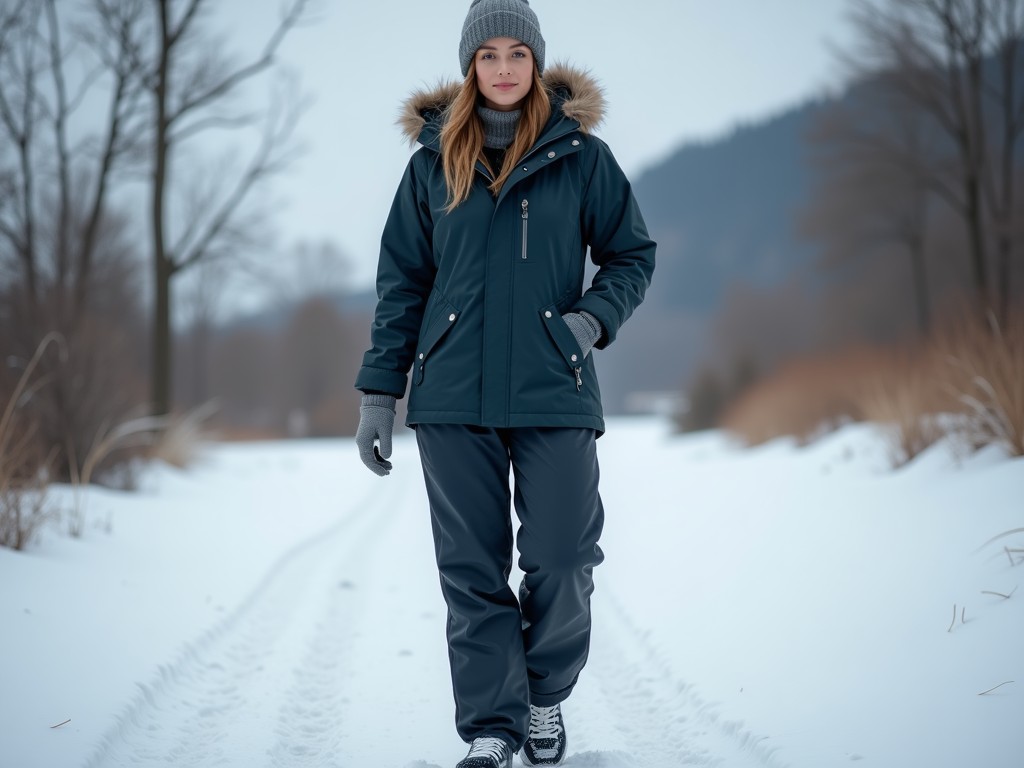
Womens Insulated Waterproof Pants
Women's Insulated Waterproof Pants
Women's insulated waterproof pants are engineered for prolonged exposure to cold, wet environments where thermal retention and moisture barrier integrity are critical. These garments combine a microporous or hydrophilic membrane system with synthetic insulation to maintain core temperature while preventing liquid water ingress and managing vapor transmission. The design prioritizes functional performance over aesthetic considerations, targeting occupational settings where failure to maintain dryness or warmth increases hypothermia risk, reduces dexterity, and compromises task efficiency.
Material Composition and Layer Function
The outer shell typically uses nylon 6,6 or polyester with a denier range of 70D to 150D, coated with a durable water repellent (DWR) finish based on fluoropolymer or silicone chemistry to achieve surface contact angles exceeding 110 degrees. Beneath the shell, a waterproof breathable membrane—commonly ePTFE or polyurethane-based—provides hydrostatic head resistance of 10,000 mm to 20,000 mm while maintaining moisture vapor transmission rates (MVTR) between 5,000 and 15,000 g/m²/24h. Insulation layers utilize polyester staple fibers with a denier of 1.5D to 3D and a loft of 15mm to 25mm, delivering a clo value of 1.8 to 2.5 at 0°C ambient temperature, measured under ASTM F1291 conditions.
Seam Construction and Waterproof Integrity
Seam sealing is performed using thermally activated polyurethane tape applied to 100% of stitched joints, with tape width ranging from 20mm to 25mm and adhesion strength exceeding 8 N/cm after 50 wash cycles per ISO 105-C06. Critical seams—such as those along the inseam, outseam, and knee articulation zones—are double-stitched with polyester thread (Tex 40 to Tex 60) before taping to prevent needle hole leakage. The stitch density is maintained at 8 to 10 stitches per cm to balance seam strength with flexibility, ensuring no degradation in hydrostatic resistance after repeated flexing at -20°C.
Insulation Performance and Thermal Efficiency
Insulation performance is evaluated using a heated copper plate simulator (ASTM F1291) at 0°C, 5 m/s wind speed, and 50% relative humidity. The pants achieve a total thermal resistance (Rct) of 0.45 to 0.65 m²·K/W, equivalent to a clo value of 1.8 to 2.6, sufficient to maintain skin temperature above 32°C in still air at -10°C when worn with a base layer. Insulation fill power is not applicable due to synthetic construction; instead, performance is defined by fiber diameter, crimp frequency (8–12 crimps/cm), and thermal conductivity of the batt material (~0.04 W/m·K). Compression resistance is tested per ASTM F1868, showing less than 15% thickness loss under 0.5 psi sustained pressure.
Fit, Mobility, and Ergonomic Design
The pattern incorporates articulated knees with a 15° to 20° pre-bend and gusseted crotch to maintain range of motion during squatting, kneeling, and ladder climbing. Inseam lengths range from 76cm to 84cm in 2cm increments, with waist adjustments via internal elastic cords or thermoplastic polyurethane (TPU) toggles, allowing ±5cm adjustment without compromising seal integrity. Leg openings feature adjustable hook-and-loop straps or barrel locks with cord diameters of 3mm to 4mm, enabling secure fit over boots ranging from 380mm to 450mm circumference. The rise is engineered to provide 28cm to 32cm front coverage and 36cm to 40cm rear coverage to prevent exposure during forward flexion.
Applications in Industrial and Operational Environments
These pants are specified for industries where personnel face prolonged outdoor exposure in precipitation and sub-zero temperatures, including winter road maintenance, utility line inspection in alpine zones, offshore wind turbine servicing during ice accumulation periods, and forestry operations in snow-covered terrain. In utility work, they reduce the risk of cold-induced muscle stiffness that can impair tool handling and increase slip incidents. For offshore personnel, the combination of windproofing and insulation counters evaporative heat loss exacerbated by spray and spray-induced convection. In forestry, the abrasion-resistant outer shell (rated to 20,000 cycles Martindale) withstands contact with bark and frozen undergrowth while maintaining waterproofing.
Comparison of Key Performance Parameters
| Parameter | Typical Range | Test Standard |
|---|---|---|
| Hydrostatic Head | 10,000–20,000 mm | ISO 811 |
| MVTR | 5,000–15,000 g/m²/24h | ASTM E96 BW |
| Thermal Resistance (Rct) | 0.45–0.65 m²·K/W | ASTM F1291 |
| Seam Adhesion (after 50 washes) | >8 N/cm | ISO 105-C06 |
| Abrasion Resistance | >15,000 cycles | ASTM D3884 |
Customization Options for Operational Requirements
Customization is available for insulation thickness (clo range 1.2 to 3.0), membrane hydrostatic head (5,000 mm to 30,000 mm), and outer shell denier (40D to 200D) based on specific environmental exposure profiles. Pocket configurations can be modified to include internal thermos pockets with reflective lining or external tool loops rated for 5 kg load. Reinforcement patches in high-wear zones (knees, seat, cuffs) utilize Cordura® nylon 1000D or HPPE blends upon request. Closure systems can be switched from standard zippers to waterproof aquaguard® coils or magnetic fasteners for gloved operation. All modifications are subject to revalidation of seam integrity and thermal performance under the intended use conditions.
Quality Control and Validation Protocols
Each production lot undergoes 100% hydrostatic testing of sealed seams at 1.5x rated pressure for 60 seconds, with zero leakage accepted. Thermal performance is verified on a sample basis using a guarded hot plate apparatus per ASTM C518, with acceptance criteria set at ±10% of target Rct. Dimensional stability is assessed after 5 wash cycles at 40°C per ISO 6330, requiring <3% shrinkage in length and <2% in width. Visual inspection includes 10x magnification of seam tape adhesion and stitch uniformity, with defective units segregated for reprocessing. Documentation includes batch-specific test reports, material safety data sheets (MSDS) for all components, and compliance declarations for REACH and PFAS restrictions where applicable.