
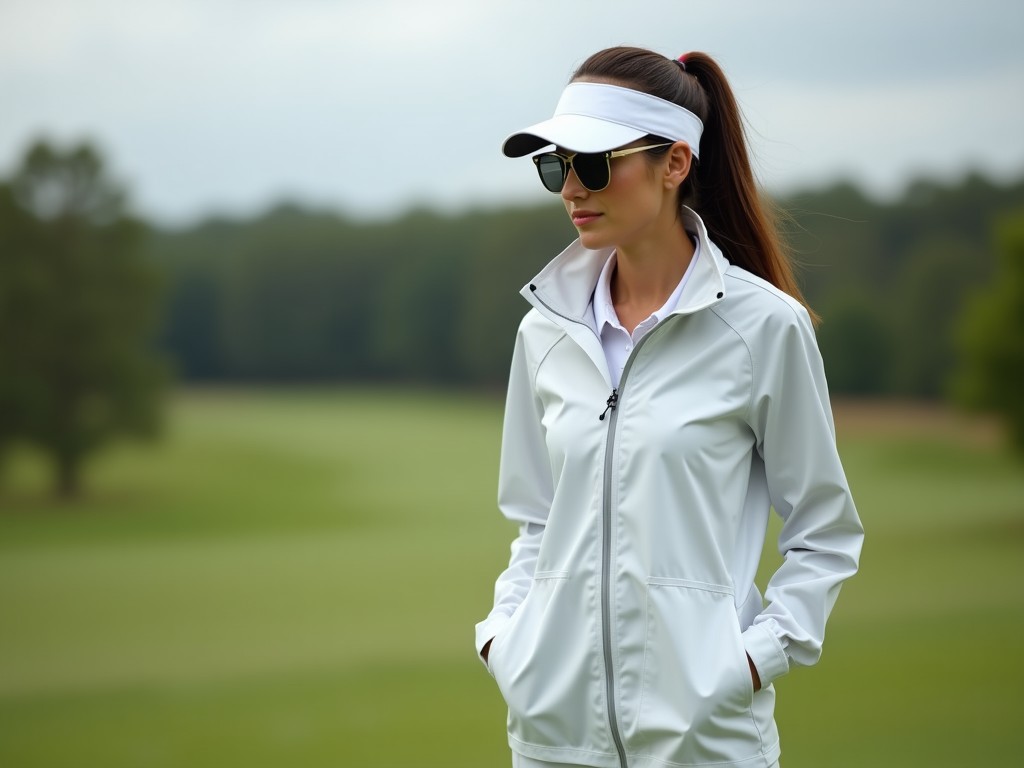
Womens Golf Rain Suit Waterproof
Women's Golf Rain Suit Waterproof
A women's golf rain suit designed for continuous play in wet conditions integrates breathable waterproof membranes with articulated patterning to maintain swing mechanics while preventing water ingress. The system addresses two conflicting requirements: establishing a reliable barrier against precipitation and managing microclimate heat buildup during physical exertion.
Technical specification begins with material selection at the fiber level, where microporous polytetrafluoroethylene (ePTFE) laminates or polyurethane-coated nylons provide hydrostatic head ratings exceeding 10,000 mm while maintaining moisture vapor transmission rates (MVTR) of at least 8,000 g/m²/24h. These values are measured under controlled conditions per ISO 811 and ASTM E96 standards, ensuring performance consistency across production batches.
Core Technical Layers
The rain suit employs a three-layer laminate construction: an outer shell treated with durable water repellent (DWR) finish, a middle waterproof breathable membrane, and an inner protective tricot or mesh layer. The DWR treatment reduces surface tension, causing water to bead and roll off rather than saturate the fabric, which preserves breathability by preventing outer layer wetting.
Hydrostatic head testing measures the water pressure required to penetrate the membrane; values above 10,000 mm indicate resistance to heavy rainfall and wind-driven spray. Simultaneously, MVTR quantifies how effectively sweat vapor escapes; rates above 8,000 g/m²/24h prevent interior dampness during extended wear, a critical factor for maintaining comfort over 18 holes.
Seam integrity is addressed through thermoplastic polyurethane (TPU) tape application over all stitched joints, applied under heat and pressure to create a continuous barrier. This method eliminates needle holes as potential leak points, which is essential since standard stitching compromises waterproof integrity even in high-performance fabrics.
Ergonomic Design for Golf Motion
Pattern engineering focuses on preserving unrestricted shoulder rotation and hip turn during the golf swing. Raglan sleeve construction extends the shoulder seam toward the collarbone, increasing underarm gusset area and reducing fabric tension when arms are raised. This design minimizes binding compared to traditional set-in sleeves.
Articulated knees incorporate bi-scurve shaping that follows the natural flexion line, preventing fabric pull during crouching or kneeling to read putts. The torso features slight waist suppression and hip ease to accommodate layering without creating excess material that could interfere with arm swing or create drag.
Cuffs and hems use adjustable hook-and-loop closures rather than elastic alone, allowing precise tension adjustment to seal against water ingress while accommodating glove use or layer thickness. Ankle zippers with internal storm flaps enable easy boot entry and establish a secondary barrier against water travel up the pant leg.
Performance Validation Metrics
| Parameter | Test Method | Target Value |
|---|---|---|
| Hydrostatic Head | ISO 811 | ≥ 10,000 mm |
| Moisture Vapor Transmission | ASTM E96 BW | ≥ 8,000 g/m²/24h |
| Seam Strength | ASTM D1683 | ≥ 20 N |
| DWR Durability (after 20 washes) | AATCC 135 | Grade 4 minimum |
These values represent typical performance benchmarks for laminated waterproof breathable fabrics used in active outdoor apparel. Actual results may vary based on specific material formulations and construction techniques; confirmation testing is available upon request for project-specific validation.
Material Customization Options
- Outer shell: 100% nylon taslan with DWR finish (standard) or recycled polyester variants available
- Membrane: ePTFE laminate (higher MVTR) or polyurethane coating (cost-effective alternative)
- Inner layer: brushed tricot for warmth or lightweight mesh for enhanced ventilation
- Seam tape: TPU width options from 20mm to 35mm based on seam stress exposure
Customization extends to fit profiling, where torso length, sleeve articulation, and pant taper can be adjusted based on anthropometric data for specific user groups. These modifications require new pattern development and may affect material yield; lead times increase accordingly.
Quality Control Philosophy
Each production lot undergoes random sampling for hydrostatic head and MVTR testing per AQL 2.5 standards. Visual inspection checks for DWR uniformity, seam tape adhesion, and stitching consistency under 10x magnification. Functional testing includes spray rack simulation and wear trials to validate real-world performance beyond laboratory metrics.
Traceability is maintained through batch coding that links raw material suppliers, laminate lot numbers, and final garment units. This enables rapid isolation of any non-conforming material sources and supports continuous improvement feedback loops with suppliers.
Documentation includes material safety data sheets (MSDS) for all chemical treatments, Oeko-Tex Standard 100 certification where applicable, and compliance documentation for REACH and PFAS regulations as required by destination markets.
Applications in Golf Environments
The suit is engineered for temperate to cool climates where precipitation occurs as rain or drizzle, typically between 5°C and 18°C. In these conditions, evaporative cooling is a greater concern than overheating, making breathability paramount to prevent chill from damp inner layers.
For tropical downpours exceeding 25 mm/hour, the suit functions as an outer shell over lightweight base layers, relying on its hydrostatic head rating to prevent saturation. Users may increase ventilation through pit zips (if specified) or adjust cuff tightness to manage interior humidity during high-intensity play.
In windy conditions common on coastal or links courses, the DWR finish prevents fabric from wetting out, which would otherwise increase convective heat loss. The suit's low permeability to wind combined with maintained breathability creates a stable microclimate that reduces the need for excessive layering.
Inquiry and Technical Support
For detailed specifications, customization requests, or sample evaluation, contact our technical team. Provide intended use conditions, expected precipitation levels, and any required certifications to receive accurate material recommendations and lead time estimates.