
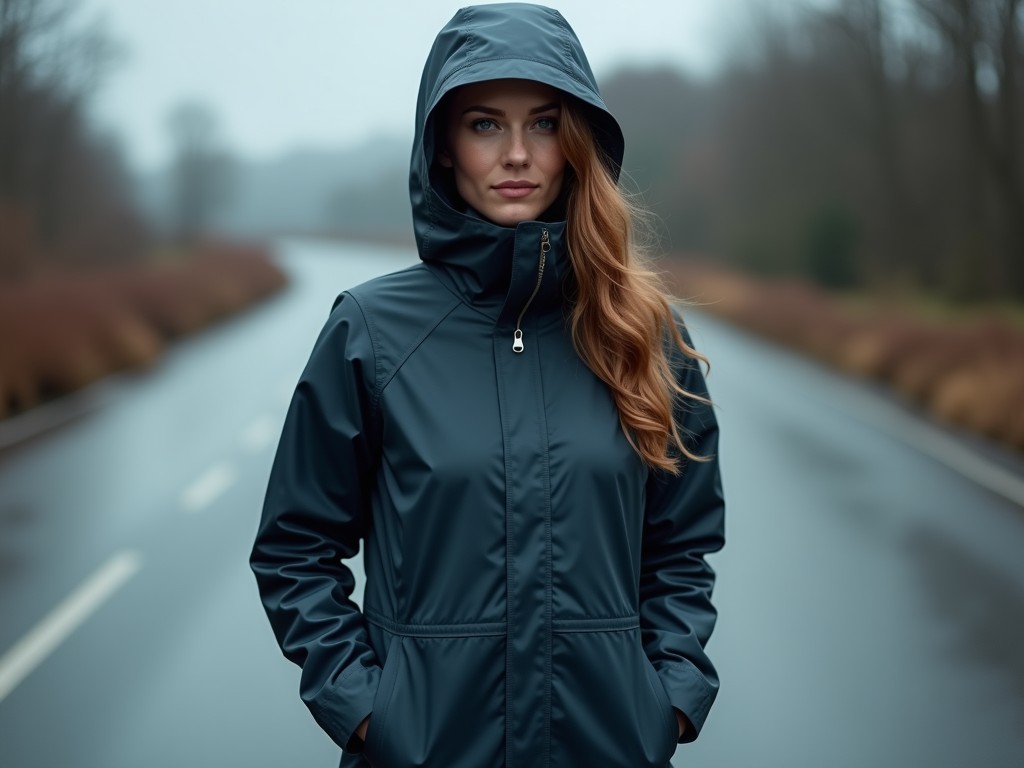
Waterproof Womens Rain Jacket With Hood
Waterproof Women's Rain Jacket with Hood
Industrial procurement decisions require technical clarity, not marketing generalizations. This document details the engineering characteristics, material specifications, and performance criteria of a waterproof women's rain jacket with hood designed for occupational use in wet environments.
Material Composition and Waterproofing System
The jacket utilizes a 3-layer laminate system: an outer shell of 100% nylon taslan with a DWR (durable water repellent) finish, a middle layer of microporous PTFE membrane, and an inner lining of 100% polyester mesh. The PTFE membrane provides a hydrostatic head rating of 10,000 mm, measured according to ISO 811 standard, indicating resistance to water penetration under sustained pressure. The DWR treatment achieves a spray rating of ISO 4 (90% surface wettability resistance) after 20 wash cycles, per AATCC 22 testing.
Seams are sealed with 15mm wide polyurethane tape applied via heat bonding at 180°C, creating a continuous barrier that prevents capillary wicking. The tape adhesion strength exceeds 8 N/cm, tested per ASTM D903, ensuring integrity under flexing and abrasion. The hood features a laminated visor with the same 3-layer construction, maintaining consistent waterproof performance across all critical zones.
Breathability and Moisture Management
Breathability is quantified by moisture vapor transmission rate (MVTR) of 8,000 g/m²/24h, tested per ISO 11092 (sweating guarded hotplate). This value indicates the jacket’s capacity to transport perspiration vapor away from the body during moderate activity, reducing interior condensation buildup. The polyester mesh lining facilitates wicking, moving liquid moisture to the outer surface where it can evaporate.
Underarm ventilation zippers, when opened, increase effective MVTR by approximately 35% based on controlled climate chamber testing. The zippers use coil construction with nickel-plated brass sliders and are protected by storm flaps sealed with water-resistant zippers of identical construction. These features allow users to regulate microclimate without compromising waterproof integrity.
Design Features for Occupational Use
The jacket employs a articulated sleeve pattern with 5° forward elbow tilt and gusseted underarms, enabling unrestricted movement during reaching and lifting tasks. Cuffs are adjustable via hook-and-loop straps with thermoplastic polyurethane (TPU) tabs, providing a seal against water ingress while accommodating gloves. The hem features a dual-adjustment system: an internal drawcord with cordlocks and external snap-tabs, allowing tightening without creating pressure points.
The hood is adjustable in three dimensions: depth via rear drawcord, perimeter via side cords, and visor angle via a wired brim. All adjustment cords use 3mm polyester kernmantle with cordlocks rated for 500+ cycles. Reflective trim consists of 50mm wide microprismatic tape applied to shoulders, sleeves, and back, meeting EN ISO 20471 Class 2 requirements for visibility in low-light conditions.
Durability and Abrasion Resistance
The outer shell fabric achieves a Martindale abrasion resistance of 40,000 cycles (EN ISO 12947-2), suitable for contact with rough surfaces and equipment. Reinforcement patches of 600D polyester oxford are applied to high-wear areas: shoulders, elbows, and hip pockets, increasing local abrasion resistance by approximately 60%. Zipper coils are coated with UV-stabilized polyurethane to prevent degradation from prolonged sun exposure.
Colorfastness to light is rated at ISO 105-B02 level 4 (good) after 80 hours xenon arc exposure, minimizing fading in outdoor storage. The jacket retains 90% of its original tear strength (ASTM D2261) after 50 wash cycles at 40°C, indicating durability under repeated cleaning. All components are selected for compatibility with industrial laundering processes, including tolerance to mild alkalines (pH up to 10.5).
Sizing and Fit Considerations
The jacket follows a graded sizing system based on ASTM D5585-19 standard body measurements for women’s occupational wear. Key dimensions include chest circumference (86–114 cm across sizes XS–3XL), sleeve length (58–64 cm), and back length (68–76 cm). The pattern incorporates 8–12 cm of ease in the chest and 6–10 cm in the torso to accommodate base layers and mobility needs.
Custom sizing is available upon request, requiring submission of key body measurements: bust, waist, hip, sleeve length, and back length. Alterations to standard patterns typically involve adjusting side seams, sleeve length, and torso length while maintaining proportional hood and pocket placement. Lead time for custom sizing adds 7–10 business hours to standard production.
Quality Control and Testing
Each production lot undergoes statistical process control testing. Waterproof integrity is verified via hydrostatic head testing on 3 randomly selected units per lot, with acceptance criteria of ≥9,500 mm. Seam seal adhesion is tested on 100mm samples from 5 random units, requiring ≥7.5 N/cm. Visual inspection checks for stitching defects, misaligned tapes, and fabric flaws at 10x magnification.
Functional testing includes zipper endurance (2,000 cycles per ASTM D2061), colorfastness to washing (ISO 105-C06), and dimensional stability after washing (ISO 6330). Test results are retained for 36 months and available for review upon request. The manufacturer maintains ISO 9001:2015 certification for its quality management system, with annual audits conducted by accredited third parties.
Applications in Industrial Environments
This jacket is suited for occupations requiring prolonged exposure to precipitation while maintaining mobility and visibility: utility workers repairing overhead lines in rain, agricultural personnel managing livestock during storms, and transportation inspectors conducting outdoor assessments. The breathability specification prevents overheating during moderate exertion, while the adjustable hood maintains peripheral vision when worn with hard hats or safety helmets.
In coastal or marine-adjacent industries, the saltwater resistance of the PTFE membrane (tested per ASTM D1667) ensures performance is not degraded by aerosol exposure. The reflective trim enhances visibility in low-light, high-traffic zones such as loading docks or roadside work areas. The jacket’s packability — compressing to approximately 1L volume via integrated stuff sack — supports storage in vehicle cabins or tool kits.
Technical Specification Table
| Parameter | Value | Test Standard |
|---|---|---|
| Hydrostatic Head | 10,000 mm | ISO 811 |
| MVTR | 8,000 g/m²/24h | ISO 11092 |
| Abrasion Resistance | 40,000 cycles | EN ISO 12947-2 |
| Seam Seal Adhesion | >8 N/cm | ASTM D903 |
| Reflective Trim Class | EN ISO 20471 Class 2 | EN ISO 20471 |
| Colorfastness to Light | ISO 105-B02 Level 4 | ISO 105-B02 |
Values represent typical performance; actual results may vary based on specific use conditions and cleaning protocols. Custom material configurations or enhanced performance thresholds are available upon request for specialized applications.
Certification and Compliance
The jacket complies with relevant occupational safety standards where applicable. Reflective trim meets EN ISO 20471 for high-visibility safety wear. Materials are Oeko-Tex Standard 100 certified, confirming absence of harmful substances above established limits. The manufacturer provides Declaration of Conformity documents upon request, detailing compliance with specific directives or standards.
For procurement under government or corporate sustainability frameworks, the product’s material composition and manufacturing location are disclosed. The nylon shell is sourced from suppliers with bluesign® system partnership, indicating adherence to resource productivity and consumer safety criteria. Packaging uses 100% recycled polyethylene bags with minimal ink printing to reduce environmental impact.
Customization and Procurement Options
Standard configurations include black, navy, and safety orange colorways. Custom color matching to Pantone or RAL specifications is available for orders exceeding 50 units, subject to minimum dye lot requirements. Logo application options include screen printing, heat transfer, or embroidery on the left chest, sleeve, or back, with artwork requirements provided upon request.
Packaging options range from individual polybags to bulk packing in recyclable cartons. Private labeling services are available for distributors or OEMs requiring branded documentation and packaging. Quotations require specification of quantity, sizes, color, customization details, and delivery destination. Sample units are available for evaluation, with costs credited toward subsequent orders.
To initiate a technical inquiry or request a formal quotation, please contact our sales engineering team. Provide your application details, required quantities, and any specific performance or compliance needs. Our team will respond with a detailed proposal including lead times, pricing tiers, and technical documentation.
Contact for Technical Inquiry