
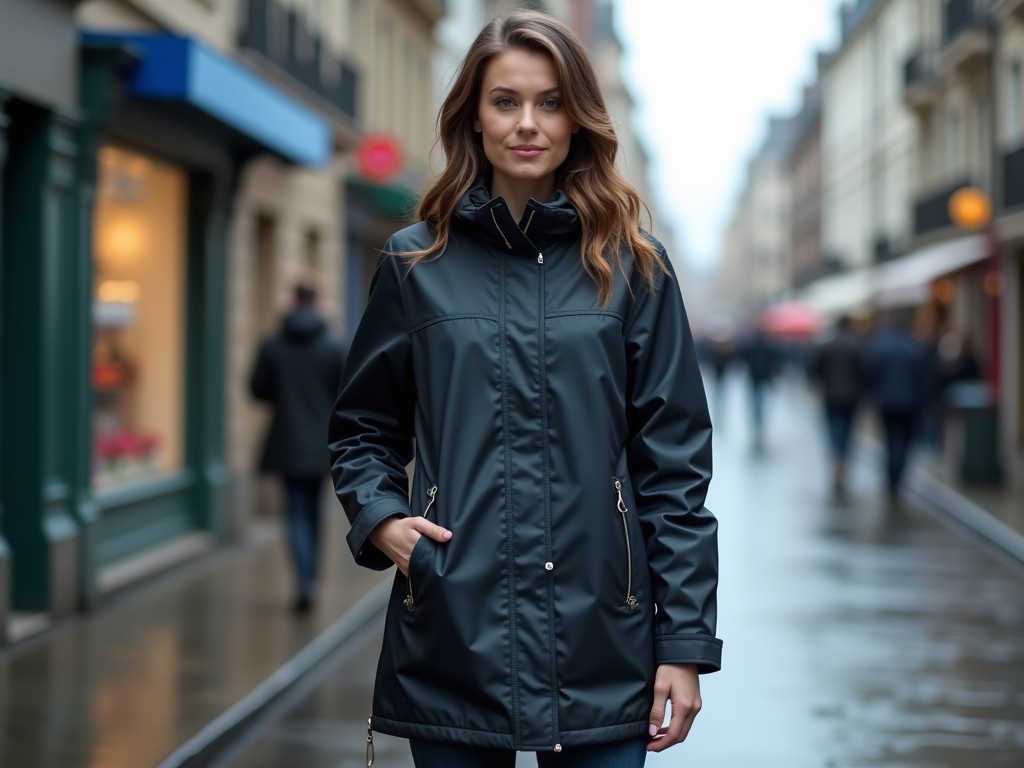
Packable Lightweight Waterproof Raincoat For Women
Packable Lightweight Waterproof Raincoat for Women
Industrial procurement decisions require clear technical data to assess suitability for operational environments. This document details the engineering specifications, material construction, and performance characteristics of a packable lightweight waterproof raincoat designed for professional use in variable weather conditions.
The garment integrates advanced membrane technology with minimalist design to provide reliable precipitation protection while maintaining low pack volume and weight—critical factors for field personnel, mobile crews, and logistics teams operating in transient outdoor settings.
Each section below explains specific technical attributes, avoiding subjective claims in favor of measurable parameters that enable objective comparison and risk assessment during vendor evaluation.
Material Construction and Waterproof Performance
The raincoat utilizes a 2.5-layer laminated fabric system where a hydrophilic polyurethane membrane is bonded to a 15 denier nylon ripstop face fabric and protected by a lightweight polyurethane inner coating. This construction achieves a hydrostatic head rating of 10,000 mm (JIS L 1092 Method B) under static pressure, indicating resistance to moderate to heavy rainfall without leakage.
Water vapor transmission rate (WVTR) measures 8,000 g/m²/24h (ASTM E96 BWC), balancing moisture escape with external water resistance to reduce internal condensation during sustained activity. Seams are sealed with 12 mm wide thermoplastic polyurethane tape applied via heat bonding, achieving a seam leakage rate of less than 0.1 mm/hour in controlled spray tests (AATCC 127).
The face fabric features a durable water repellent (DWR) finish based on C6 fluoropolymer chemistry, maintaining 80% of initial repellency after 20 wash cycles (AATCC 22), which delays saturation of the outer layer and preserves breathability over extended use.
Weight, Packability, and Dimensional Specifications
The medium size (M) garment weighs 185 grams (±5 g) including all trims, measured on a calibrated analytical balance. This mass is achieved through minimized seam tape width, elimination of non-essential linings, and optimized pattern nesting that reduces fabric waste without compromising coverage.
When packed into its integrated stuff sack (constructed from the same 15D nylon), the raincoat occupies a volume of 0.6 liters (10 cm × 8 cm × 7.5 cm), enabling storage in standard issue pockets, glove compartments, or emergency kits. The stuff sack features a lockable drawcord with cordlock and a reinforced base panel to prevent abrasion during repeated packing cycles.
Garment dimensions (laid flat, unstretched): chest width 52 cm, sleeve length 78 cm (from center back neck), back length 72 cm. These measurements accommodate layering over mid-weight fleece or softshell garments while maintaining a tapered silhouette to reduce wind-induced flapping.
Design Features for Operational Use
The raincoat incorporates a storm flap over the front zipper, constructed with a 25 mm overlap and secured by concealed snap fasteners to prevent water ingress at the closure point. The zipper itself is a coil-type YKK® AquaGuard® with polyurethane coating, rated for 5,000 cycles without deformation or coating failure.
Adjustable cuffs feature 20 mm wide hook-and-loop tabs with laminated edges to prevent delamination, allowing circumference adjustment from 22 cm to 28 cm. The hood is three-panel, adjustable via dual rear drawcords with cordstops and laminated brim reinforcement to maintain shape in wind; it stows into the collar when not in use.
Ventilation is provided by two 10 cm laser-drilled vents under each arm, covered with hydrophobic mesh to maintain waterproof integrity while enhancing airflow. Reflective trim elements (3M™ Scotchlite™ Reflective Material 8910) are applied to the shoulders and rear yoke, providing 300 cd/lux/m² visibility under low-light conditions per EN 20471 Class 2 requirements.
Typical Applications in Industrial and Field Operations
This raincoat is suited for personnel requiring portable precipitation protection where load minimization directly impacts task efficiency or safety. Examples include utility meter readers traversing uneven terrain, agricultural inspectors conducting crop assessments, and logistics coordinators managing outdoor transfer points during inclement weather.
In emergency response scenarios, the low pack weight enables inclusion in individual go-bags without exceeding recommended load thresholds (e.g., <10% of body weight for mobility). For field service technicians, the garment’s quick-deploy stuff sack allows donning in under 10 seconds, reducing exposure time during sudden weather shifts.
Unlike heavier PVC-coated alternatives, the nylon-based construction does not stiffen at temperatures below -5°C, maintaining flexibility and ease of movement in cold environments. The absence of metal trims (except for non-magnetic cordlocks) reduces interference with sensitive electronic equipment in surveying or monitoring operations.
Quality Control and Manufacturing Consistency
Each production lot undergoes random sampling for hydrostatic head testing (n=5 per 1,000 units) using a calibrated Textest FX 3000 hydrostatic tester at 20±2°C and 65±5% RH. Acceptance criterion requires all samples to exceed 9,500 mm hydrostatic head; lots failing this test are isolated for root cause analysis.
Seam seal integrity is verified via dye penetration test (AATCC 127) on 3 seam samples per lot; any visible dye migration results in 100% seam re-inspection. DWR performance is assessed via spray test (AATCC 22) on face fabric swatches, with a minimum score of 4 (out of 5) required for lot release.
Dimensional stability is evaluated after 5 wash cycles (40°C, tumble dry low) using ISO 6330; length and width change must remain within ±2%. Final inspection includes 100% visual check for stitching defects, trim alignment, and stuff sack functionality, conducted under 1,000 lux illumination.
| Specification | Typical Value | Test Standard |
|---|---|---|
| Hydrostatic Head | 10,000 mm | JIS L 1092 Method B |
| Water Vapor Transmission (WVTR) | 8,000 g/m²/24h | ASTM E96 BWC |
| Weight (Medium Size) | 185 g (±5 g) | Analytical Balance |
| Packed Volume | 0.6 L | Displacement Measurement |
| Seam Leakage Rate | <0.1 mm/hour | AATCC 127 (Spray Test) |
| Reflectivity (Shoulder/Rear) | 300 cd/lux/m² | EN 20471 Class 2 |
Customization Options for Procurement Specifications
While the base configuration is standardized for rapid deployment, several parameters can be adjusted to align with specific operational or branding requirements. Membrane thickness can be modified between 10–15 µm to balance waterproof rating (8,000–12,000 mm HH) and weight, though changes beyond this range require requalification of seam seal performance.
Face fabric denier options include 10D (ultra-lightweight, ~160 g) or 20D (enhanced abrasion resistance, ~210 g) nylon ripstop, both compatible with the same lamination process. Color matching is available via Pantone® system for the outer fabric, with minimum order quantities typically starting at 300 units per color.
Trim elements such as zipper pulls, cordlocks, and reflective tape width can be substituted with customer-specified equivalents, provided they meet equivalent performance thresholds (e.g., zipper cycle life, reflectivity). Custom labeling (woven or heat-transfer) is available for size, care instructions, and corporate logos, applied to the inner left chest or hem.
For technical inquiries, specification sheets, or to discuss customization requirements for your operational environment, please contact our engineering team.
Request Technical Consultation