
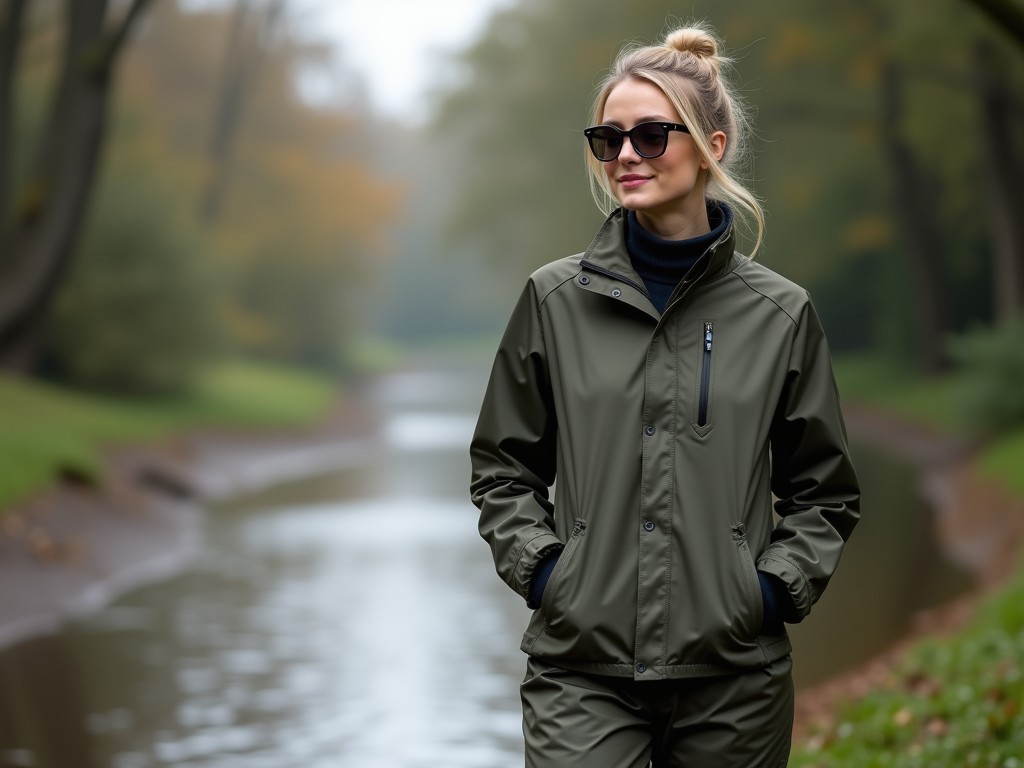
Lightweight Waterproof Trousers Womens
Lightweight Waterproof Trousers for Women
When selecting protective apparel for field operations, the balance between weather resistance and mobility is critical. Lightweight waterproof trousers for women are engineered to provide reliable barrier protection against precipitation while minimizing thermal burden and restriction of movement. These garments are designed for environments where prolonged exposure to wet conditions must be managed without compromising operational efficiency or comfort over extended wear periods.
Material Construction and Performance Characteristics
The primary fabric consists of a 2.5-layer laminate system: a nylon face fabric with a denier rating of 40D, bonded to a microporous polyurethane membrane, and finished with a lightweight tricot backing. This construction achieves a hydrostatic head rating of 10,000 mm, meaning it can withstand the pressure equivalent to a 10-meter column of water before leakage occurs. The membrane’s pore structure allows vapor transmission at a rate of 8,000 g/m²/24h (MVTR), enabling sweat to escape while blocking liquid ingress. Seams are fully taped with 15mm-wide polyurethane tape applied under heat and pressure to maintain continuity of the waterproof barrier.
The face fabric receives a durable water repellent (DWR) finish based on C6 fluoropolymer chemistry, which reduces surface tension to cause water to bead and roll off. This treatment is rated for 20 wash cycles before reapplication is recommended, as measured by AATCC Test Method 22. The absence of insulation or lining minimizes added weight, resulting in a typical garment weight of 180 grams for size M, measured per ASTM D3776. This low mass reduces fatigue during prolonged wear, particularly when layered under other equipment such as harnesses or belts.
Design Features for Functional Utility
The trousers feature a articulated knee pattern with dual-point darts to accommodate flexing without binding or fabric pull. This design reduces strain on the material during crouching, kneeling, or stair climbing — common movements in utility, inspection, and field service work. The waistband incorporates a partial elastic core with adjustable tab closures on both sides, allowing for a secure fit over base layers while accommodating minor fluctuations in waist measurement due to layering or hydration changes. Belt loops are omitted to prevent snag hazards and reduce points of potential leakage.
Ankle closures use adjustable hook-and-loop straps with a 35mm overlap, enabling the hem to be tightened over boot tops or loosened for ventilation. The strap is positioned laterally to avoid pressure points on the Achilles tendon. Side seam vents, located 10cm above the hem, are covered by storm flaps bonded with waterproof adhesive and secured with snap closures. These vents allow passive airflow when opened, reducing internal humidity buildup during high-exertion tasks without compromising waterproof integrity when closed.
Intended Use Cases and Environmental Suitability
These trousers are suited for professionals engaged in outdoor infrastructure maintenance, environmental surveying, utility line inspection, and emergency response operations where exposure to rain, snow, or spray is expected. The lightweight construction makes them particularly valuable in temperate climates where heavy insulated rainwear would cause overheating, yet reliable precipitation protection is still required. They are commonly worn as an outer layer over moisture-wicking base layers and light insulating midsoles in temperatures ranging from 5°C to 15°C.
In higher intensity activities such as rapid response or prolonged walking, the breathability rating prevents excessive heat accumulation, reducing the risk of heat-related discomfort. The garment is not intended for sub-zero conditions requiring thermal insulation, nor for high-pressure washdown environments where hydrostatic head demands exceed 15,000 mm. For such scenarios, alternative constructions with higher denier faces or additional layers are recommended.
Size Range and Fit Considerations
Available in regular lengths with inseam measurements of 76cm (XS), 79cm (S), 81cm (M), 84cm (L), and 87cm (XL), graded to accommodate proportional height variations across the size range. The cut follows a relaxed but not loose silhouette, designed to allow freedom of movement without excess fabric that could snag on equipment. Waist measurements range from 64cm (XS) to 84cm (XL), with hip measurements scaling proportionally. Inseam length can be customized upon request for non-standard heights, subject to production minimums and lead time adjustments.
Fit validation is conducted using anthropometric data from female workforce samples in industries such as telecommunications, water management, and rail maintenance. Measurements are taken under simulated load conditions, including wearing a harness and carrying a 5kg tool belt, to ensure the garment does not ride up or restrict motion during real-world use. Customers requiring specific dimensional tolerances for uniform programs can request detailed measurement charts and proto-sample evaluation prior to bulk order.
Quality Assurance and Consistency Controls
Each batch undergoes hydrostatic head testing on three random specimens per 500 units, following ISO 811 standards, with acceptance criteria set at a minimum of 9,500 mm. MVTR is verified using ASTM E96 BWD (cup method) on laminated fabric samples, targeting a range of 7,500–8,500 g/m²/24h. DWR performance is assessed via spray rating (AATCC 22) after 5 and 15 wash cycles, requiring a minimum score of 80 (surface wetness <20% coverage) to pass. All tests are conducted at 20±2°C and 65±5% RH to ensure repeatability.
Visual and dimensional inspections are performed at 100% for critical points: seam tape adhesion, stitch density (min 8 stitches/cm), and symmetry of articulated knees. Functional testing includes a 10-minute kneeling test on a wet surface to verify no leakage through the knee area under pressure. Any unit failing these checks is segregated for rework or rejection. Traceability is maintained via lot numbers linking raw material receipt to final inspection, supporting audit readiness for clients with strict compliance requirements.
Packaging and Logistics Preparation
Trousers are folded using a standardized method to minimize creasing in high-flex areas, then placed in individual polyethylene bags with a thickness of 50μm to prevent moisture ingress during transit. Each bag is labeled with a barcode containing SKU, size, lot number, and QR code linking to the product’s technical data sheet. Cartons are constructed from single-wall corrugated fiberboard with a burst strength of 275 kPa, sized to hold 20 units (approximately 3.6kg gross weight) to optimize palletization and reduce handling strain.
For export shipments, cartons are stacked on heat-treated pallets and secured with PET strapping. A desiccant packet (5g silica gel) is included per carton to mitigate condensation risks during temperature fluctuations. All packaging materials are recyclable where facilities exist. Lead time for standard sizes is typically 3–4 weeks from approved artwork and fabric confirmation, with expedited options available upon request for critical project timelines.
To discuss sizing requirements, material documentation, or request a proto-sample for field evaluation, contact our technical apparel team.
Request Technical Specification or Sample