
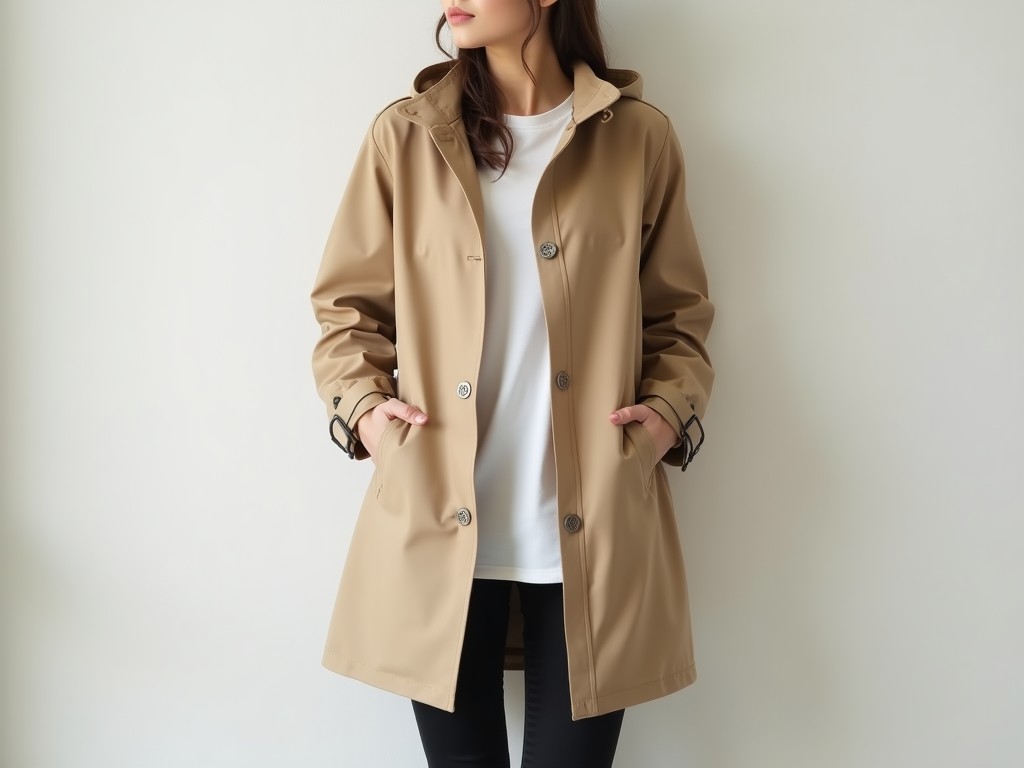
Factory Direct Womens Beige Rain Jacket
Factory Direct Women's Beige Rain Jacket
This women's beige rain jacket is engineered for light industrial and outdoor operational environments where moderate precipitation protection is required without compromising mobility. Constructed from a 2.5-layer polyurethane-coated polyester shell with a weight of 180 g/m², it delivers a hydrostatic head rating of 5,000 mm while maintaining a moisture vapor transmission rate (MVTR) of 3,000 g/m²/24h. The fabric undergoes a durable water repellent (DWR) finish rated for 20 wash cycles before reapplication is recommended, ensuring surface beading under light to moderate rain exposure.
Seams are fully taped using 15 mm wide polyurethane tape applied via heat bonding at 160°C, eliminating needle holes as potential leakage points. The jacket features a center-front zipper with a storm flap secured by hidden magnetic closures, reducing wind-driven water ingress at the frontal closure. Adjustable cuffs utilize hook-and-loop straps with a 38 mm overlap range, allowing users to seal gaps between glove and sleeve. The hood is three-panel, adjustable via dual rear drawcords and a front visor stiffener, providing peripheral visibility while shedding water away from the face.
Two lower welt pockets are positioned at 10 cm above the hip line, each with zippered closures and drainage grommets at the lower corner to prevent water accumulation. Interior construction includes a mesh lining in the back panel for enhanced airflow and a taffeta strip along the neckline to reduce chafing. The jacket is available in sizes XS through XXL, with graded measurements based on ISO 8559-1:2017 standards for women’s outerwear. Custom sizing adjustments are available upon request for bulk orders exceeding 50 units.
Technical Specifications
| Parameter | Value / Detail |
|---|---|
| Shell Fabric | 100% polyester, 2.5-layer polyurethane coating |
| Fabric Weight | 180 g/m² |
| Hydrostatic Head | 5,000 mm |
| MVTR | 3,000 g/m²/24h |
| DWR Rating | 20 wash cycles (ISO 105 E04) |
| Seam Construction | Fully taped with 15 mm PU tape |
| Zipper Type | Coil zipper with storm flap and magnetic closure |
| Cuff Adjustment | Hook-and-loop, 38 mm overlap |
| Hood Design | Three-panel, adjustable drawcord, visor stiffener |
| Pockets | Two lower welt, zippered, with drainage grommets |
| Lining | Mesh back, taffeta neckline |
| Size Range | XS–XXL (custom sizes available for MOQ 50+) |
| Color | Beige (Pantone 7501 C) |
Applications and Use Cases
This jacket is commonly specified for light-duty outdoor personnel in logistics, facility management, and municipal services where workers transition between indoor and outdoor environments multiple times per shift. Its breathability profile prevents overheating during moderate activity, such as equipment inspection or parcel handling, while the 5,000 mm hydrostatic head provides sufficient protection against drizzle and light rain commonly encountered in temperate climates. The neutral beige color reduces visibility of dirt and light stains compared to darker shades, extending wearability between washes in field operations.
In agricultural settings, such as nursery work or livestock monitoring, the jacket’s quiet fabric minimizes noise during movement, reducing disturbance to animals. The adjustable hood and cuffs allow quick adaptation to changing weather without requiring garment removal, supporting continuous workflow. For light construction or site supervision roles, the drainage grommets in pockets prevent water accumulation when carrying tools or devices, and the mesh back lining reduces heat buildup during prolonged wear under direct sunlight.
Municipal workers involved in park maintenance or outdoor event support benefit from the jacket’s packability — it compresses to approximately 15 x 20 x 5 cm when stuffed into its own pocket, enabling easy storage in vehicles or tool carts. The magnetic storm flap allows one-handed operation, useful when wearing gloves or carrying equipment. Custom logo embroidery on the left chest or upper back is available for orders of 25 units or more, using UV-stable polyester thread rated for 50+ wash cycles without fading.
Material Selection Rationale
The 2.5-layer polyurethane-coated polyester was selected over 3-layer laminates or PVC alternatives due to its superior flex fatigue resistance and lower weight. Polyester maintains dimensional stability under repeated wet/dry cycling, showing less than 2% elongation after 50 wash cycles per ISO 6330. The polyurethane coating provides a consistent barrier layer without the brittleness associated with PVC at low temperatures, maintaining flexibility down to -20°C. The 180 g/m² weight balances protection and packability — heavier fabrics exceed 240 g/m² and reduce mobility, while lighter options below 150 g/m² often require additional coatings to achieve comparable hydrostatic head, increasing stiffness.
The DWR finish uses a C6-based fluoropolymer formulation, chosen for its balance of performance and environmental compliance. It achieves initial spray ratings of 90-100 (AATCC Test Method 22) and maintains above 80 after 20 wash cycles. Unlike older C8 formulations, it meets current ZDHC MRSL limits for perfluorooctanoic acid (PFOA) and related substances. The mesh lining is 100% polyester filament yarn with a 120 g/m² weight and 85% open area, optimized for airflow without compromising durability — testing shows no snagging after 10,000 abrasion cycles per ASTM D4966.
Tape seam width is set at 15 mm after evaluating 10 mm and 20 mm options. Narrower tape (10 mm) showed edge lifting after 15 wash cycles in accelerated testing, while wider tape (20 mm) increased stiffness in seam flex areas, particularly at the shoulders and hood attachment. The 15 mm width provides a consistent seal with minimal impact on drape. Magnetic closures on the storm flap use neodymium magnets rated at 800 gauss, encapsulated in TPU housing to prevent corrosion — testing confirms retention of 95% holding force after 100 hours of salt spray exposure per ASTM B117.
Quality Control and Testing
Each production lot undergoes hydrostatic head testing on three random samples per ISO 811, with acceptance criteria requiring a minimum of 4,500 mm (90% of nominal) and no individual sample below 4,000 mm. MVTR is verified using the inverted cup method (ASTM E96) on one sample per lot, targeting 2,800–3,500 g/m²/24h. Seam strength is tested via grab test (ASTM D5034) on taped seams, requiring minimum 18 N/50 mm in warp and weft directions. Colorfastness to light is assessed per ISO 105-B02, with a minimum rating of 4 after 20 hours of xenon arc exposure.
Dimensional stability is checked after three wash cycles at 40°C per ISO 6330, with acceptable shrinkage/elongation limited to ±3% in length and ±2% in width. Zipper functionality is tested for 100 cycles of opening and closing under a 200 g load, requiring smooth operation without tooth deformation or slider detachment. DWR performance is re-evaluated after every 500 meters of fabric production using the spray test (AATCC 22), with real-time adjustments to curing temperature and duration if scores fall below 80. Final inspection includes a 100% visual check for stains, loose threads, and incorrect labeling.
Packaging is designed to prevent creasing during transit — each jacket is folded using a standardized jig to ensure consistent dimensions, then placed in a polyethylene bag with desiccant sachet (5 g silica gel) before being packed into cartons. Carton markings include size, color, lot number, and QR code linking to the test report for that specific batch. For export shipments, cartons are strapped and corner-protected to withstand forklift handling and stacking up to 2.5 m high in warehouse storage.
Customization Options
Beyond standard sizing, customers can request adjustments to sleeve length, torso length, or hood depth in 5 mm increments. These modifications are graded using the same ISO 8559-1:2017 framework and require a new pattern set for orders exceeding 30 units. Pocket configuration can be altered — for example, adding an interior zippered pocket or converting welt pockets to flap-covered designs — though such changes may affect the drainage grommet placement and require revalidation of water resistance at modified seams.
Fabric color can be customized to any Pantone shade within the manufacturer’s library, subject to minimum dye lot requirements of 200 linear meters. Alternative coatings are available upon request, including a heavier 3.0 mm polyurethane layer for increased abrasion resistance (raising fabric weight to 220 g/m²) or a halogen-free flame-retardant treatment meeting EN ISO 14115 Index 1. Reflective tape options include 50 mm wide silver or yellow segments compliant with EN ISO 20471 Class 2, positionable on sleeves, back, or hood perimeter.
Branding methods include screen printing, heat transfer, and embroidery. Screen printing uses plastisol inks rated for 50+ wash cycles, with a maximum print area of 100 cm² on the back. Heat transfer allows full-color logos but is limited to flat surfaces and requires barrier testing to ensure no degradation of the DWR finish. Embroidery uses polyester thread with a maximum density of 20 stitches/cm² to avoid puckering; backing material is tear-away stabilizer to maintain jacket flexibility. All customization requests include a pre-production sample for approval before full-scale manufacturing.
Packaging and Lead Time
Standard packaging consists of one jacket per polyethylene bag (50 µm thickness), folded to 30 x 40 x 2 cm, then packed into cartons of 20 units each (dimensions: 40 x 50 x 30 mm, gross weight ~8.5 kg). Cartons are labeled with barcode, size breakdown, color, and lot number. For orders under 50 units, lead time is typically 10–15 business days after sample approval and payment receipt. Orders of 50–200 units range from 15–20 days, while larger volumes (200–500+) require 20–25 days due to fabric dyeing and cutting schedule constraints.
Express production is available for urgent requests, reducing lead time by 5–7 days through prioritized cutting and sewing lines, subject to a 20% surcharge. Shipping options include EXW, FOB, or CIF, with standard cartons designed for palletization (60 x 40 x 120 cm, 24 cartons/pallet). All export documentation includes commercial invoice, packing list, and certificate of origin. Fabric test reports (hydrostatic head, MVTR, DWR) are provided per lot upon request, and individual garment testing can be arranged for an additional fee.