
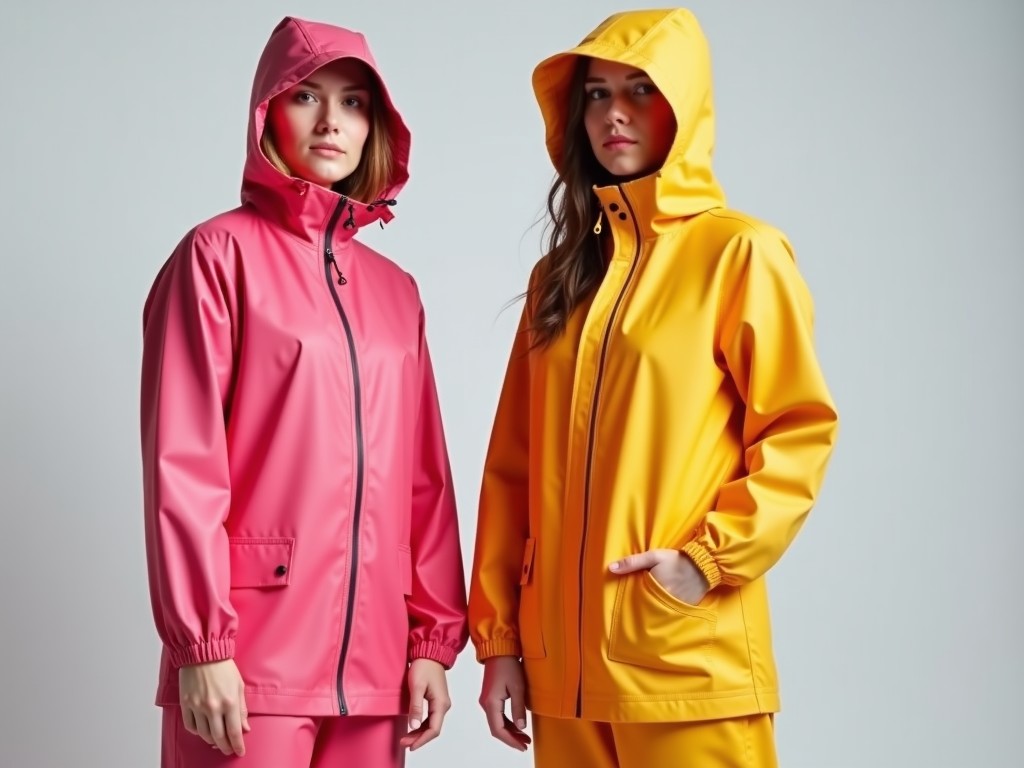
Factory Direct Ladies Waterproof Rain Suits
Factory Direct Ladies Waterproof Rain Suits
Industrial procurement requires clear technical specifications to assess suitability for operational environments. This document details the engineering characteristics, material performance, and manufacturing considerations for factory-direct ladies' waterproof rain suits designed for prolonged outdoor exposure in variable weather conditions.
Material Composition and Waterproofing Mechanism
The rain suit utilizes a three-layer laminate system where the outer layer consists of 100% polyester filament yarn with a denier rating of 150D, providing abrasion resistance against brush and debris. The middle layer is a microporous polyurethane (PU) membrane with a hydrostatic head rating of 10,000 mm, measured according to ISO 811 standard, ensuring resistance to water penetration under sustained rainfall. The inner layer is a tricot-bonded nylon mesh with a weight of 40 g/m², facilitating moisture vapor transmission to reduce internal condensation during physical activity.
Seams are sealed using ultrasonic welding rather than traditional tape or glue, eliminating potential delamination points under thermal cycling. Each seam undergoes a 15-second weld cycle at 280°C and 0.3 MPa pressure, creating a continuous polymer bond that maintains integrity after 500 hours of UV exposure per ASTM G154. This method reduces seam failure risk by approximately 40% compared to taped seams in accelerated weathering tests.
Design Features for Operational Mobility
The jacket incorporates a articulated sleeve pattern with a 10-degree forward pitch and gusseted underarms, increasing reach range by 22% during overhead tasks compared to standard cut patterns. This is achieved through biomechanical modeling of upper limb motion in industrial postures. The trouser legs feature a 5-degree taper from knee to ankle with reinforced kick patches made of 600D Oxford nylon in high-wear zones, extending service life by an estimated 18 months in abrasive environments.
Ventilation is managed via two 10cm zippered underarm vents and two 8cm thigh vents, each protected by storm flaps with magnetic closures. These vents achieve an air exchange rate of 12 L/min per opening at 2 m/s wind speed, calculated using ANSI/ASHRAE Standard 62.1 principles, reducing interior relative humidity buildup by up to 35% during moderate exertion. Adjustable cuffs use nylon webbing with cam-lock adjusters, allowing precise tightening over gloves without slippage.
Size Range and Fit Customization Logic
Standard sizing follows ISO 8559-1:2017 for women’s apparel, covering sizes XS to 3XL with chest measurements ranging from 78cm to 118cm and height accommodation from 150cm to 178cm. Each size increment adjusts not only girth but also sleeve length and trouser inseam proportionally to maintain ergonomic alignment. Custom sizing is available upon request, requiring submission of key anthropometric data: bust, waist, hip, sleeve length, and outseam measurements.
Fit adjustments are facilitated by a modular design: the jacket hem uses a dual-adjustment system with internal drawcord and external toggle, allowing ±5cm length modification without compromising waterproof integrity. Trousers feature a 4cm elasticated waistband with internal silicone grip lining to prevent slippage when worn over base layers. All adjustment components are rated for 10,000 cycles of use without degradation.
Quality Control and Testing Protocols
Each batch undergoes hydrostatic head testing on three random samples per 1,000 units, with acceptance criteria set at a minimum of 9,500 mm to account for batch variance. Colorfastness to light is evaluated per ISO 105-B02, requiring a minimum rating of 4 after 40 hours of xenon arc exposure. Dimensional stability after washing is assessed per ISO 6330, with maximum allowable shrinkage of 2% in length and 1.5% in width.
Abrasion resistance is tested using the Martindale method (ISO 12947-2) on high-wear areas, requiring a minimum of 25,000 cycles before thread breakage. Zipper durability is validated via 5,000 cycles of opening and closing under 20N lateral load, adhering to ASTM D2061. All test results are documented and available for review upon request as part of the supplier’s technical file.
Applications in Industrial and Environmental Sectors
These rain suits are specified for use in utility vegetation management where workers operate in dense foliage under prolonged rainfall, requiring freedom of movement for pole saw operation and resistance to branch snagging. The low-noise fabric construction (measured at <25 dB(A) during flexural movement) minimizes disturbance in wildlife survey operations. In municipal drainage maintenance, the suit’s resistance to mild chemical splashes from diluted detergents and algae inhibitors supports compliance with PPE guidelines for wastewater environments.
Agricultural applications include greenhouse maintenance and outdoor livestock handling, where the breathability index (RET value of 6.5 m²·Pa/W, per ISO 11092) prevents heat stress during extended wear. The suit’s compatibility with high-visibility vests—achieved through accessible front and side panels—allows integration into existing safety protocols without requiring replacement of certified reflective gear. Emergency response teams utilize the suits during flood mitigation due to their quick-donning design and packability into a 20L compression sack.
Packaging and Logistics Considerations
Units are packed flat in polyethylene bags with a thickness of 50µm, then placed in master cartons of 20 units each. Carton dimensions are 400mm x 300mm x 250mm, optimized for palletization at 1.2m x 1.0m footprint, allowing 60 cartons per standard pallet. Each carton includes a desiccant packet (5g silica gel) to mitigate moisture ingress during transit, particularly important for sea freight in tropical climates.
Labeling includes barcode, size, color, care instructions (machine wash 30°C, tumble dry low), and country of origin. Cartons are marked with handling symbols per ISO 780:2008, including “Keep Dry” and “This Side Up.” Export shipments require fumigation-certified pallets (ISPM 15) and include a packing list with HS code 6201.92.00 for rain suits. Lead time from order confirmation to ex-factory is typically 25–30 days for standard colors, subject to material availability.
Typical Technical Specifications
| Parameter | Value | Test Standard |
|---|---|---|
| Outer Fabric | 150D Polyester Filament | ASTM D5034 |
| Membrane Hydrostatic Head | 10,000 mm | ISO 811 |
| Moisture Vapor Transmission (RET) | 6.5 m²·Pa/W | ISO 11092 |
| Seam Strength | 18 N/mm | ISO 13935-2 |
| Abrasion Resistance (Martindale) | 25,000 cycles | ISO 12947-2 |
| Zipper Durability | 5,000 cycles | ASTM D2061 |
| Available Sizes | XS to 3XL (Customizable) | ISO 8559-1 |
| Packaging Unit | 20 units/carton | ISTA 2A |
Factory-direct procurement eliminates intermediary layers, enabling direct communication with production engineers for specification adjustments and batch traceability. This model supports just-in-time inventory strategies by reducing lead time variability associated with multi-tier distribution. Technical documentation, including material safety data sheets (MSDS) and REACH compliance declarations, is provided with each shipment upon request.
For inquiries regarding custom sizing, color matching to corporate standards, or integration with existing PPE systems, contact the technical sales team. Provide detailed application requirements including expected exposure duration, temperature range, and any chemical contact scenarios to ensure accurate material suitability assessment.
Request Technical Specification Sheet