
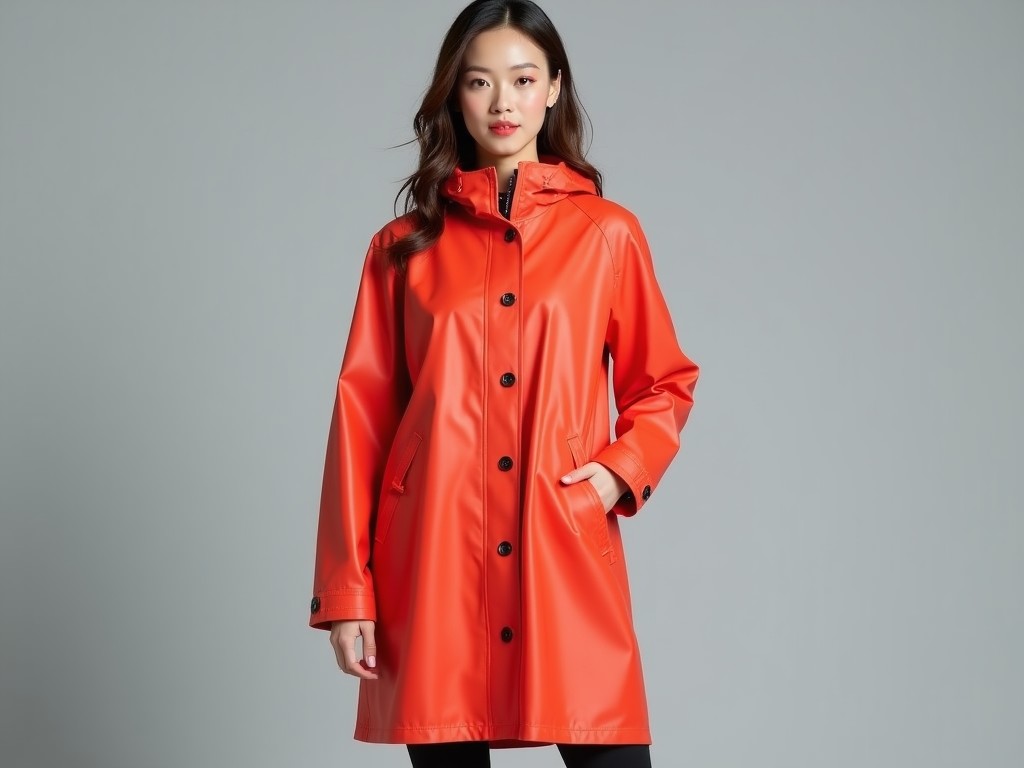
China Womens Knee Length Rain Coat
China Women's Knee Length Rain Coat
This women's knee-length rain coat is designed for industrial and commercial use in wet environments where reliable water protection and freedom of movement are essential. Constructed with a three-layer laminate system, the outer shell consists of 100% polyester with a polyurethane (PU) coating rated for 5,000 mm hydrostatic head resistance, providing effective barrier performance against moderate to heavy rainfall. The intermediate layer is a breathable microporous membrane allowing moisture vapor transmission rate (MVTR) of at least 3,000 g/m²/24h, reducing internal condensation during prolonged wear. The inner lining features a smooth, low-friction nylon tricot to facilitate easy donning and doffing over work uniforms or civilian clothing.
The coat extends to just above the knee, offering coverage that protects the torso and upper legs while maintaining mobility for tasks requiring bending, climbing, or operating machinery. Seams are fully sealed with thermoplastic polyurethane (TPU) tape applied via heat bonding, eliminating needle holes as potential leakage points. Each seam undergoes 100% visual and tactile inspection post-sealing to verify continuity and adhesion strength, with pull-test validation conducted on a sample basis per batch to ensure minimum 5 N/mm peel resistance.
Design elements prioritize functional utility over aesthetics. A two-way front zipper with storm flap and hook-and-loop closure allows adjustable ventilation and secure fastening in high-wind conditions. The storm flap extends 25 mm beyond the zipper on each side and is secured with dual rows of hook-and-loop fasteners spaced at 50 mm intervals to prevent water ingress through the zipper coil. Adjustable hook-and-loop cuffs accommodate gloves or bare wrists while maintaining a seal, and the hem features a concealed drawcord with barrel locks for perimeter tightening without snag hazards.
Material Performance Characteristics
| Property | Test Method | Typical Value |
|---|---|---|
| Hydrostatic Head | ISO 811 | 5,000 mm |
| Moisture Vapor Transmission Rate | ISO 11092 | 3,000 g/m²/24h |
| Tear Strength (Trapezoid) | ISO 9073-4 | Warp: 25 N, Weft: 22 N |
| Tensile Strength | ISO 13937-2 | Warp: 120 N, Weft: 105 N |
| Abrasion Resistance | ISO 12947-2 (Martindale) | >15,000 cycles |
The outer polyester shell is selected for its dimensional stability under UV exposure and resistance to common industrial contaminants such as oils, mild acids, and alkalis. The PU coating is formulated to remain flexible down to -20°C, preventing brittleness in cold weather storage or use. The breathable membrane is laminated under controlled temperature and pressure to ensure uniform adhesion without delamination risk during flexing or laundering. All materials comply with Oeko-Tex Standard 100 Class II requirements for skin-contact textiles, verified through third-party testing upon request.
Colorfastness is rated at minimum 4/5 on the grey scale after 20 hours of xenon arc light exposure (ISO 105-B02), ensuring minimal fading in outdoor applications. The coating exhibits no tackiness or migration after 72 hours at 70°C and 80% relative humidity, confirming stability under humid tropical conditions. These properties are validated through batch testing, with certificates of conformance available for procurement review.
Industrial Applications and Use Cases
This rain coat is commonly specified for outdoor personnel in logistics, utilities, municipal services, and light manufacturing where workers transition between indoor and outdoor environments throughout the shift. The knee-length design provides sufficient protection for tasks such as loading dock operations, utility meter reading, parking facility management, and agricultural inspection without impeding movement when entering vehicles or confined spaces. Unlike full-length rainwear, it reduces tripping hazards on stairs or uneven terrain while maintaining coverage over standard work trousers or coveralls.
In food processing and pharmaceutical facilities, the smooth nylon lining minimizes particle retention and allows for easy cleaning between uses. The absence of exposed metal components (zippers are coated, snaps are plastic) reduces contamination risk in sensitive areas. For transportation and warehousing, the coat’s lightweight construction—typically 280 g/m² for the laminate—enables storage in compact spaces such as vehicle cabs or lockers without adding significant burden during prolonged wear.
Emergency response teams and site safety officers utilize this garment as a visible outer layer during adverse weather, often paired with high-visibility vests worn underneath. The storm flap and sealed seams ensure performance during wind-driven rain, a common condition in coastal or open-site operations. Users report consistent performance over 6–12 months of regular use in temperate climates, with reapplication of durable water repellent (DWR) treatment recommended after 15–20 wash cycles to maintain surface beading.
Customization and Configuration Options
While the base configuration meets general industrial needs, several parameters can be adjusted to align with specific operational requirements or branding guidelines. Closure systems can be modified to include waterproof zippers with taped backs or heavy-duty snaps for environments where hook-and-loop fasteners may accumulate debris. Hood options range from stowaway designs in the collar to detachable versions with adjustable drawcords and reinforced brims, all maintaining the same seam-sealing standards as the main body.
Pocket configurations are customizable: common additions include dual chest pockets with flap closures and drainage grommets, side-access hand warmer pockets, or internal document pockets made from the same nylon lining material. Reflective trim can be applied in 25 mm or 50 mm widths along the sleeves, hem, and vertical panels, using heat-transfer or sew-on methods that do not compromise seam integrity. For corporate identification, screen printing or heat transfer logos are available on the left chest, upper back, or sleeve, using inks formulated for elasticity and wash resistance.
Sizing follows standard women’s dimensions but can be graded to accommodate layered insulation or specific regional anthropometric data. Length adjustments—such as mid-thigh or mid-calf variants—are possible upon request, though these require requalification of seam sealing and drawcord placement. All customizations are subject to minimum order quantities and lead time adjustments, with technical data sheets provided for each variant to support specification alignment.
Quality Control and Manufacturing Considerations
Production occurs in lines dedicated to technical outerwear, with operators trained in handling laminated fabrics to prevent stretching, scorching, or contamination during cutting and sewing. Pattern pieces are cut using heated blades or ultrasonic tools to seal edges simultaneously, reducing fraying and particulate shedding. Sewing employs polyester thread with a tensile strength of 5.5 cN/dtex and moisture resistance, using 8–10 stitches per cm for seam strength exceeding 70% of the material’s tensile capacity.
Seam sealing is performed immediately after stitching using automated tape applicators set to 135–145°C with controlled pressure and dwell time. Each sealed seam is inspected under 2x magnification for uniform tape adhesion, absence of bubbles, and complete coverage over stitch holes. Random samples from each batch undergo hydrostatic retesting post-sealing to confirm that seam performance matches or exceeds the base material rating. Final inspection includes dimensional checks, functionality testing of zippers and fasteners, and visual assessment for defects such as misalignment, staining, or incomplete tape coverage.
Packaging is designed to prevent creasing and moisture exposure during transit. Coats are folded using standardized methods to minimize stress points, then placed in polyethylene bags with desiccant packs before being packed into corrugated cartons with edge protection. Cartons are labeled with batch codes, size specifications, and care instructions in multiple languages as required. Storage recommendations advise keeping the garment in a cool, dry place away from direct sunlight to preserve coating flexibility and colorfastness over time.
Care, Maintenance, and Lifecycle Guidance
To maintain performance, the rain coat should be cleaned according to the care label: machine wash cold at 30°C on a gentle cycle, using a mild detergent without fabric softeners or bleach. Tumble drying is not recommended; instead, line drying in shaded air preserves the PU coating and membrane integrity. Ironing is prohibited due to risk of melting or delamination; if wrinkle removal is necessary, a cool iron (<110°C) may be used with a pressing cloth and no steam.
Reapplication of DWR treatment is advised after every 15–20 wash cycles or when water no longer beads on the surface. This restores surface hydrophobicity without affecting breathability. Storage in compressed states (e.g., tightly packed bags) should be avoided for extended periods, as it may cause temporary creasing that affects appearance but not function. With proper care, the coat retains effective water resistance for 2–3 years of regular use in moderate climates, after which recoating or replacement may be considered based on inspection.
Repair kits containing seam seal tape, patches, and adhesive are available for minor damage such as punctures or abrasion tears. Repairs should follow the same sealing procedures as original manufacturing to maintain waterproof integrity. End-of-life considerations include the polyester and nylon components, which are recyclable through specialized textile recovery streams, though the PU laminate layer currently limits full material circularity. Users are encouraged to consult local recycling facilities for available options.
Inquiry and Technical Support
For procurement teams evaluating this rain coat for operational use, detailed technical documentation is available, including material safety data sheets (MSDS), test reports for hydrostatic head and breathability, and seam sealing validation records. Samples can be provided for wear testing under actual field conditions, with feedback used to refine specifications before full-scale ordering. To initiate a quotation or request specific configuration details, please use the contact channel below.
Our engineering team is available to discuss customization requirements, lead times, and compliance with regional safety or environmental standards. We recommend providing anticipated usage conditions, expected wash frequency, and any required certifications (such as REACH or ISO 14001 alignment) to ensure accurate specification matching. All inquiries are treated with technical rigor and confidentiality, supporting informed purchasing decisions that reduce risk and enhance long-term value.
Request Technical Specification