
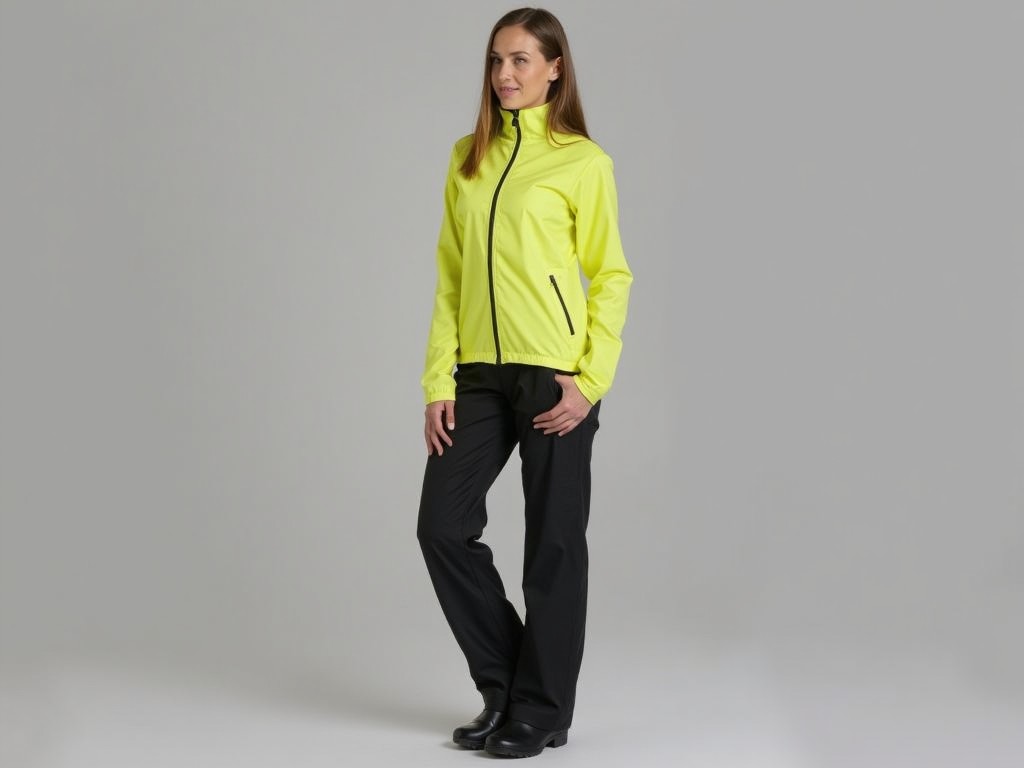
Buy Cycling Rain Pants Womens
Cycling Rain Pants for Women: Technical Specifications and Application Guide
Women’s cycling rain pants are engineered to maintain rider comfort and performance during precipitation without compromising mobility or safety. These garments integrate waterproof membranes, strategic seam sealing, and articulated patterning to address the biomechanical demands of cycling while resisting wind-driven rain and road spray.
Unlike general rainwear, cycling-specific designs prioritize aerodynamic fit, ventilation management, and compatibility with cycling footwear and saddle interfaces. Material selection and construction methods directly influence durability, breathability, and long-term value in frequent-use scenarios.
Core Technical Features
The primary functional layer consists of a 2.5-layer laminate system: a face fabric treated with durable water repellent (DWR), a microporous polyurethane (PU) membrane rated for 10,000mm hydrostatic head, and a protective inner scrim. This configuration balances water resistance with moisture vapor transmission rate (MVTR) targeting 8,000 g/m²/24h under ISO 11092 conditions.
Seams are fully sealed using 12mm-wide thermoplastic polyurethane tape applied via heat bonding to prevent leakage at needle holes. Critical stress points—inner thigh, seat panel, and knee articulation zones—receive reinforced tape application or double-stitching with bonded seams to resist abrasion from saddle contact and pedal strokes.
Ventilation is managed through laser-drilled micro-vents (0.2mm diameter) placed at posterior knee and inner thigh locations, providing targeted airflow without compromising waterproof integrity. Ankle closures employ adjustable hook-and-loop straps with silicone grippers to prevent ride-up while accommodating cycling shoe cuffs and overshoes.
Material Composition and Performance Metrics
Face fabrics typically utilize 100% nylon 6,6 microfiber with a 40D denier weight, offering a tensile strength of approximately 45 N warp and 38 N weft per ISO 13937-2. The DWR finish (C6-based fluoropolymer) achieves initial spray rating ISO 4:5, retaining minimum ISO 4:3 after 20 wash cycles per AATCC 35.
The PU membrane layer measures 12–15µm thickness, enabling selective permeability where water vapor molecules (0.0004µm diameter) pass while liquid water droplets (20–100µm) are blocked. Inner scrim layers use 100% polyester tricot (50gsm) to protect the membrane from internal abrasion and improve next-to-skin comfort.
Reflective elements incorporate 3M Scotchlite™ reflective tape (width: 25mm) positioned at distal femur and calf regions, meeting EN ISO 20471 Class 2 requirements for conspicuity when combined with upper-body visibility gear. All components are free from phthalates and heavy metals per Oeko-Tex Standard 100 certification.
Pattern Design and Ergonomic Considerations
Patterning employs a pre-bent knee articulation with 15° flexion and a gusseted crotch panel (40mm width) to accommodate hip rotation and knee extension during pedaling. Inseam lengths are graded to maintain 78–82mm clearance between hem and crankarm at bottom dead center across sizes XS–XL, preventing chainring interference.
Waist construction features a 40mm-wide elasticated rear panel with silicone-printed grip line to resist slippage, paired with a front-mounted adjustable tab closure (hook-and-loop) for fine-tuning without bulk. Side panels incorporate 4-way stretch inserts (88% nylon, 12% spandex) over the iliac crest to allow pelvic rotation without binding.
Hem design includes asymmetric shaping: longer posterior coverage (15mm drop) to protect against wheel spray, tapered anterior profile to reduce bulk behind the knee. Ankle openings measure 140mm circumference (unstretched) with 60mm adjustment range via dual hook-and-loop tabs, accommodating shoe diameters from 90mm to 160mm.
Comparison Table: Key Performance Parameters
| Parameter | Standard Specification | Typical Range (Industry) |
|---|---|---|
| Hydrostatic Head | 10,000mm | 8,000–15,000mm |
| MVTR (ISO 11092) | 8,000 g/m²/24h | 5,000–12,000 g/m²/24h |
| Face Fabric Weight | 85 gsm | 70–110 gsm |
| Reflective Area | 45 cm² | 30–60 cm² |
| Ankle Adjustment Range | 60mm | 40–80mm |
*Typical range values derived from publicly available technical data sheets of comparable cycling rain pants (2023–2024). Actual performance depends on specific material formulations and construction tolerances.
Quality Control and Manufacturing Considerations
In-line inspection includes hydrostatic head testing on random samples (1 per 500 units) using a Suter Hydrostatic Tester per ISO 811, with acceptance threshold set at 9,000mm minimum. Seam seal integrity is verified via dye penetration test (AATCC 127) requiring zero leakage after 5-minute exposure.
Dimensional stability is assessed after 5 wash cycles (40°C, mild detergent) per ISO 6330, with maximum allowable shrinkage of 3% in length and 2% in width. Reflective tape adhesion undergoes peel strength testing (ASTM D903) requiring minimum 2.0 N/mm retention after 100 dry/wet cycles.
Final audit includes 100% visual inspection for stitch density (minimum 8 stitches/cm), thread tension uniformity, and correct placement of reflective elements. Functional testing involves simulated pedaling motion on a mannequin to verify clearance and articulation performance before packaging.
Applications and Use Case Suitability
These rain pants are optimized for road cycling, gravel riding, and urban commuting where sustained exposure to light to moderate rainfall is expected. The 10,000mm membrane rating provides adequate protection against convective rain and road spray at speeds up to 35 km/h, though prolonged exposure to heavy downpours (>10mm/hr) may require additional poncho layers for complete dryness.
Breathability targets align with moderate-intensity efforts (150–250W output), where MVTR of 8,000 g/m²/24h manages sweat accumulation during 60–90 minute rides in 10–15°C conditions. For higher-intensity efforts or warmer climates, ventilation efficiency becomes the limiting factor rather than waterproofness.
In mountain biking scenarios, the articulated patterning and reinforced seams provide adequate abrasion resistance against brush and occasional falls, though the smooth face fabric may snag on sharp vegetation. Reflective placement enhances visibility during low-light commuting but does not substitute for active lighting systems per local traffic regulations.
For procurement teams evaluating technical specifications, material test reports, or size-specific pattern charts, contact our technical sales department to request detailed documentation. We provide engineering support for integration into corporate apparel programs or OEM supply chains.
Submit inquiries via the contact form on our website or email [email protected] with your project requirements, including anticipated usage conditions, order volumes, and compliance needs. Our team will respond with material data sheets, sample availability, and lead time estimates within one business day.