
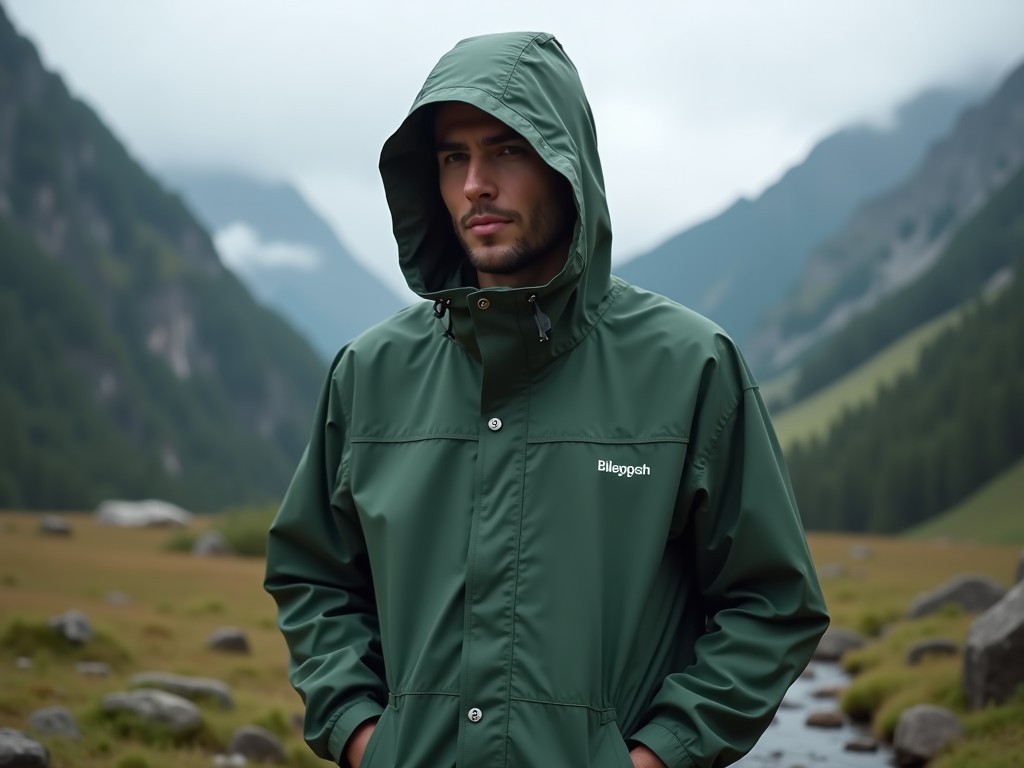
Ultralight Backpacking Rain Poncho
Ultralight Backpacking Rain Poncho
An ultralight backpacking rain poncho is a single-layer, packable garment designed to provide immediate rain protection during backcountry travel while minimizing added weight and bulk. Unlike traditional rain jackets, it typically features a simple pullover design with a hood and minimal seams, optimized for rapid deployment and compact stowage in a stuff sack. The primary design goal is to achieve effective waterproofing at the lowest possible mass, making it suitable for long-distance hiking where every gram impacts endurance and comfort.
These ponchos are constructed from advanced synthetic membranes or coated fabrics that balance hydrostatic head, tear strength, and packability. Common materials include silicone-treated nylon (Silnylon), polyurethane-coated polyester, or emerging bio-based polyolefin films. Fabric weight typically ranges from 15 to 30 grams per square meter, with hydrostatic head ratings between 1,500mm and 3,000mm to resist moderate to heavy rain without leakage. The poncho’s loose fit allows it to be worn over a backpack, covering both user and gear simultaneously—a critical advantage in prolonged exposure scenarios.
Packed size is a key performance metric; most models compress to less than 100mm in diameter and 150mm in length when stored in their included stuff sack, occupying a volume comparable to a large orange. This enables storage in a hip belt pocket or side mesh pouch without disrupting load distribution. Deployment time averages under 5 seconds due to the absence of zippers, cuffs, or complex closures—relying instead on a drawcord hood and side snaps or toggles for adjustment. This simplicity reduces failure points in cold, wet conditions where dexterity is limited.
Ventilation is addressed through strategic design rather than mechanical features. The open sides and loose cut promote airflow, reducing internal condensation compared to enclosed jackets. Some models incorporate mesh panels under the arms or along the sides to enhance breathability during high-exertion segments. The poncho’s length—typically extending to mid-calf or ankle—ensures coverage of backpack hip belts and thigh areas, preventing water ingress at the waist and legs during prolonged rain or wind-driven spray.
Material Construction and Performance Characteristics
The fabric’s waterproofing mechanism relies on a hydrophilic or microporous coating applied to a lightweight nylon or polyester base. Silicone-treated nylon (Silnylon) achieves water resistance through a durable silicone layer that reduces surface tension, causing water to bead and roll off. Polyurethane (PU) coatings create a continuous film that blocks liquid water while allowing vapor transmission via molecular diffusion. Performance degrades over time with abrasion, UV exposure, or improper cleaning, necessitating periodic re-treatment with silicone or PU-based sealants.
Tear strength is a critical durability factor in ultralight fabrics. Ripstop patterns—typically hexagonal or square grids woven with thicker reinforcement threads—are standard to inhibit crack propagation. A 15gsm Silnylon fabric with 5mm ripstop spacing may achieve a trapezoidal tear strength of 8–12N, sufficient for typical brush and branch contact but vulnerable to sharp rocks or prolonged abrasion against gear. Heavier variants (25–30gsm) increase tear resistance to 15–25N but add 40–60% to packed weight, requiring a trade-off analysis based on expected terrain and trip duration.
Hydrostatic head testing measures resistance to water penetration under pressure. A rating of 1,500mm indicates the fabric can withstand a 1.5-meter column of water before leakage occurs—adequate for light to moderate rain. For alpine or storm-prone environments, a minimum of 2,000mm is recommended to resist wind-driven rain and puddle pooling. Breathability, while less critical in ponchos than in jackets due to open design, is still quantified via moisture vapor transmission rate (MVTR); values above 5,000 g/m²/24hr help mitigate interior dampness from perspiration during sustained activity.
Design Features and Functional Adaptations
The poncho’s cut is intentionally asymmetrical to accommodate backpack geometry. The front panel is shorter to avoid interfering with waist belt access, while the rear panel extends further to cover the backpack’s frame and hip belt. Side panels are often tapered or curved to reduce excess fabric when worn without a pack, minimizing flap and wind catch. Some models incorporate adjustable side tabs or elastic cord locks to tighten the poncho around the body during high wind, reducing flapping and heat loss.
Hood design directly impacts usability in precipitation. A deep, adjustable hood with a laminated or wired brim maintains visibility by shedding water away from the face. Drawcords are typically routed through cord locks rather than grommets to reduce snag points and weight. A well-designed hood allows full head rotation without gaping, critical when navigating technical terrain or using trekking poles. Ventilation holes or mesh inserts near the temples prevent fogging of eyewear or glasses.
Packability is engineered through fabric selection and folding methodology. The stuff sack is usually made from the same base fabric, coated for water resistance, and features a roll-top or drawcord closure. The poncho is folded along specific axes to minimize crease stress on the coating—often in a tri-fold or roll-and-stuff method—to prevent delamination or cracking over time. Stuff sack volume is typically 60–80% of the poncho’s deployed footprint, ensuring efficient space utilization in a backpack.
Typical Applications in Backcountry Use
Ultralight rain ponchos are most effective in environments where weight savings directly influence trip feasibility, such as thru-hiking long-distance trails (e.g., Pacific Crest Trail, Continental Divide Trail) or alpine traverses requiring multiple days of self-supported travel. In these contexts, saving 100–200g on rain gear can reduce daily fatigue and increase daily mileage potential. The poncho’s ability to cover both user and pack eliminates the need for a separate pack cover, simplifying gear systems and reducing potential failure points.
They are particularly advantageous in variable weather patterns where rain is intermittent but prolonged exposure is likely. Unlike jackets, which require stopping to don or doff, a poncho can be deployed in seconds while walking, maintaining momentum during passing showers. This is valuable in coastal regions, mountain passes with diurnal thunderstorms, or tropical forests where convective rainfall is frequent but brief. The open design also prevents overheating during active movement in humid conditions.
In emergency or survival scenarios, the poncho serves as a multi-functional tool beyond rain protection. It can be rigged as a temporary shelter using trekking poles or cordage, employed as a groundsheet to prevent moisture transfer from wet terrain, or used to collect rainwater due to its large surface area and waterproof nature. Some models include reinforced grommets or tie-out points specifically for shelter conversion, though this adds minimal weight. Its versatility increases utility per gram carried, a key consideration in ultralight philosophies where gear must justify its weight through multiple functions.
Comparison with Alternative Rain Protection Systems
| Feature | Ultralight Poncho | Rain Jacket | Rain Kilt + Jacket |
|---|---|---|---|
| Typical Weight (incl. stuff sack) | 80–150g | 180–350g | 150–280g |
| Packed Volume | 60–100cc | 120–250cc | 100–200cc |
| Coverage (User + Pack) | Full | User only | Partial (user + lower pack) |
| Deployment Time | 3–5 seconds | 10–20 seconds (zippers, cuffs) | 8–15 seconds |
| Ventilation (Open Design) | High | Low-Moderate | Moderate |
| Adjustability in Wind | Moderate (side tabs) | High (cuffs, hem, hood) | Low-Moderate |
| Multi-Use Potential (Shelter, Groundsheet) | Yes | No | Limited (kilt only) |
Values represent typical ranges for commercially available ultralight options; actual performance varies by material, construction, and brand.
Manufacturing Considerations and Quality Control
Fabric inspection begins with roll testing for coating uniformity and hydrostatic head consistency. Each batch is sampled for water resistance using a standardized hydrostatic tester, with acceptance criteria typically set at ≥90% of rolls meeting the rated minimum (e.g., 1,800mm for a 2,000mm-rated fabric). Thickness and weight are verified via gravimetric and optical methods to ensure compliance with target areal density (e.g., 20gsm ±2g). UV stability is assessed through accelerated weathering tests (ASTM G154) to predict coating degradation over 300+ hours of UV exposure.
Seam integrity is a critical focus despite the poncho’s minimal seam count. Most designs use flat-felled or sewn-and-taped seams on the hood and side closures. Tape adhesion strength is measured via peel testing (ASTM D903), with minimum values of 1.5 N/mm required to prevent delamination under flex and thermal cycling. Needle hole sealing is verified through post-sewing hydrostatic retest—any seam showing >10% reduction in water resistance is rejected. Bar-tack reinforcement at stress points (hood drawcord exits, side snap attachments) is inspected for stitch count and thread tension.
Final product testing includes functional deployment trials: timing the donning process from stuff sack, assessing hood visibility and range of motion, and checking for unintended gaps during simulated backpack wear. Water retention and drying time are evaluated post-spray test to ensure the coating does not retain moisture that could add weight or promote mildew. Stuff sack compatibility is confirmed by verifying that the poncho folds to within 90% of the sack’s internal volume without excessive force or coating stress.
Customization Options for OEM and Bulk Orders
Fabric selection can be tailored to specific environmental demands. For high-UV exposure environments (e.g., desert trails, high-altitude routes), fabrics with enhanced UV stabilizers or titanium dioxide additives are available to slow coating degradation. In chemically harsh settings (e.g., volcanic regions with sulfuric aerosols), polyurethane coatings may be preferred over silicone due to better resistance to acidic compounds. Base fabric denier can be adjusted—7D nylon for maximum lightness, 10D or 15D for improved abrasion resistance—while maintaining target weight through precise coating thickness control.
Dimensions are scalable to accommodate different user profiles and pack geometries. Standard ponchos range from 140–160cm in width and 100–120cm in length (hood to hem). Custom lengths can be extended to 130cm for taller users or reduced for pediatric/small-frame applications. Width adjustments alter coverage: narrower cuts (120cm) reduce weight and bulk but decrease pack protection; wider cuts (180cm+) increase shelter potential but add 20–40g. Side seam placement can be modified to optimize fit for specific backpack hip belt widths or torso lengths.
Closure systems offer functional trade-offs. Side snaps (plastic or nylon) provide quick adjustment and low weight but may fail under repeated flex. Elastic cord locks with adjustable toggles offer better wind resistance and durability at a slight weight increase (3–5g). Hood brims can be laminated (lighter, less rigid) or wired (better shape retention, +2–4g). Additional features such as internal mesh pockets, reflective trims for low-light visibility, or integrated cord channels for shelter setup are available upon request, each adding 2–8g depending on complexity.
Packaging and branding options support supply chain integration. Stuff sacks can be customized with color-coding for size identification, laser-etched logos, or biodegradable materials for eco-conscious markets. Fold instructions may be printed directly onto the sack or included as a separate waterproof card. Bulk orders (typically 500+ units) receive volume-based pricing, with lead times ranging from 3–6 weeks depending on fabric availability and customization complexity. Sample units are provided for field validation before production approval.
For technical specifications, material data sheets, or to discuss customization requirements for your specific application, please contact our engineering team.
Request Technical Consultation