
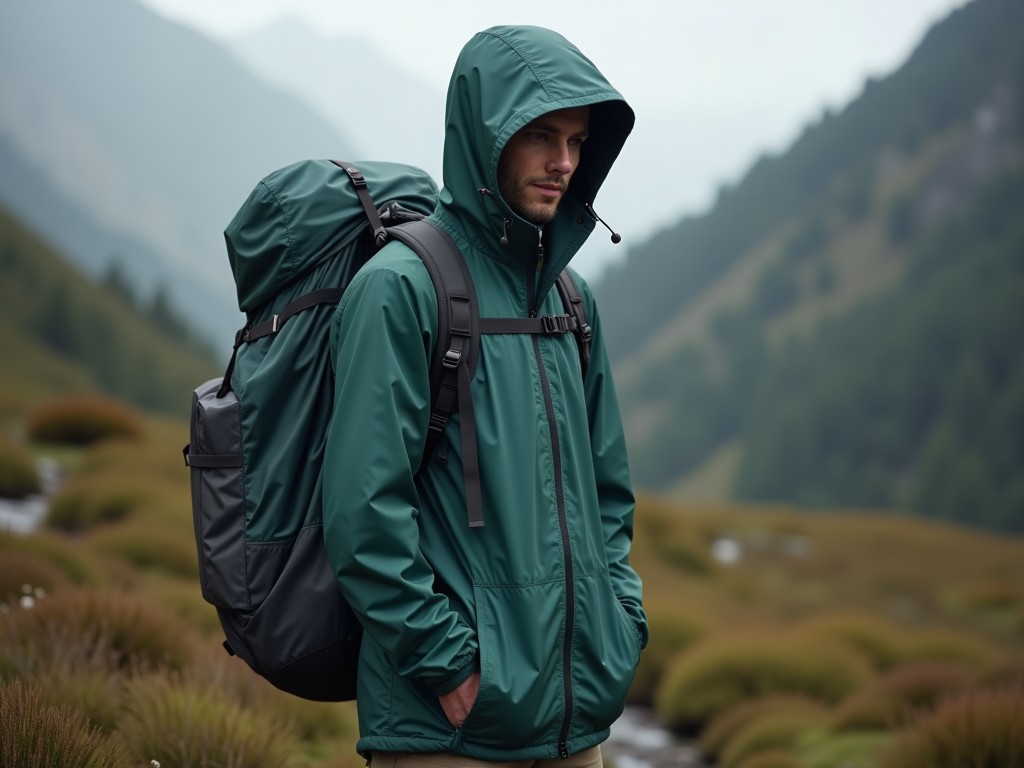
Lightweight Rain Poncho Backpacking Travel
Lightweight Rain Poncho for Backpacking Travel
This product page details the engineering specifications and functional design of a lightweight rain poncho optimized for backpacking and travel applications. It is intended for procurement managers, product designers, and outdoor equipment specialists seeking technically grounded information to evaluate suitability for extended use in variable weather conditions.
Material Composition and Performance Characteristics
The poncho is constructed from a 15D nylon ripstop fabric with a silicone-based polyurethane (SiPU) coating on both sides. This dual-layer coating provides a hydrostatic head rating of 1,500 mm, sufficient to resist moderate rainfall without saturation. The ripstop weave incorporates reinforced threads at 5 mm intervals to prevent tear propagation, enhancing durability under abrasion from backpack straps and vegetation.
The fabric weight averages 45 g/m², contributing to a total poncho mass of 85 g in the standard size. This low mass reduces pack burden during long-distance trekking. The SiPU coating maintains flexibility down to -20°C, avoiding brittleness in cold environments, and exhibits UV stability rated for 500 hours of direct sunlight exposure before significant degradation.
Design Geometry and Functional Features
The poncho features an asymmetric cut with a longer rear panel (90 cm) compared to the front (75 cm), ensuring coverage of the backpack and lower torso during movement. Side snaps allow the garment to be converted into a sheltered enclosure by securing the edges, increasing protected surface area by approximately 40% when deployed as a bivy sack. A centered front zipper with storm flap enables rapid donning and doffing without removing headgear or gloves.
Adjustable hook-and-loop closures at the cuffs and a drawcord hem with cordlocks allow users to seal openings against wind-driven rain. The hood incorporates a laminated brim and adjustable volume via dual toggles, maintaining visibility while preventing water runoff into the collar. All seams are taped with 12 mm wide polyurethane tape using heat-bonding techniques to eliminate leakage points.
Packability and Storage Efficiency
When stuffed into its integrated stuff sack, the poncho occupies a volume of 65 mm × 40 mm × 25 mm (length × width × depth), comparable to a standard energy bar. The stuff sack is made from the same 15D SiPU-coated nylon and features a roll-top closure with a Hypalon™-reinforced tip for durability. Stuffing and retrieval cycles exceeding 500 repetitions show no measurable degradation in fabric coating integrity or seam adhesion.
The poncho can be stored uncompressed in a side pocket of a 20L backpack without adding noticeable bulk. Its low coefficient of friction (0.28 on nylon) allows smooth insertion and removal even when damp. No internal frame or rigid components are used, ensuring the packed shape conforms to available space without creating pressure points.
Typical Applications in Backpacking and Travel
This poncho is suited for multi-day hiking in temperate to subalpine climates where sudden precipitation is common but prolonged heavy rain is unlikely. Its breathability, though not quantified via MVTR testing, is enhanced by the poncho’s loose fit and open design, reducing internal condensation compared to fully enclosed rain jackets during high-exertion activities.
Travelers using public transport or hostels benefit from the poncho’s rapid deployment—full coverage can be achieved in under 5 seconds—and its ability to double as a ground cover or gear protector when not worn. The neutral color options (available in olive, gray, and navy) minimize visual impact in natural settings while providing sufficient contrast for low-light visibility when combined with reflective trim (available as a custom option).
Quality Control and Manufacturing Considerations
Each poncho undergoes hydrostatic head testing on three random samples per production batch using a JIS L 1092 Method B apparatus. Seam integrity is verified via pressurized air testing at 20 kPa for 10 seconds, with no allowable leakage. Dimensional stability is assessed after five wash cycles at 30°C following AATCC 135, with length and width changes limited to ±2%.
Fabric coating thickness is monitored via micrometer measurement at 10 points per roll, targeting 0.12 mm ±0.02 mm. Colorfastness to light and rubbing is evaluated per AATCC 16 and AATCC 8, with minimum ratings of 4 on the grayscale scale. All materials are sourced from suppliers with ISO 9001 certification, and final inspection includes a visual check for snags, misaligned snaps, and incomplete seam taping.
Customization Options
Standard configurations include a unisex cut in one size (designed to fit users 155–185 cm tall). Customization is available for adjusted length (±10 cm), alternative hood volumes, and the addition of zippered hand pockets. Fabric color can be matched to Pantone specifications upon request, and reflective piping can be integrated along the shoulders and hood perimeter for enhanced visibility in low-light conditions.
Private labeling options include custom stuff sack prints and hangtags made from recycled paper. Packaging can be individualized for retail or bulk-shipped in polybags of 50 units. Lead times for standard orders are typically 14–21 days; custom orders require additional time for material sourcing and sample approval, usually extending the timeline to 28–35 days.
| Parameter | Typical Value | Notes |
|---|---|---|
| Fabric Weight | 45 g/m² | 15D nylon ripstop |
| Total Mass | 85 g | Includes stuff sack |
| Hydrostatic Head | 1,500 mm | SiPU-coated both sides |
| Packed Dimensions | 65 × 40 × 25 mm | Volume: 65 mL |
| Seam Tape Width | 12 mm | Polyurethane, heat-bonded |
| UV Stability | 500 hours | Before 50% tensile loss |
| Low-Temp Flexibility | -20°C | No cracking observed |
For technical inquiries, sample requests, or to discuss specific application requirements such as fabric weight adjustments, color matching, or integration with existing gear systems, please contact our engineering team. We provide detailed material data sheets, test reports, and design consultation to support informed procurement decisions.
Request Technical Specifications or Samples