
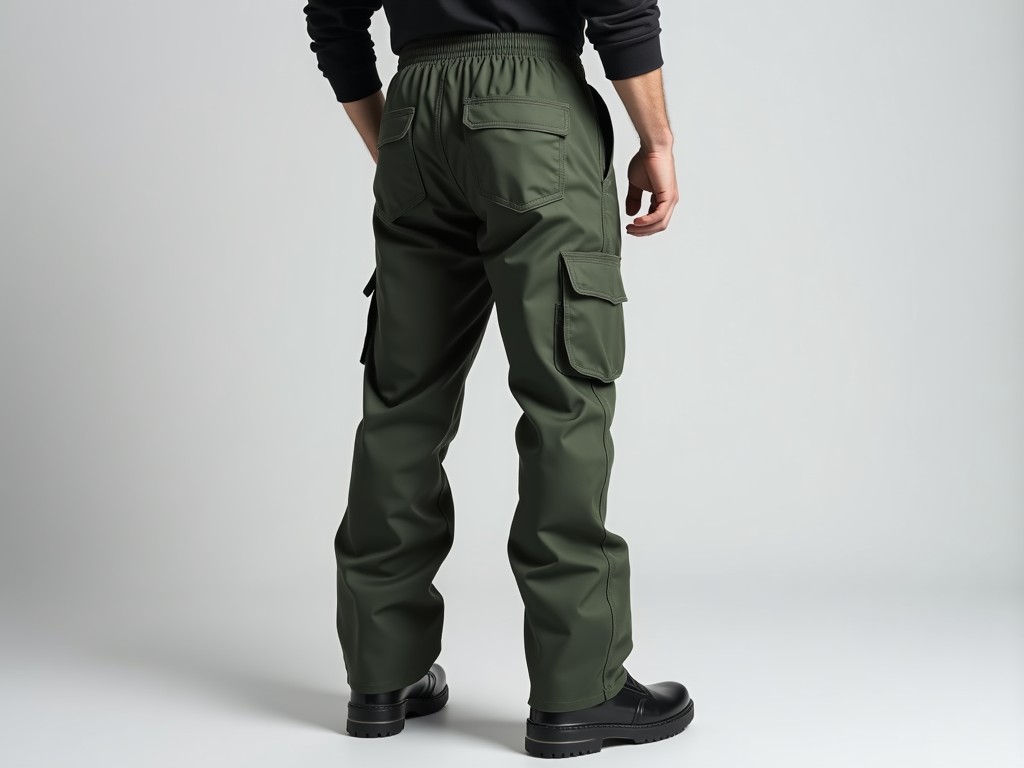
Wholesale Waterproof Mens Work Pants
Wholesale Waterproof Mens Work Pants
Waterproof work pants for men must balance moisture protection with durability and mobility in demanding industrial environments. Selecting the right product requires understanding material science, seam construction, and functional design rather than relying on generic claims. This page explains the technical considerations that influence performance and longevity.
Material Composition and Waterproofing Mechanism
Effective waterproofing begins with the base fabric. Most industrial-grade pants use tightly woven nylon or polyester with a denier rating between 420D and 600D, providing abrasion resistance while maintaining flexibility. A microporous polyurethane (PU) or polytetrafluoroethylene (PTFE) laminate is bonded to the interior surface, creating a barrier that blocks liquid water while allowing water vapor transmission. The laminate thickness typically ranges from 0.02 to 0.05 mm, calibrated to prevent delamination under flex stress. Seams are sealed with thermoplastic polyurethane tape applied via heat bonding, ensuring continuity of the waterproof layer at stitch points.
Functional Design for Industrial Use
Cut and articulation directly affect usability. Knees feature a 3D articulated pattern with gusseted inserts to accommodate squatting and crawling without restricting motion. The rise is elevated in the rear to prevent exposure during bending, while a gusseted crotch reduces strain on the inseam seam. Reinforcement panels at high-wear areas—such as the inner knees, seat, and cuffs—use 1000D Cordura® or equivalent ballistic nylon, doubling abrasion resistance compared to the base fabric. Pocket flaps are angled to shed water and secured with hook-and-loop closures or water-resistant zippers.
Performance Specifications and Testing
Waterproof performance is measured using hydrostatic head testing, where a column of water is applied to the fabric until penetration occurs. Industrial work pants typically achieve ratings between 5,000 mm and 10,000 mm, sufficient for prolonged exposure to rain, splashes, and wet surfaces. Breathability is quantified via moisture vapor transmission rate (MVTR), with values ranging from 3,000 to 5,000 g/m²/24h, preventing heat buildup during extended wear. Abrasion resistance follows ASTM D3884 or EN 530 standards, with reinforced zones exceeding 20,000 cycles before thread failure. Colorfastness to light and washing is evaluated per AATCC standards, ensuring minimal fading after repeated industrial laundering.
Customization Options for Bulk Orders
Wholesale buyers can specify adjustments to meet site-specific requirements. Waist sizes range from 28 to 50 inches in 1-inch increments, with inseam lengths from 28 to 36 inches. Belt loops accommodate webbing up to 2 inches wide, and snap or button closures can be substituted for zippers based on safety regulations. Reflective tape compliant with ANSI/ISEA 107-2020 can be applied to legs and back in Class 2 or Class 3 configurations. Logo placement is available via screen printing, heat transfer, or embroidery on the left chest, rear pocket, or down the leg.
Quality Control and Consistency
Production batches undergo inline inspection at cutting, sewing, and sealing stages. Each roll of laminated fabric is tested for hydrostatic head before cutting, and seam seal integrity is verified using dye penetration tests on 10% of finished units. Dimensional stability is checked after three wash cycles at 60°C, with shrinkage limited to 3% in length and 1% in width. Final audit includes a functional wear test simulating knee flexion and crouching motions to ensure no restriction or seam stress. Non-conforming items are segregated and reworked or scrapped based on defect severity.
Applications Across Industries
These pants are suited for environments where workers face wet conditions combined with physical labor. In utility maintenance, crews repairing underground conduits or storm drains require protection from groundwater and mud while maneuvering in confined spaces. Food processing facilities use them during washdown shifts where high-pressure water and cleaning agents are present. Agricultural workers handling irrigation systems or livestock in rain benefit from the combination of water resistance and ease of movement. Cold storage and fishing dock personnel rely on the pants to stay dry when handling ice, slurry, or wet cargo, reducing the risk of cold-related discomfort.
Packaging and Logistics
Bulk orders are packed in polyethylene bags to prevent moisture ingress during transit, then placed in corrugated cartons with burst strength exceeding 200 psi. Each carton contains 10 to 20 units depending on size variation, labeled with SKU, size breakdown, and country of origin. Palletized shipments use heat-shrink wrap and corner boards to stabilize loads, with standard 40"x48" pallets holding 20 to 30 cartons. Export documentation includes material safety data sheets (MSDS) for any chemical treatments and compliance certificates for waterproof and reflective standards upon request.
| Parameter | Typical Range | Test Standard |
|---|---|---|
| Hydrostatic Head | 5,000–10,000 mm | EN 20811 / ASTM D3393 |
| MVTR (Breathability) | 3,000–5,000 g/m²/24h | ASTM E96 / JIS L1099 |
| Abrasion Resistance (Reinforced) | >20,000 cycles | ASTM D3884 / EN 530 |
| Seam Strength | >25 N/mm | ASTM D1683 / ISO 13935-2 |
| Dimensional Change (After Wash) | <3% length, <1% width | AATCC 135 / ISO 6330 |
For procurement teams evaluating wholesale waterproof mens work pants, technical specifications provide a clearer basis for comparison than marketing language. Understanding the interplay between fabric density, laminate integrity, seam sealing, and reinforcement placement allows buyers to anticipate real-world performance and service life. The next step is to share your operational requirements—such as expected exposure levels, mobility needs, and branding preferences—to receive a precise quotation and sample options.