
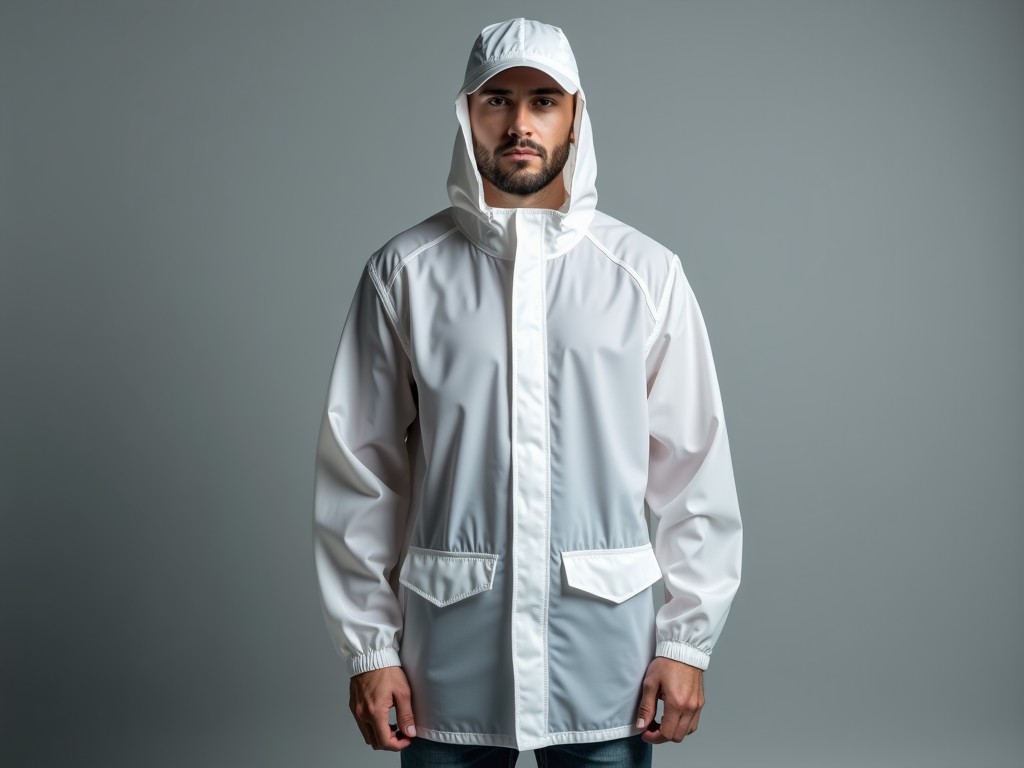
Wholesale Transparent Raincoat For Men
Wholesale Transparent Raincoat for Men
Transparent raincoats for men combine visibility requirements with weather protection in environments where facial recognition, team identification, or equipment monitoring must remain unobstructed during precipitation. These garments are commonly specified in logistics hubs, outdoor maintenance crews, event security, and agricultural operations where clear sightlines are critical for safety and coordination. Unlike opaque alternatives, transparent PVC or TPU constructions allow supervisors to verify uniform compliance, identify personnel rapidly, and monitor tool usage without removing protective layers. The material selection directly impacts durability, flexibility across temperature ranges, and resistance to common industrial chemicals.
Material Construction and Performance Characteristics
The base film for transparent raincoats is typically formulated from either polyvinyl chloride (PVC) or thermoplastic polyurethane (TPU), each offering distinct trade-offs in mechanical properties. PVC films generally provide superior cost efficiency and good resistance to oils and mild acids, with tensile strength ranging from 20 to 30 MPa and elongation at break between 300% and 500%. TPU variants, while higher in cost, deliver enhanced low-temperature flexibility (retaining elasticity down to -30°C), superior abrasion resistance, and better UV stability, making them suitable for prolonged outdoor exposure. Film thickness for wholesale men’s models usually ranges from 0.15 mm to 0.25 mm, balancing wear resistance with drape and mobility.
Seam integrity is critical in preventing leakage, and industrial-grade transparent raincoats employ either heat-sealed or ultrasonic welded joints rather than stitching, which would create permeable pathways. Heat sealing fuses the thermoplastic layers at temperatures between 140°C and 180°C, creating a continuous barrier with shear strength exceeding 80% of the base film. Ultrasonic welding, though more energy-intensive, produces seams without thermal degradation risks and is preferred for TPU materials. Seam width is typically maintained at 8–12 mm to ensure adequate bonding area while minimizing stiffness. Quality control includes hydrostatic head testing, where materials must withstand a minimum water column pressure of 800 mm to qualify as rainproof under EN 343 standards.
Design Features for Industrial Use
The cut and geometry of transparent raincoats are engineered to accommodate layering over workwear while maintaining unrestricted movement. Standard men’s wholesale models feature a raglan sleeve design, which eliminates shoulder seams and improves range of motion compared to set-in sleeves, particularly beneficial when wearing backpacks, tool belts, or harnesses. The garment length typically extends to mid-thigh (approximately 70–80 cm from shoulder to hem) to protect the torso and upper legs without impeding knee articulation. A detachable hood with adjustable drawcords accommodates headwear such as hard hats or beanies, with a clear viewing window molded into the hood front to maintain peripheral vision.
Fastening systems prioritize reliability and ease of use with gloved hands. Front closures commonly use overlapping storm flaps secured by either snap fasteners or welded hook-and-loop tape, both of which maintain integrity after repeated flexing. Snap fasteners are typically made from acetal resin or nylon, chosen for corrosion resistance and low-temperature toughness, with pull-off strength exceeding 25 N per fastener. Ventilation is addressed through underarm eyelets or welded mesh patches, which allow vapor escape while maintaining a water barrier—critical for preventing heat stress during prolonged use in humid conditions. All hardware is radio-frequency welded or thermally bonded to the film to avoid punctures that could compromise waterproofing.
Customization Options for Wholesale Orders
Wholesale buyers can specify variations in film thickness, width, and additives to match operational demands. Thicker films (0.20–0.25 mm) are recommended for high-abrasion environments such as construction or mining, while thinner gauges (0.15 mm) suit light-duty applications like event staffing or indoor facility transfers. Additives can include anti-fog agents to reduce condensation buildup on the inner surface, UV stabilizers to extend service life in sunny climates, or antimicrobial treatments for hygiene-sensitive settings. Color tints—such as light blue or gray—are available upon request to reduce glare while preserving translucency, though true transparent remains the standard for maximum visibility.
Sizing is typically offered in standard men’s ranges (S to 3XL) based on chest circumference and height, but custom grading is available for bulk orders exceeding 500 units. This includes adjustments to sleeve length, torso taper, and hood dimensions to accommodate specific workforce anthropometrics. Reflective tape strips, compliant with ANSI/ISEA 107 standards, can be heat-applied to cuffs, hem, and hood for low-visibility conditions without obscuring the transparent base. All customizations are subject to minimum order quantities and require material compatibility validation to ensure seam adhesion and long-term performance.
Quality Assurance and Testing Protocols
Industrial buyers require verifiable consistency across large production runs, which is addressed through standardized incoming material inspection and in-process checks. Each batch of film is tested for thickness variation (±0.01 mm tolerance), tensile strength, and elongation at break using ASTM D882 methods. Seam samples undergo peel and shear testing per ASTM D882 and D413, with acceptance criteria requiring a minimum peel strength of 2.5 N/mm and shear strength of 15 N/mm². Finished garments are subjected to spray testing (AATCC 35) to simulate wind-driven rain and hydrostatic resistance testing (AATCC 127) to confirm waterproof integrity under pressure.
Dimensional stability is evaluated after exposure to elevated temperatures (70°C for 2 hours) to assess shrinkage, which must remain under 2% in both warp and weft directions to prevent fit distortion. Weathering testing involves 100 hours of UV-B exposure (ASTM G154) followed by flexibility assessment at low temperatures. For wholesale orders, suppliers typically provide a first article inspection report and offer batch-specific test certificates upon request. Traceability is maintained through batch numbers on packaging, linking each unit to its raw material lot and production shift.
Packaging and Logistics Considerations
Packaging for wholesale transparent raincoats is designed to prevent creasing, sticking, and surface damage during transit and storage. Units are typically folded along predefined seams to minimize sharp folds that could cause stress cracking in the film, then placed in low-density polyethylene (LDPE) bags with anti-static additives to reduce cling. Each bag contains one garment to prevent color transfer or abrasion between units. Cartons are constructed from single-wall corrugated fiberboard with burst strength exceeding 200 psi, sized to optimize pallet utilization—commonly 20 or 40 units per carton depending on film thickness and folded dimensions.
To prevent adhesion during storage, especially in warm climates, a talc or silicone-based release agent is applied to the film surface during manufacturing, which does not affect transparency or tactile feel. Cartons are labeled with handling instructions: “Keep away from direct sunlight,” “Do not store above 40°C,” and “Avoid contact with solvents.” For export shipments, moisture-barrier liners and corner protectors are added to mitigate condensation and impact damage. Lead times for standard wholesale orders range from 15 to 25 days after sample approval, with air freight options available for urgent requirements.
| Parameter | Typical Range | Test Standard |
|---|---|---|
| Film Thickness | 0.15–0.25 mm | ASTM D374 |
| Tensile Strength | 20–30 MPa | ASTM D882 |
| Elongation at Break | 300–500% | ASTM D882 |
| Seam Peel Strength | ≥2.5 N/mm | ASTM D882 |
| Hydrostatic Head | ≥800 mm | AATCC 127 |
| Low-Temp Flexibility | No cracking at -20°C (PVC), -30°C (TPU) | ASTM D2136 |
Applications in Industrial and Commercial Sectors
Transparent raincoats serve specific functional needs where visual access is as important as weather protection. In logistics and warehouse operations, supervisors use them to monitor barcode scanning, inventory labeling, and forklift operations without obscuring worker identification or creating blind spots. Outdoor maintenance teams in utilities or telecommunications wear them to read instrument panels, splice trays, or wiring diagrams during rain, reducing the need to pause work or remove gear. Event staff at concerts, sports venues, or festivals benefit from rapid identification by coordinators while remaining protected from precipitation, improving response times during crowd management or emergency scenarios.
Agricultural workers apply transparent raincoats when operating machinery or inspecting crops, allowing clear vision of gauges, seed meters, or livestock while staying dry. In food processing or pharmaceutical facilities, they are used during washdowns or cleaning cycles where supervisors must observe hygiene compliance or equipment status without compromising containment zones. The transparency also aids in training scenarios, enabling mentors to observe trainee hand movements or tool handling in real time. These use cases demonstrate that the value of transparent rainwear lies not in replacing standard rain gear, but in enabling critical visual tasks to continue uninterrupted during adverse weather.
For wholesale inquiries, technical specifications, or sample requests, contact our industrial sales team to discuss material selection, sizing, and customization options tailored to your operational environment.