
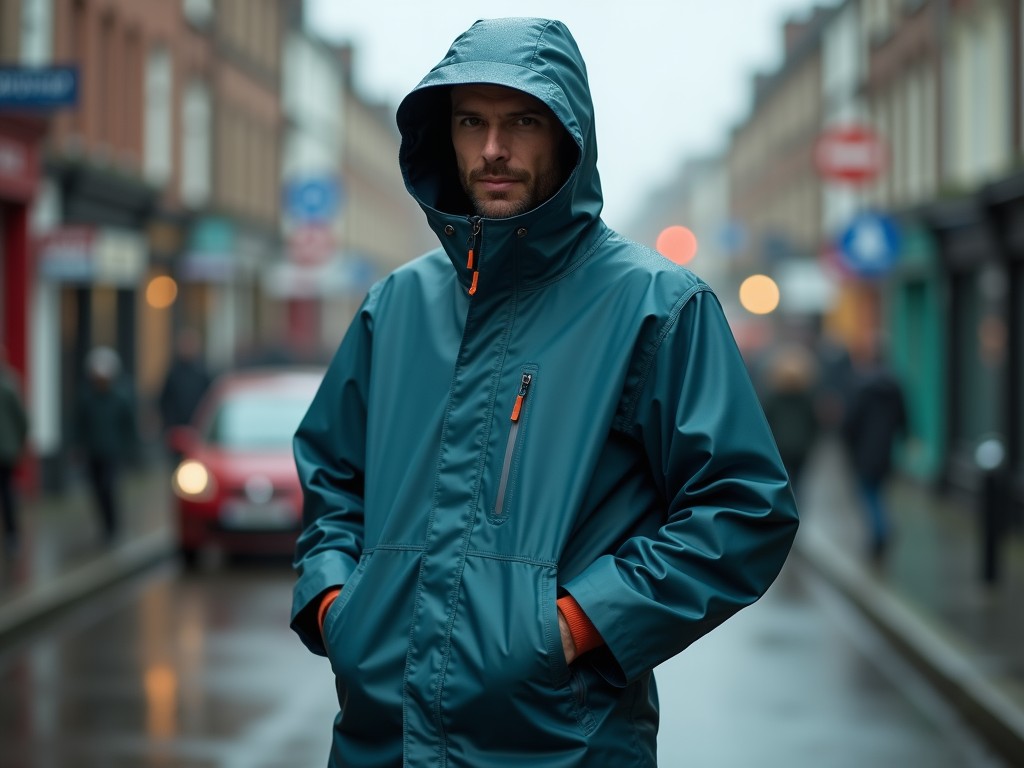
Waterproof Rain Gear For Tall Men
Waterproof Rain Gear for Tall Men
Industrial and occupational environments often require personnel to work outdoors in prolonged wet conditions. Standard rain gear frequently fails to provide adequate coverage for individuals exceeding 185 cm in height, resulting in exposure at the wrists, ankles, or torso due to insufficient sleeve and inseam lengths. This gap in protection increases the risk of hypothermia, reduced dexterity, and compromised safety during extended operations.
Addressing this need requires gear engineered with anthropometric data specific to taller statures, incorporating extended pattern grading, strategic seam placement, and material performance validated under continuous precipitation. The following details the technical specifications, material considerations, and design logic behind rain gear optimized for tall male users in demanding industrial applications.
Anthropometric Basis for Extended Sizing
Standard sizing charts typically cap at XL or 2XL with assumed proportions based on average height-to-weight ratios. For individuals over 190 cm, this results in disproportionate scaling where girth increases without corresponding length adjustments, leaving critical zones exposed. Effective rain gear for tall men must override standard grading rules by applying height-based increments to sleeve length, inseam, and torso rise independently of chest or waist measurements.
For example, a 2XLT (extra-large tall) designation may add 5 cm to sleeve length and 7 cm to inseam compared to a standard 2XL, while maintaining equivalent circumferential dimensions. This approach ensures that waterproof integrity is preserved at the cuffs, ankles, and waistband even when the wearer is fully extended during reaching, bending, or climbing motions common in utility, construction, or emergency response tasks.
Material Performance and Layer Integration
Waterproof performance depends on both the barrier properties of the outer fabric and the integrity of sealed seams. Commonly used materials include polyurethane-coated nylon, PVC laminate, or breathable microporous membranes (e.g., ePTFE) with hydrostatic head ratings exceeding 5,000 mm to resist wind-driven rain. For tall users, material selection must also account for increased surface area and stress points at extended seams, requiring higher tensile strength coatings to prevent delamination under load.
Breathability becomes increasingly important in taller individuals due to greater metabolic output and larger microclimate volume within the garment. A moisture vapor transmission rate (MVTR) of at least 5,000 g/m²/24h helps mitigate internal condensation buildup during sustained activity. Laminated constructions with hydrophilic polyurethane layers offer a balance of waterproofing and vapor transfer without relying solely on microporous structures that may clog in contaminated environments.
Seal Integrity and Design Features
Even the most waterproof fabric fails if moisture penetrates through stitch holes, zippers, or gaps at the interface with gloves, boots, or hoods. Seam sealing is therefore critical—typically achieved via thermoplastic polyurethane tape applied under heat and pressure to create a continuous barrier over stitched joints. For tall men, seam placement must avoid high-flex areas like the underarm or crotch gusset where repeated motion could compromise tape adhesion over time.
Adjustable closures at the wrists, ankles, and waist prevent water ingress during movement. Hook-and-loop storm flaps over zippers, adjustable hoods with laminated brims, and reinforced cuffs with internal gaiters enhance protection. These features are not merely additive; their geometry must be scaled proportionally to maintain effectiveness across extended dimensions—for instance, a longer hood requires a deeper brim to prevent rain from running into the face.
Typical Configuration Options
| Feature | Typical Specification | Notes |
|---|---|---|
| Available Height Range | 185 cm – 205 cm | Graded in 5 cm increments for torso and limb length |
| Sleeve Length (2XLT) | 68 cm – 72 cm | Measured from center back neck to cuff |
| Inseam Length (2XLT) | 88 cm – 94 cm | Ensures boot coverage without tripping hazard |
| Hydrostatic Head | ≥ 5,000 mm | Tested per JIS L 1092 Method B |
| MVTR (Breathability) | ≥ 4,000 g/m²/24h | Dependent on laminate construction |
| Seam Sealing | 100% taped seams | TPU tape, 20mm width, heat-activated |
Application-Specific Considerations
In utility work involving overhead line maintenance, tall personnel require rain gear that remains effective when arms are elevated for extended periods. Standard jackets may ride up, exposing the midsection; tall-specific designs counter this with longer torso length and grip-enhanced inner cuffs that interface with glove gauntlets to prevent ride-up.
For transportation and logistics workers operating in loading bays or rail yards, ankle protection is critical. Extended inseams with integrated boot gaiters prevent water from entering footwear during prolonged standing in puddles. Similarly, in forestry or terrain surveying, a longer hem prevents water spray from boots from wicking up the pant legs during brush clearance or slope traversal.
These functional adaptations are not speculative; they derive from field feedback and ergonomic testing across industries where height correlates with specific task exposures. The design logic prioritizes maintaining the dry zone where it is most needed—based on posture, movement patterns, and environmental interaction—rather than simply scaling up a standard pattern.
Quality Control and Validation
Consistency in extended sizing requires pattern grading verified against 3D body scans of target demographics, not just manual measurement checks. Each production batch should include dimensional validation of sleeve length, inseam, and torso height at multiple points to ensure grading integrity. Waterproofness is confirmed via hydrostatic head testing on finished garments, not just raw material, to account for seam and fastener performance.
Seam seal integrity is assessed through dye penetration tests or electronic leak detection on sealed joints, particularly at stress points like shoulder yokes and knee areas. Breathability is validated using controlled climate chambers to measure MVTR under standardized temperature and humidity gradients. These tests are not one-time certifications but part of ongoing statistical process control to detect drift in coating adhesion or tape activation efficiency.
Packaging and labeling must clearly indicate tall sizing (e.g., LT, XLT, 2XLT) to prevent misselection during distribution. User instructions should emphasize proper adjustment of cuffs and hem to maintain seal effectiveness, as improper fit—even in correctly sized gear—can compromise protection. This level of detail supports informed procurement decisions and reduces field failure rates.
For technical specifications, customization requests, or sample evaluation, contact our engineering team to discuss your operational requirements.
Request Technical Consultation