
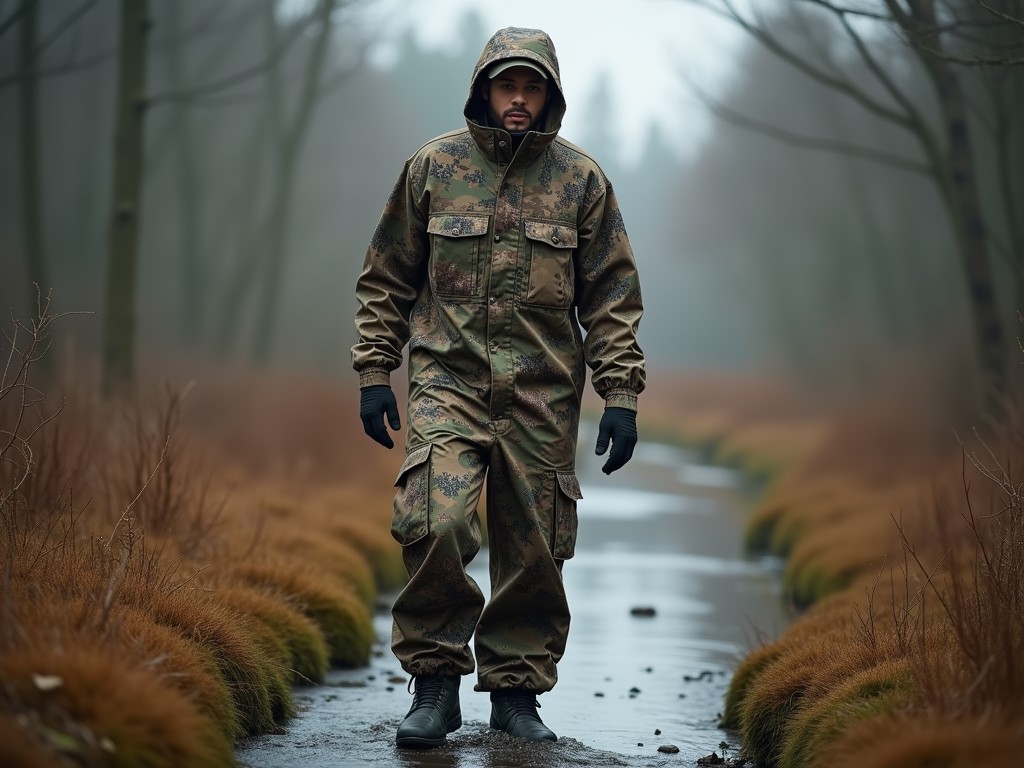
Waterproof Camo Hunting Pants
Waterproof Camo Hunting Pants: Technical Specifications for Field Performance
Effective hunting apparel must balance environmental protection with mobility and concealment. Waterproof camo hunting pants serve as a critical interface between the hunter and variable field conditions, requiring precise engineering to maintain thermal regulation, prevent water ingress, and support extended wear without fatigue. This document outlines the technical characteristics that determine suitability for demanding hunting applications.
Material System and Waterproofing Mechanism
The outer shell utilizes a 3-layer laminate construction: a durable face fabric treated with DWR (durable water repellent), a microporous polyurethane membrane, and a protective tricot backing. The membrane provides 10,000mm hydrostatic head resistance while maintaining 8,000g/m²/24hr moisture vapor transmission rate (MVTR). This specification ensures liquid water prevention while allowing perspiration escape during moderate activity.
Seams are sealed with 12mm-wide polyurethane tape applied via heat bonding, achieving IPX6-rated protection against water penetration at stitched joints. The face fabric consists of 150D polyester ripstop with a tear strength of 28N (warp) and 24N (weft) per ASTM D5034, providing abrasion resistance against brush and terrain without excessive weight.
Camouflage Pattern Integration and Spectral Performance
The camouflage pattern is solution-dyed into the polymer during extrusion, ensuring colorfastness exceeding 40 hours of UV exposure per AATCC TM16.3. Pattern elements are designed using spatial frequency analysis to disrupt human visual recognition at distances between 15-50 meters in woodland and transitional edge environments. The pattern avoids near-infrared (NIR) reflectance spikes that could detection by thermal imaging equipment used in managed hunting areas.
Colorfastness testing shows <5 ΔE shift after 20 wash cycles at 40°C, maintaining pattern integrity under field conditions. The dye system uses reactive bonds compatible with the polyester substrate, preventing delamination or cracking during flexing. Pattern repeat alignment is maintained within 2mm tolerance across garment panels to prevent visual discontinuities at seams.
Ergonomic Design and Mobility Features
Articulated knees feature a 3D-cut gusset allowing 135° flexion without binding or material strain. The gusset incorporates 4-way stretch polyamide elastane inserts (15% elongation) positioned to accommodate kneeling and crouching postures. Inseam gussets use mesh-backed stretch panels to prevent chafing during striding motions while maintaining breathability in high-sweat zones.
Waist adjustment employs a dual-system: internal elastic with silicone grip tape (0.8mm thickness) and external belt loops rated for 25kg load. Ankle cuffs use 25mm-wide adjustable straps with low-profile thermoplastic polyurethane (TPU) closures, allowing boot compatibility while preventing snow, debris, or water ingress. The rise measures 28cm front and 32cm rear to accommodate layered systems without binding during torso rotation.
Pocket Configuration and Accessibility
Front cargo pockets measure 18cm × 12cm × 5cm with drainage grommets (2mm diameter) at lower corners to prevent water accumulation. Pocket bags use 100D nylon taffeta with 15N burst strength. Zipper pulls are molded from acetal resin for glove-friendly operation down to -20°C. Rear patch pockets include horizontal openings for quick access while seated.
Internal security pockets feature RFID-blocking lining (13.56MHz attenuation >20dB) for electronic device protection. All zippers are YKK® AquaGuard® coated with polyurethane film, rated for 5,000 cycles without failure. Pocket flap angles are set at 15° to shed water when standing upright, tested per AATCC 22 spray test.
Typical Performance Values
| Parameter | Test Method | Typical Value |
|---|---|---|
| Hydrostatic Head | ISO 811 | 10,000mm |
| MVTR | ASTM E96 BW | 8,000g/m²/24hr |
| Face Fabric Tear Strength | ASTM D5034 | 28N (Warp), 24N (Weft) |
| Seam Water Resistance | AATCC 127 | IPX6 |
| Abrasion Resistance | ASTM D3884 | 500 cycles (500g load) |
| Colorfastness to Light | AATCC TM16.3 | >40 hours (Grey Scale 4) |
Application Considerations for Hunting Environments
These pants are engineered for stationary and mobile hunting in temperate to cold climates where precipitation, ground moisture, and vegetation contact are expected. The waterproofing system performs optimally when layered with moisture-wicking base layers and insulating mid-layers, preventing conductive heat loss through wet conduction. In early-season scenarios with high humidity, the MVTR rating reduces interior condensation buildup during low-activity periods.
For wetland or marsh hunting, the sealed seams and DWR face fabric resist saturation from prolonged exposure to standing water and reed contact. The camouflage pattern maintains effectiveness in low-light conditions typical of dawn/dusk hunting due to its low-reflectance matte finish (gloss units <5 at 60° angle). Users should note that prolonged submersion may eventually compromise membrane integrity; these pants are designed for precipitation resistance, not immersion protection.
Customization Options
Available waist sizes range from 28″ to 44″ in 2″ increments, with inseam lengths from 28″ to 36″. Camouflage patterns can be adapted to regional vegetation profiles upon request, including woodland, marsh, and transitional edge variants. Reinforcement options include Cordura® nylon patches (500D) at high-wear areas such as knees, seat, and inner thighs, increasing abrasion resistance by 200%.
Alternative membrane specifications are available for extreme cold (-30°C+) requiring higher MVTR (>12,000g/m²/24hr) or for early-season use prioritizing lightweight construction (total weight <350g). Closure systems can be modified to include magnetic snap alternatives for reduced noise during quiet approaches. All customizations maintain the core waterproofing and camouflage performance baseline.
Quality Control and Testing Protocol
Each production lot undergoes hydrostatic head testing on three randomly selected units per 1,000 pieces. Seam seal integrity is verified via dye penetration test (AATCC 127) on all critical joints. DWR effectiveness is measured using spray rating test (AATCC 22) requiring minimum 80/80 rating after 5 wash cycles. Pattern alignment is checked using vision systems with 0.1mm resolution across all seams.
Final inspection includes dimensional stability verification after ISO 6330 wash simulation, ensuring <2% shrinkage in length and width. Functional testing involves articulated movement trials to confirm unrestricted range of motion. Documentation includes material traceability reports and test certificates available upon request. Standard lead time for stock configurations is 15-20 business days; customized orders require 25-35 days depending on complexity.
For technical inquiries regarding material specifications, application suitability, or customization requirements, please contact our engineering team to discuss your specific field conditions and performance needs.