
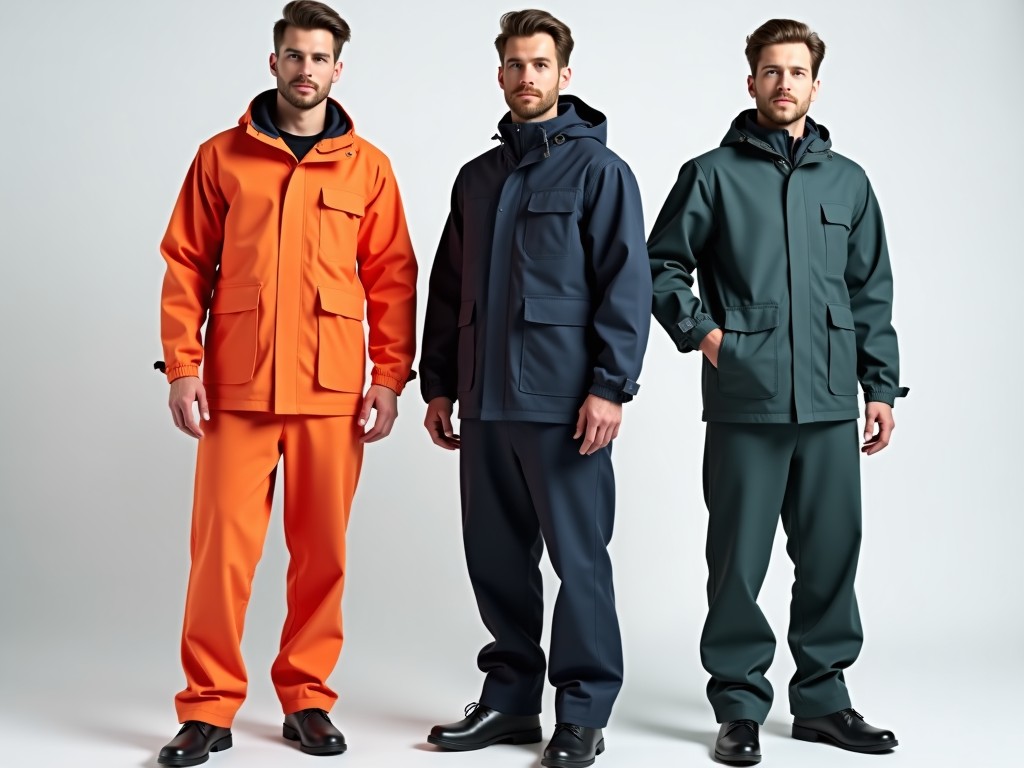
Oem Work Rain Pants Mens
OEM Work Rain Pants for Men
Industrial work rain pants are designed to protect workers from precipitation while maintaining mobility and durability in demanding environments. Unlike standard rainwear, OEM versions are engineered to meet specific operational requirements, including integration with existing uniform systems, compliance with workplace safety standards, and adaptation to site-specific hazards. These garments are not merely water-resistant barriers; they are functional components of personal protective equipment (PPE) systems where failure can lead to discomfort, reduced productivity, or increased risk of hypothermia and slip-related incidents. Understanding the technical specifications behind material selection, seam construction, and ergonomic design is essential for procurement decisions that impact long-term value and worker safety.
Material Composition and Performance Characteristics
The effectiveness of work rain pants depends on the balance between waterproofing, breathability, and mechanical strength. Commonly used materials include polyurethane-coated nylon, PVC-laminated polyester, and advanced microporous membranes such as ePTFE. Each material offers distinct trade-offs: polyurethane coatings provide flexibility and abrasion resistance at lower cost, while microporous membranes achieve higher moisture vapor transmission rates (MVTR) critical for high-exertion tasks. For example, a 300D nylon base with 1.5mm PU coating typically delivers 5,000mm hydrostatic head resistance and 3,000g/m²/24hr MVTR, suitable for general construction and utility work. In contrast, laminated ePTFE variants exceed 20,000mm hydrostatic head and 15,000g/m²/24hr MVTR, making them appropriate for prolonged exposure in wet, cold climates where sweat management is critical.
Material selection must also account for chemical exposure risks. In environments with oils, solvents, or industrial cleaners, PVC-laminated polyester offers superior resistance to degradation compared to PU-coated alternatives, though at the expense of flexibility and breathability. Reinforcement zones at high-wear areas—such as knees, seat, and cuffs—often use double-layered fabric or abrasion-resistant overlays like Cordura® nylon to extend service life. These technical distinctions allow OEMs to tailor rain pants to specific operational profiles rather than applying a one-size-fits-all solution.
Seam Construction and Waterproof Integrity
Even the most waterproof fabric fails if seams are not properly sealed. Industrial rain pants typically use sealed seams through one of three methods: heat-activated tape welding, ultrasonic bonding, or liquid sealant application. Heat-activated tape, applied over stitched seams under controlled temperature and pressure, creates a continuous barrier that matches the fabric’s hydrostatic resistance. Ultrasonic bonding eliminates needle holes entirely by fusing thermoplastic layers, ideal for high-integrity applications. Liquid sealants, while cost-effective, may degrade faster under UV exposure or repeated flexing and are generally reserved for short-term or low-abrasion use.
Seam placement is equally critical. OEM designs avoid placing seams in areas subject to constant flex or pressure—such as the inner knee or crotch—where failure is most likely. Instead, seams are routed along less stressed paths, often following anatomical contours to minimize stress points. Bar tacks at pocket corners and fly openings prevent tear propagation, while bartacked belt loops distribute load evenly. These construction details are not visible to the end user but directly influence garment longevity and reliability in field conditions.
Ergonomic Design and Functional Features
Mobility and comfort are non-negotiable in work rain pants, as restricted movement increases fatigue and error rates. Articulated knee patterns, achieved through pre-bent fabric shaping or gusseted inserts, allow unrestricted flexion during kneeling, squatting, or climbing. Gussets in the crotch area—typically diamond-shaped and made from stretch-enhanced fabric—prevent binding and reduce seam stress. Waistband designs vary: elasticated backs with adjustable tabs provide secure fit without constriction, while belt loops accommodate tool belts or harnesses common in utility and telecommunications work.
Functional access points are engineered for real-world use. Side zippers with storm flaps enable quick donning over boots without removing them, a critical feature in emergency response or rapidly changing weather. Pocket placement avoids interference with harnesses or tool belts; cargo pockets are often positioned high on the thigh with angled openings for easy access while seated or kneeling. Reflective trims, when required, are applied using heat-transfer or sew-on methods that maintain seam integrity and comply with ANSI/ISEA 107 visibility standards. These features are not optional extras—they are direct responses to observed workflow inefficiencies in wet-weather operations.
Customization Options for OEM Integration
OEM work rain pants are rarely sold as off-the-shelf products. Customization begins with baseline specifications but adapts to client-specific needs: corporate color matching via Pantone®-approved dyes, logo application through embroidery or heat transfer, and integration with existing uniform systems through tailored inseam lengths, waist adjustments, or compatible snap systems for jackets. Material selection can be adjusted based on regional climate data—for instance, specifying higher MVTR fabrics for humid subtropical zones or increased insulation compatibility for layering in sub-zero environments.
Additional customization includes hardware specification: YKK® zippers with reinforced pulls, non-corrosive snaps for marine environments, or magnetic closures for rapid access in cold-weather gear. Seam tape color can be matched to fabric for aesthetic consistency or contrasted for inspection visibility. Some clients request internal labeling systems for RFID tracking or barcode integration to support inventory management. These modifications are not cosmetic; they address logistical, safety, and operational workflows unique to each client’s site.
Quality Control and Testing Protocols
Reliability in industrial rainwear is validated through standardized testing, not visual inspection. Hydrostatic head testing (ISO 811) measures water penetration resistance under increasing pressure, with values reported in millimeters of water column. Moisture vapor transmission rate (MVTR) is assessed per ASTM E96 using the desiccant or inverted cup method, indicating how effectively sweat vapor escapes. Abrasion resistance follows ASTM D3884 (Taber Abraser), while tear strength is measured via ASTM D2261 (Elmendorf) or ASTM D5587 (trouser tear). These tests are conducted on both raw materials and finished garments to ensure performance is not compromised during assembly.
Beyond laboratory tests, OEMs often implement wear trials under simulated or actual working conditions. Feedback from field users on comfort, mobility, and seam durability informs design refinements before full production. Batch-to-batch consistency is monitored through incoming material QC, in-process checks (e.g., seam seal integrity via spark testing), and final random inspections. Documentation of test results, material certifications (e.g., Oeko-Tex® Standard 100 for harmful substances), and compliance records are maintained for traceability. This systematic approach reduces the risk of field failure and supports warranty claims or audit requirements.
Typical Specifications and Customization Parameters
| Parameter | Typical Range | Customizable? |
|---|---|---|
| Fabric Base | 300D nylon, 420D polyester | Yes – material type, denier, weave |
| Coating/Laminate | PU, PVC, ePTFE | Yes – thickness, type |
| Hydrostatic Head | 3,000 – 20,000 mm | Yes – per application |
| MVTR | 2,000 – 15,000 g/m²/24hr | Yes – membrane selection |
| Inseam Length | 28” – 36” | Yes – custom increments |
| Waist Adjustment | Elastic, tabs, belt loops | Yes – combination options |
| Reflective Trim | 50mm, ANSI/ISEA 107 compliant | Yes – placement, width |
| Closure Type | Zipper, snap, magnetic | Yes – per access point |
The values in the table represent typical ranges observed across industrial applications. Exact specifications are determined during the OEM consultation phase, where environmental exposure data, task analysis, and uniform compatibility requirements are reviewed. For example, a utility worker in coastal regions may require PVC-laminated fabric with taped seams and high-visibility trim, while a forestry technician in temperate zones might prioritize breathable ePTFE with articulated knees and side zippers. This table serves as a starting point for technical discussions, not a fixed catalog.
Applications in Industrial Environments
Work rain pants are essential in any occupation where outdoor exposure to precipitation is frequent and unavoidable. In telecommunications, technicians climbing poles or working in bucket trucks need rainwear that allows full range of motion without snagging on equipment or interfering with fall arrest harnesses. The ability to don pants quickly over boots via side zippers reduces downtime during sudden storms, maintaining schedule adherence. In construction, crews pouring concrete or setting forms in wet conditions rely on abrasion-resistant knees and reinforced seat areas to withstand constant contact with rough surfaces and debris, preventing premature wear that would compromise protection.
Utility workers maintaining power lines or water systems in rainy climates benefit from breathable fabrics that prevent heat stress during prolonged exertion, reducing the risk of fatigue-related errors. In mining and quarrying, where mud and water combine to create slip hazards, rain pants with reinforced cuffs and non-slip-friendly ankle closures help maintain footing when worn over boots. Even in indoor-outdoor transitions—such as food processing plants with washdown zones or pharmaceutical facilities with cleaning cycles—rain pants serve as a barrier against chemical splashes and particulate ingress when made from appropriate resistant materials. Each application drives specific technical requirements, which OEMs address through targeted design rather than generic solutions.