
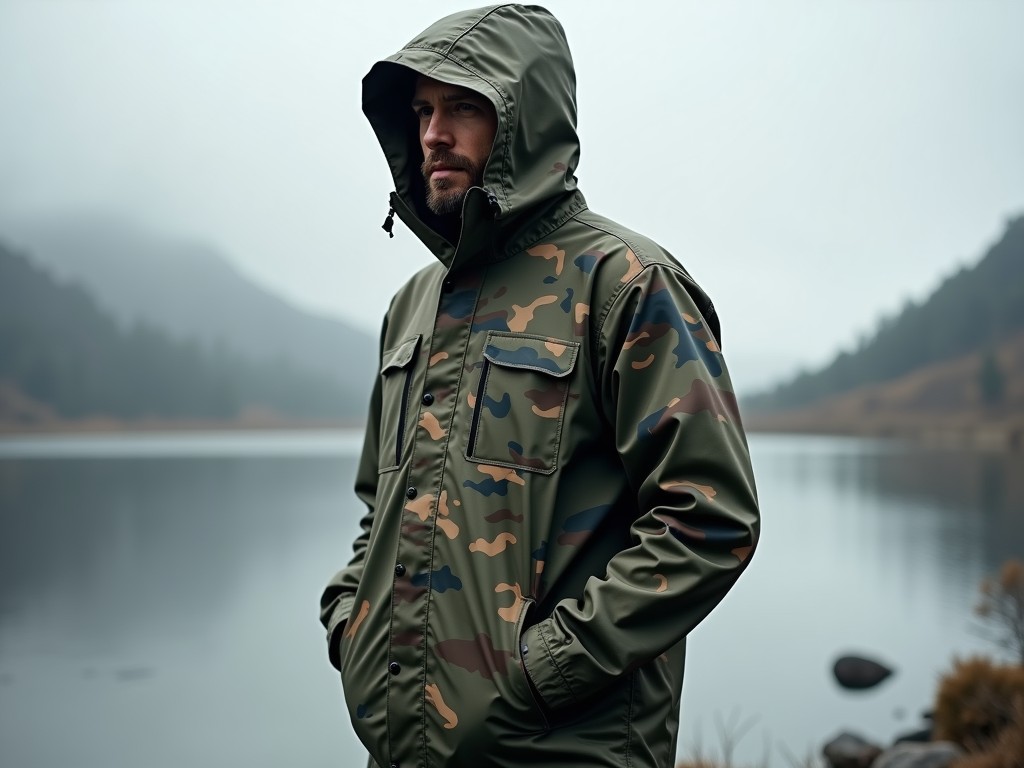
Oem Packable Camo Rain Gear For Men
OEM Packable Camo Rain Gear for Men
Packable camouflage rain gear for men is engineered to provide reliable weather protection in field operations where concealment, weight, and rapid deployment are critical. Unlike conventional rainwear, these systems integrate waterproof membranes, breathable linings, and camouflage patterns into a lightweight construction that compresses into a small stowage volume—typically under 1 liter—without compromising seam integrity or abrasion resistance. Industrial buyers prioritize such gear for missions requiring extended outdoor exposure, where logistical constraints favor minimal bulk and immediate readiness.
The core functionality relies on a three-layer laminate: an outer shell treated with durable water repellent (DWR) finish, a microporous polyurethane or ePTFE membrane for waterproofing (typically rated 10,000–20,000 mm hydrostatic head), and an inner tricot or mesh lining to protect the membrane and enhance comfort. Seams are sealed using heat-activated tape or ultrasonic welding to prevent leakage at stitch points, a critical failure mode in prolonged wet exposure. Packability is achieved through minimalist patterning, elimination of non-essential features (e.g., heavy zippers, insulated linings), and use of low-density fabrics such as 70D nylon ripstop with a weight of 60–80 g/m².
Key Technical Characteristics
Waterproof performance is validated through standardized hydrostatic head testing, where fabric samples resist water penetration under increasing pressure until leakage occurs. For tactical rain gear, a minimum rating of 10,000 mm is typical, meaning the fabric withstands a 10-meter column of water before seeping. Breathability, measured as moisture vapor transmission rate (MVTR), commonly ranges from 5,000 to 15,000 g/m²/24h, allowing sweat vapor to escape while blocking liquid ingress. This balance prevents internal condensation buildup during high-exertion activities.
Abrasion resistance is assessed via Martindale or Taber testing, with outer shell fabrics typically enduring 20,000+ cycles before showing noticeable wear—essential for brush, rock, or equipment contact in rugged terrain. Tear strength, measured in both warp and weft directions using ASTM D5034, averages 20–35 N for 70D nylon ripstop, providing resistance to propagation of small punctures. These metrics ensure the gear maintains integrity across repeated field use without sudden failure.
Weight and pack size directly impact operational mobility. A complete jacket and pant set usually weighs between 280–400 grams total, depending on size and feature set. When stuffed into its integrated storage sack or compression pouch, the volume reduces to approximately 10×15×5 cm (1.5–2.0 liters), comparable to a standard water bottle. This efficiency is achieved through patterned nesting during cutting, minimal seam tape width (often 12–15 mm), and avoidance of bulky hardware.
Material Selection and Performance Trade-offs
Outer shell fabrics are predominantly nylon or polyester ripstop, chosen for their strength-to-weight ratio and DWR retention. Nylon 6,6 offers superior abrasion resistance and tensile strength but absorbs more moisture, slightly increasing wet weight. Polyester resists UV degradation better and retains dimensional stability when wet, making it preferable for prolonged sun exposure. Both are commonly coated with a fluoropolymer-free DWR (e.g., silicone-based) to meet environmental regulations while maintaining water shedding.
The waterproof membrane is the defining layer. Microporous PU coatings are cost-effective and flexible but may reduce breathability over time due to hydrolysis. ePTFE membranes (e.g., expanded polytetrafluoroethylene) provide consistent MVTR and durability but require careful lamination to prevent delamination. Some manufacturers use hydrophilic PU layers that transport moisture via molecular diffusion, offering better long-term breathability in humid climates, though with slightly lower initial MVTR.
Linings are typically smooth polyester tricot or open-mesh mesh. Tricot reduces friction against base layers and protects the membrane from oils and particulates. Mesh linings enhance airflow in high-heat conditions but offer less protection against snagging. The choice depends on expected use: tricot for general tactical use, mesh for high-exertion training in warm environments.
Design Features for Field Utility
Ergonomic patterning ensures mobility without excess fabric. Articulated elbows and knees, gusseted underarms, and curved seams follow natural body movement, reducing binding during crawling, climbing, or weapon shouldering. Hem adjustments use low-profile elastic cords with cordlocks instead of bulky toggles, minimizing snag hazard and pack volume. Cuffs often feature hook-and-loop tabs or elastic bindings to seal against water ingress at wrists and ankles.
Ventilation is managed through pit zips (underarm zippers) or mesh-backed vents, allowing heat dumping without compromising camouflage integrity. These are sealed with waterproof zippers or storm flaps to maintain waterproof rating when closed. Pocket placement avoids interference with harnesses or belts; chest and hand pockets are angled for access while wearing gear, and often include drainage grommets to prevent water accumulation.
Camouflage patterns are applied via sublimation printing or solution dyeing to ensure colorfastness and resistance to fading from UV and washing. Near-infrared (NIR) compliance is often integrated into the dye formulation to reduce visibility under night vision devices—a critical requirement for military and law enforcement users. Patterns are selected based on operational environment: woodland, desert, transitional, or multi-terrain variants, each optimized for specific terrain reflectance profiles.
Customization Options for OEM Partners
OEM buyers can specify core parameters to align the gear with end-user requirements. Fabric weight and construction (e.g., 50D vs 70D nylon, 2-layer vs 3-layer laminate) are adjusted based on expected wear duration and environmental severity. Membrane type and MVTR targets are tuned for climate-specific breathability needs—higher MVTR for tropical humidity, lower for cold, dry conditions where sweat accumulation is less critical.
Camouflage patterns can be customized to match specific territorial specifications or proprietary designs, subject to minimum order quantities and print setup fees. Seam sealing methods (tape vs ultrasonic), stitch density (e.g., 8–10 stitches per inch), and reinforcement zones (seat, knees, cuffs) are engineered per anticipated abrasion exposure. Pocket configuration, closure types (YKK zippers, snap-tabs, magnetic), and accessory compatibility (e.g., for radio pouches, holster mounts) are defined during technical review.
Packaging and labeling are also adaptable. Gear can be supplied with individual compression sacks, bulk-packed in polybags with desiccants, or kitted with matching accessories. Labeling includes care instructions, size charts, NIR compliance marks, and batch tracking barcodes. All customizations are reviewed for impact on waterproof integrity and packability before tooling.
| Parameter | Typical Range | Customizable? |
|---|---|---|
| Fabric Weight (Shell) | 50–80 g/m² | Yes |
| Hydrostatic Head | 10,000–20,000 mm | Yes (min. 10,000 mm) |
| MVTR | 5,000–15,000 g/m²/24h | Yes |
| Total Weight (Jacket + Pant) | 280–400 g | Yes |
| Packed Volume | 1.0–2.0 L | Yes |
| Camouflage Pattern | Woodland, Desert, Multi-Terrain | Yes (OEM-specific) |
Quality Assurance and Testing Protocols
Manufacturing quality control begins with incoming material inspection, where fabric rolls are tested for hydrostatic head, MVTR, DWR durability (after 20 wash cycles), and colorfastness to light and laundering. Each batch is sampled per AQL standards, with deviations triggering hold or rejection. In-line checks monitor seam sealing temperature and pressure, stitch consistency, and pattern alignment to prevent defects that compromise performance.
Finished garments undergo functional testing: waterproof spray testing (AATCC 35) to verify surface resistance, hydrostatic retest on sealed seams, and breathability assessment via sweating guarded hotplate (ISO 11092). Dimensional stability is checked after washing and drying to ensure no shrinkage beyond 3% that could affect fit or seam integrity. Abrasion resistance is spot-tested on high-wear zones using Martindale abrasion per ISO 12947.
Packability is validated by measuring volume after repeated stuffing cycles (typically 10–20 compressions) to ensure no permanent deformation or seam stress. Colorfastness to rubbing (wet and dry) is assessed per ISO 105-X12 to prevent transfer onto gear or skin. Final random inspection includes visual checks for loose threads, missing components, and correct labeling before packaging. All test data is retained for traceability and available to OEM partners upon request.
Applications in Tactical and Operational Environments
This rain gear is suited for dismounted infantry, special operations forces, and law enforcement units operating in variable weather where concealment and endurance are paramount. In woodland or jungle patrols, the lightweight packability allows soldiers to carry the gear in a vest pocket or assault pack, deploying it rapidly during sudden downpours without compromising mobility or stealth. The breathability prevents overheating during prolonged wear in humid tropics, reducing heat stress risk.
In desert or transitional environments, the NIR-compliant camouflage maintains effectiveness under thermal imaging and night vision, while the DWR finish resists dust and light sand abrasion. Emergency medical teams and search-and-rescue personnel use the gear for rapid deployment in flood zones or storm-affected areas, where the small stowage size allows multiple sets to be carried in standard medical kits or vehicle compartments. The durability ensures reliability across multiple missions without frequent replacement.
Outdoor professionals such as wildlife biologists, forestry surveyors, and pipeline inspectors benefit from the gear’s low profile when wearing harnesses or carrying equipment. The absence of noisy hardware (e.g., metal zippers) reduces acoustic signature during observation tasks. Hunters and guides in wetland or mountainous terrain value the combination of waterproofing, camouflage, and packability for multi-day trips where weather shifts are unpredictable and resupply is limited.
For technical specifications, customization requests, or sample evaluation, contact our engineering team to discuss your operational requirements. We provide detailed material data sheets, test reports, and pattern options to support informed procurement decisions.