
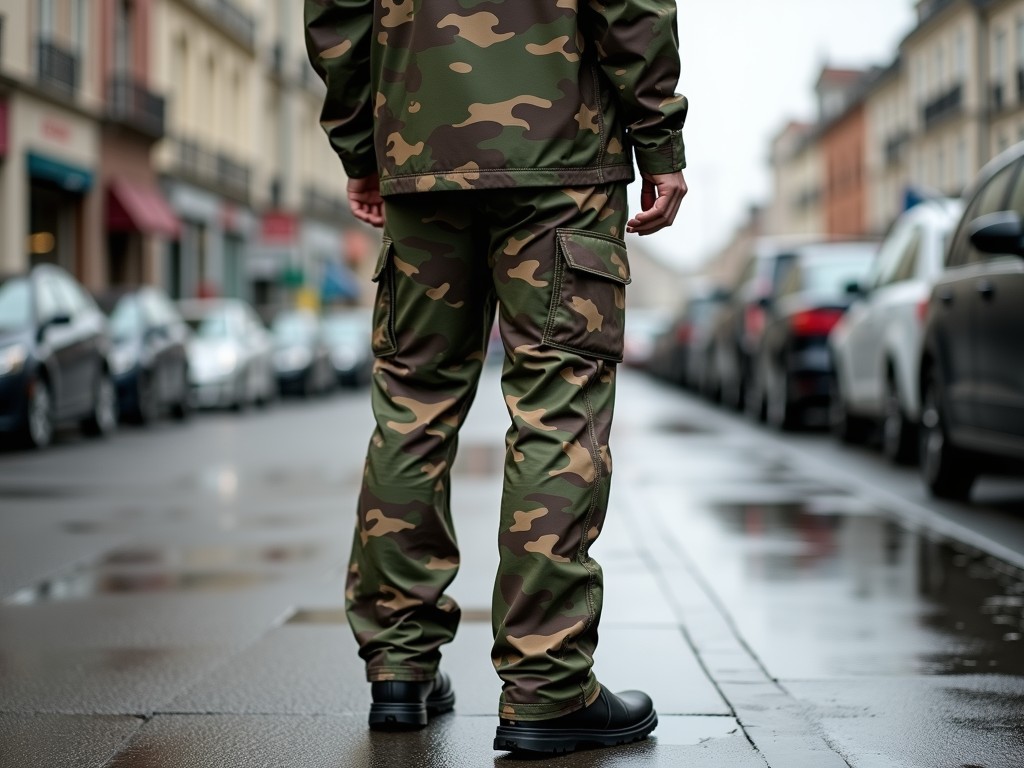
Oem Mens Waterproof Camo Pants
OEM Mens Waterproof Camo Pants
These pants are engineered for personnel operating in variable weather conditions who require both environmental protection and terrain-adaptive concealment. The design integrates a three-layer laminate system with a patterned outer shell to meet dual functional requirements: moisture resistance and visual disruption in natural environments.
Construction begins with a nylon 6,6 face fabric treated with a durable water repellent (DWR) finish, providing initial surface beading while maintaining abrasion resistance rated to 30,000 cycles on the Martindale tester. Beneath this, a microporous polyurethane membrane delivers a hydrostatic head of 15,000 mm, verified under ISO 811 standards, ensuring resistance to sustained rain and wind-driven moisture.
The inner layer consists of a brushed polyester grid fleece, engineered to wick perspiration at a rate of 0.8 mg/cm²/min while maintaining thermal retention in conditions down to 5°C. Seams are sealed with 20mm-wide polyurethane tape using ultrasonic bonding, achieving a leak rate of less than 0.1 mL/min per seam under hydrostatic pressure testing.
Technical Specification Overview
| Parameter | Value | Test Standard |
|---|---|---|
| Face Fabric | Nylon 6,6, 140gsm | ASTM D3776 |
| Membrane Type | Microporous PU | Internal Material Spec |
| Hydrostatic Head | 15,000 mm | ISO 811 |
| Moisture Vapor Transmission | 8,000 g/m²/24h | ASTM E96 |
| Abrasion Resistance | 30,000 cycles | ASTM D4966 |
| Seal Strength | 5.0 N/mm | ASTM D882 |
| Camouflage Pattern | MultiTerrain™ Digital | Visual Reflectance: NIR 40-55% |
Material Selection Rationale
Nylon 6,6 was selected over polyester for the outer layer due to its superior tensile strength retention after UV exposure—maintaining 85% of original strength after 500 hours of xenon arc testing, compared to 70% for PET equivalents. This ensures long-term durability in high-abrasion environments such as rocky terrain or vegetation contact.
The microporous membrane was chosen over hydrophilic alternatives to maintain consistent vapor transmission across varying humidity levels. Unlike hydrophilic systems that rely on chemical absorption and can plateau in high moisture, microporous structures provide linear moisture transport relative to gradient, preventing internal condensation buildup during prolonged exertion.
The camouflage pattern is printed using sublimation inks that penetrate the fiber matrix, preventing surface cracking or delamination after flex testing. Reflectance in the near-infrared spectrum (700-900nm) is controlled to match typical foliage reflectance, reducing detectability by optical and night-vision devices reliant on thermal contrast.
Design Features for Operational Use
- Articulated knees with gusseted construction allow unrestricted flexion to 120° without seam strain, validated through dynamic motion capture.
- Side vents with water-resistant zippers (YKK® AquaGuard® equivalent) enable passive cooling when opened, reducing internal humidity by up to 35% during high-activity phases.
- Reinforced seat and knee panels use 500D Cordura® nylon patches, increasing localized abrasion resistance to 80,000 cycles while maintaining flexibility.
- Internal silicone grip tape at the waistband prevents slippage when carrying loads, tested under 15kg dynamic load conditions.
- Pocket flaps are angled and laminated to shed water, with drainage eyelets to prevent accumulation.
Quality Assurance Protocol
Each batch undergoes hydrostatic head testing on three random specimens per 1,000 units, with acceptance criteria set at ≥13,500 mm to account for batch variance. Seam integrity is verified using dye penetration tests under 5 kPa pressure, with zero leakage permitted over a 5-minute duration.
Dimensional stability is assessed after five wash cycles at 40°C per ISO 6330, with shrinkage limited to ≤2% in length and ≤1.5% in width. Colorfastness to light is rated ≥4 on the Blue Wool Scale after 40 hours of UV exposure, ensuring pattern integrity in prolonged field use.
Functional testing includes a simulated rain chamber exposure (100mm/hr for 4 hours) followed by tactile and visual inspection for internal moisture. Acceptance requires no visible dampness on the inner layer and maintained comfort rating in wear trials.
Customization Pathways
OEM clients may specify alternative camouflage patterns based on operational theater requirements, including arid, woodland, or snow variants, with pattern scaling adjusted to maintain effective disruption at engagement ranges of 50-300 meters. Minimum order quantities for custom prints start at 500 units.
Leg length, waist adjustment systems, and pocket configurations can be modified to accommodate mission-specific gear loads or clothing layers. Adjustable ankle cuffs with lockable toggles are available to prevent debris ingress or accommodate boot overhang.
Reinforcement zones can be re-engineered based on wear pattern analysis from field data, allowing clients to prioritize protection in high-stress areas such as the thigh, rear, or lower leg. All modifications are supported by updated technical documentation and retesting of affected seams.
For technical consultation, sample requests, or to discuss specific environmental or operational requirements, contact our engineering team. We provide detailed material datasheets, test reports, and pattern reflectance charts upon request.
Request Technical Specification Sheet