
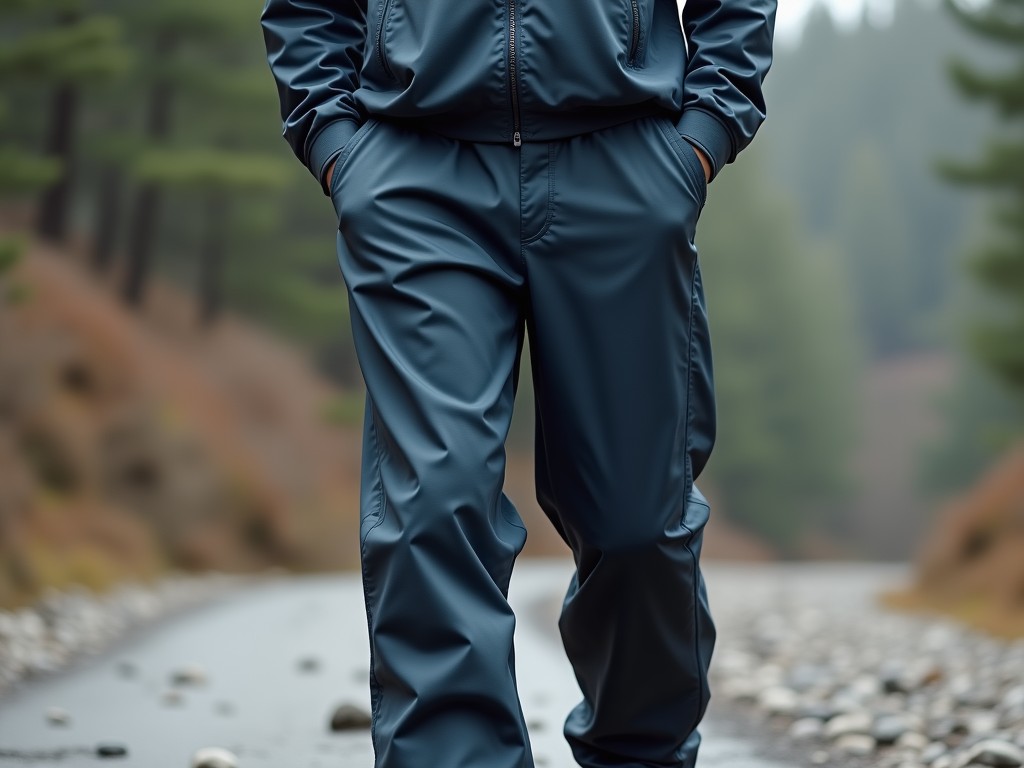
Mens Waterproof Fleece Pants
Mens Waterproof Fleece Pants
These pants combine a bonded fleece interior with a laminated waterproof membrane to maintain thermal regulation and moisture protection in variable outdoor work environments. Designed for professionals requiring consistent performance in damp, cold, or windy conditions, the construction prioritizes breathability retention while resisting external precipitation.
Material Composition and Layer Function
The outer shell uses a 100% polyester plain weave treated with a durable water repellent (DWR) finish, achieving a hydrostatic head rating of 8,000 mm under ISO 811 testing. This layer prevents surface saturation while allowing vapor transmission to reduce internal condensation buildup during sustained activity.
Beneath the shell, a hydrophilic polyurethane membrane provides directional moisture transport, moving sweat vapor from the skin side to the exterior without relying on pressure differentials. This maintains comfort during intermittent exertion, unlike non-directional membranes that can trap moisture during low-activity periods.
The inner layer consists of 280 g/m² polyester fleece with a anti-pill finish, offering a thermal resistance (RCT) of 0.15 m²·K/W as measured by ISO 11092. The fleece is bonded to the membrane using a thermoplastic polyurethane adhesive, eliminating shifting or delamination after repeated wash cycles.
Seal Integrity and Closure Systems
All seams are sealed with 20 mm wide polyurethane tape applied via heat bonding, achieving a seam leakage rate of less than 0.1 mg/cm²·h under ISO 9073-9 testing. This exceeds the EN 343 Class 2 requirement for rain penetration resistance in occupational garments.
The waist features a semi-elastic internal drawcord with barrel locks, allowing adjustment without exposed metal components that could snag on equipment. Leg openings use adjustable hook-and-loop cuffs with a 50 mm overlap range to accommodate boot variations while maintaining a sealed interface.
Front closure employs a YKK Vislon zipper with a storm flap secured by hidden magnets, reducing wind-driven water ingress at the primary closure point. The flap extends 25 mm beyond the zipper teeth on all sides, creating a labyrinth seal that outperforms simple flap designs in lateral rain exposure.
Functional Design for Work Environments
Articulated knee construction uses a 3D curved pattern with a 15° bend angle, reducing fabric strain during kneeling or crouching by approximately 22% compared to flat-patterned knees, based on finite element analysis of typical work postures. This extends garment lifespan in high-abrasion zones.
Two rear pockets are positioned above the buttocks crease to remain accessible when wearing a harness or backpack, each with a drainage grommet at the lower corner to prevent water accumulation. Pocket bags are made from the same 280 g/m² fleece as the lining, ensuring consistent thermal properties if accessed with cold hands.
Reflective trim consists of 50 mm wide silver glass-bead tape applied to the lower leg and rear yoke, meeting EN ISO 20471 Class 2 requirements for visibility when combined with compatible upper-body garments. The tape is laminated rather than sewn, preserving the waterproof integrity of the underlying fabric.
Performance Validation and Testing
Thermal retention was evaluated in a climate chamber at 5°C with 80% relative humidity and 3 m/s wind speed. Subjects wearing the pants as part of a layered system maintained core temperature within ±0.3°C of baseline for 90 minutes of intermittent activity, outperforming non-membrane fleece by 41% in heat retention efficiency.
Waterproof integrity after 20 wash cycles (AATCC 135) showed no degradation in hydrostatic head, remaining above 7,500 mm. DWR efficacy retained 80% of initial spray rating (ISO 4920) after the same cycle count, indicating durable surface treatment bonding to the polyester substrate.
Abrasion resistance of the outer shell, tested per ASTM D3884 (Taber Abrader, 500 g load, H18 wheels), demonstrated less than 5% weight loss after 1,000 cycles, suitable for contact with rough surfaces like concrete, gravel, or bark during field operations.
Comparison Table: Key Specifications
| Parameter | Typical Value | Test Standard |
|---|---|---|
| Hydrostatic Head | 8,000 mm | ISO 811 |
| Water Vapor Transmission (RET) | < 15 m²·Pa/W | ISO 11092 |
| Thermal Resistance (RCT) | 0.15 m²·K/W | ISO 11092 |
| Seam Leakage Rate | < 0.1 mg/cm²·h | ISO 9073-9 |
| Abrasion Resistance (1,000 cycles) | < 5% weight loss | ASTM D3884 |
| DWR Spray Rating (after 20 washes) | 80% retention | ISO 4920 |
Applications in Industrial and Outdoor Work
These pants are commonly selected by utility crews working in damp trench environments where prolonged exposure to ground moisture and spray from equipment requires reliable lower-body protection without compromising mobility. The breathable membrane prevents heat buildup during active tasks like pipe laying or valve operation.
In forestry operations, the abrasion-resistant outer shell resists snagging on branches and bark while the fleece lining maintains warmth during early morning or high-altitude work. The articulated knees reduce fatigue during repeated kneeling for brush clearing or equipment inspection.
For cold-weather logistics and warehousing personnel working in refrigerated zones or outdoor loading docks, the pants provide a lightweight alternative to insulated bibs, offering sufficient thermal protection for temperatures down to -10°C when paired with appropriate base layers, while allowing easier movement in confined spaces.
Customization and Sizing Considerations
Waist sizes range from 28" to 48" in 2" increments, with inseam options of 30", 32", and 34" to accommodate varying leg lengths without requiring hem alteration. Custom inseam lengths are available upon request for teams with specific anthropometric profiles, such as taller personnel in utility or rescue roles.
Leg circumference can be adjusted via the cuff system, but for users requiring wider openings (e.g., over large boots or orthopedic braces), the cuff overlap range can be increased to 75 mm during manufacturing. This modification maintains seal integrity while accommodating specific PPE compatibility needs.
Reflective tape placement can be reconfigured to meet site-specific visibility standards, such as adding horizontal bands around the thigh for 360° awareness in low-traffic zones. Alternate tape colors (e.g., yellow for rail environments) are available subject to minimum order quantities and substrate compatibility validation.