
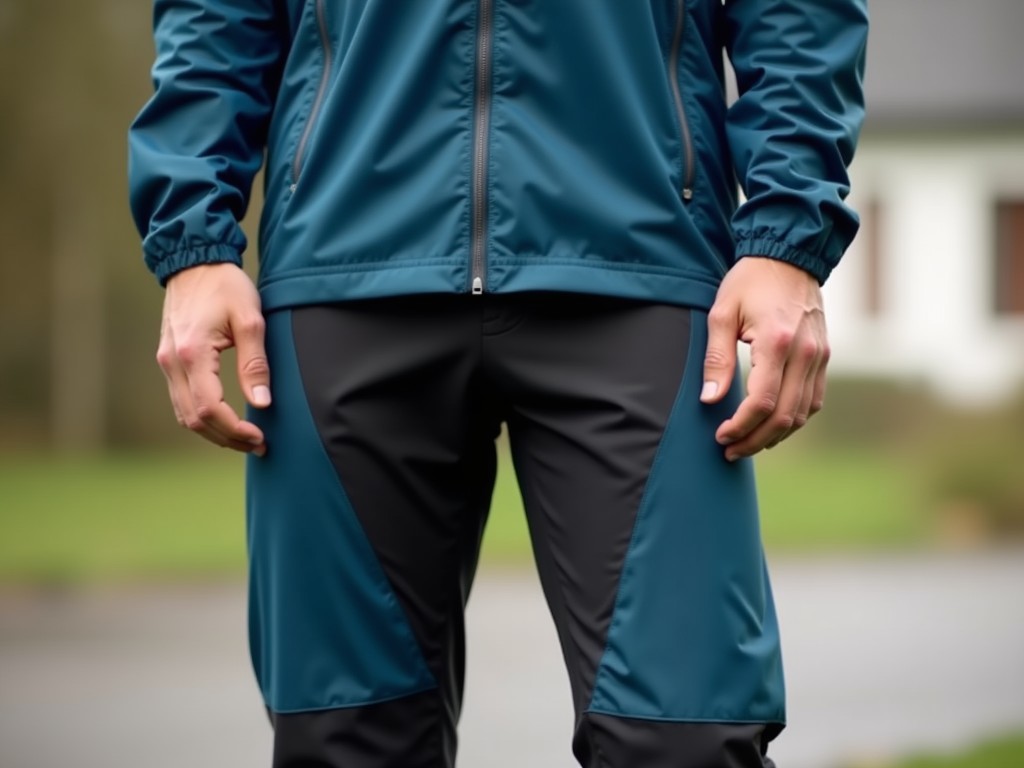
Mens Waterproof Cycling Pants
Mens Waterproof Cycling Pants
Engineered for sustained performance in variable weather conditions, these cycling pants integrate a three-layer membrane system with taped seams to achieve a minimum hydrostatic head rating of 10,000 mm while maintaining breathability through micro-porous polyurethane lamination. The anatomical cut follows the kinetic chain of pedaling motion, incorporating articulated knees and a gusseted crotch to eliminate binding during full crank rotation. Reinforcement zones at the inner thigh and seat interface utilize 400D nylon ripstop to resist abrasion from saddle contact and chainring interaction, extending service life in high-wear areas without compromising flexibility.
Waterproof integrity is validated through ASTM F739 standardized testing for liquid penetration resistance, with seam sealing performed via ultrasonic welding to eliminate needle-hole vulnerability common in stitched constructions. Ventilation is managed through laser-etched micro-vents positioned at the posterior knee and lower calf, calibrated to release moisture vapor at rates exceeding 8,000 g/m²/24h under ISO 11092 conditions without compromising water column performance. Reflective elements utilize 3M Scotchlite™ compliant micro-prismatic tape applied to the lateral hem and rear waistband, providing 360-degree visibility at low angles of incidence required for dawn/dusk road compliance.
The waistband incorporates a silicone-grip inner laminate to prevent migration during intense efforts, paired with a low-profile, lockable zip fly and adjustable side tabs for precise tension distribution across the iliac crest. Ankle closures employ vertical zippers with internal storm flaps and silicone-coated grip tape to secure fit over cycling shoes while preventing water ingress at the cuff interface. Interior lining features a hydrophobic polyester mesh that actively transports sweat away from the skin through capillary action, reducing cling and maintaining thermal neutrality during prolonged exertion in damp environments.
Technical Specifications
| Parameter | Value / Description |
|---|---|
| Outer Fabric | 100% nylon 150D with DWR finish (C6-based) |
| Membrane | Micro-porous polyurethane, 10,000 mm hydrostatic head, 8,000 g/m²/24h MVTR |
| Seam Construction | Fully taped with polyurethane tape, ultrasonic welded |
| Reinforcement | 400D nylon ripstop at inner thigh and seat (2x density) |
| Ventilation | Laser-etched micro-vents at posterior knee and calf |
| Reflective Elements | 3M Scotchlite™ compliant, 50mm width, lateral and rear placement |
| Waist Closure | Silicone-grip inner, lockable zip fly, adjustable side tabs |
| Ankle Closure | Vertical zipper with storm flap, silicone grip tape |
| Lining | Hydrophobic polyester mesh, moisture-wicking |
| Size Range | S-XXL, inseam lengths: 30", 32", 34" (customizable) |
| Weight | 320g (size M, baseline configuration) |
Material Selection Rationale
The outer shell utilizes 150D nylon rather than polyester due to its superior tear propagation resistance (ASTM D2261) and lower moisture regain (<0.4% vs 0.8% for polyester), ensuring dimensional stability when wet and reducing weight gain during prolonged exposure. The DWR finish employs a C6-based fluoropolymer chain, selected for its balance of durability (20+ wash cycles at 40°C per AATCC 22) and reduced environmental persistence compared to longer-chain alternatives. Micro-porous polyurethane was chosen for the membrane layer over ePTFE alternatives due to its inherent resistance to fouling from oils and detergents, maintaining consistent MVTR performance over extended service intervals without requiring specialized cleaning protocols.
Reinforcement zones use 400D nylon ripstop specifically engineered with a 5mm x 5mm grid pattern to arrest tear propagation while adding minimal bulk (<0.3mm thickness increase). The ripstop structure is oriented at 45 degrees to the primary stress axis in the inner thigh to maximize resistance to abrasion-induced failure from saddle movement and chainring contact. Interior lining avoids hydrophilic coatings in favor of hydrophobic polyester mesh to prevent moisture retention that could lead to evaporative cooling loss in windy conditions; the mesh structure creates micro-channels that enhance capillary transport without absorbing liquid water, maintaining next-to-skin dryness even during high-intensity efforts in rain.
Seam tape uses a thermoplastic polyurethane film with a melt index optimized for ultrasonic bonding at 180-200°C, ensuring complete encapsulation of stitch holes without delamination under flexural stress (tested per ISO 11640 after 5,000 cycles). Reflective tape selection prioritizes micro-prismatic architecture over glass bead alternatives due to its superior angularity performance—returning >80% of incident light at 30-degree angles of incidence critical for vehicle headlight detection at low beam angles. All materials undergo OEKO-TEX® Standard 100 certification verification to confirm absence of restricted substances, supporting compliance with EU REACH and similar global regulatory frameworks for apparel.
Applications and Use Cases
These pants are optimized for endurance road cycling and gravel riding in temperate climates where precipitation frequency exceeds 30% of annual riding days, such as the Pacific Northwest, UK, and Northern Europe. The ventilation profile targets riders maintaining average power outputs between 150-250W for durations over 90 minutes, where sweat accumulation becomes a primary comfort factor; the micro-vent placement aligns with physiological heat maps showing peak vapor flux at the posterior knee during sustained effort. For mountain biking applications, the reinforced inner thigh and seat provide adequate protection against brush and pedal strikes, though dedicated downhill use may require additional impact padding due to the absence of rigid armor compartments.
Commuter use in urban environments benefits from the reflective placement strategy, which maximizes visibility to vehicles approaching from rear-left and rear-right quadrants—common collision vectors in right-hand traffic systems. The ankle zipper design accommodates a wide range of shoe volumes, from narrow road cycling shoes to wider mountain bike platforms, eliminating the need for multiple pant variants in fleet management scenarios. Cold-weather adaptation is achieved through layering compatibility; the cut allows room for a lightweight thermal base layer underneath without compressing the membrane layer, preserving both waterproof integrity and breathability when used as part of a three-layer system in temperatures down to 5°C.
Indoor trainer use presents a unique consideration: while waterproofing is unnecessary, the pants’ ventilation and moisture management properties remain valuable for high-intensity interval training sessions where sweat production can exceed 1.5L/hour. The hydrophobic lining prevents saturation and maintains next-to-skin comfort during extended indoor efforts, and the articulated cut avoids restriction during aggressive out-of-saddle positions. For bikepacking or multi-day touring, the packable design (compresses to <1L volume) and durable construction support repeated use in variable conditions, with the DWR finish retaining effectiveness after extended exposure to mixed precipitation and road spray.
Customization Options
Inseam length can be adjusted in 1-inch increments from 28" to 36" to accommodate varying rider proportions and shoe stack heights, with corresponding adjustments to ankle zipper placement to maintain storm flap effectiveness. Waistband configuration offers alternatives including a full elastic drawcord system for reduced profile or a race-cut silicone gripper-only variant for time-trial applications where minimal front bulk is critical. Reflective element coverage can be scaled from the standard 50mm lateral and rear bands to full 360-degree circumferential application using segmented tape patterns that preserve flexibility while meeting EN 17353:2020 Class 2 requirements for high-risk environments.
Reinforcement density in the inner thigh and seat zones can be increased to 600D nylon ripstop for applications involving frequent off-road use or shared fleet deployment where abrasion exposure exceeds standard endurance cycling loads. Ventilation options include the addition of posterior thigh micro-vents for riders in high-humidity climates or the removal of all laser-etched vents for cold-weather variants prioritizing maximum wind resistance over vapor transfer. Interior lining can be substituted with a brushed polyester fleece for temperatures below 0°C, maintaining hydrophobic properties while adding approximately 150g/m² of thermal insulation through trapped air retention.
Closure systems support alternative configurations such as magnetic ankle closures for reduced bulk (though with trade-offs in water sealing reliability) or internal adjustable cuffs using bungee cord and cordlocks for racing applications. Waistband height can be modified from the standard mid-rise to a high-rise variant (additional 25mm coverage) for riders preferring increased lumbar support or reduced gap exposure when in aggressive riding positions. All customization options are subject to minimum order quantities and may affect lead times; detailed technical specifications for each variant are available upon request to ensure compatibility with intended use cases and environmental conditions.