
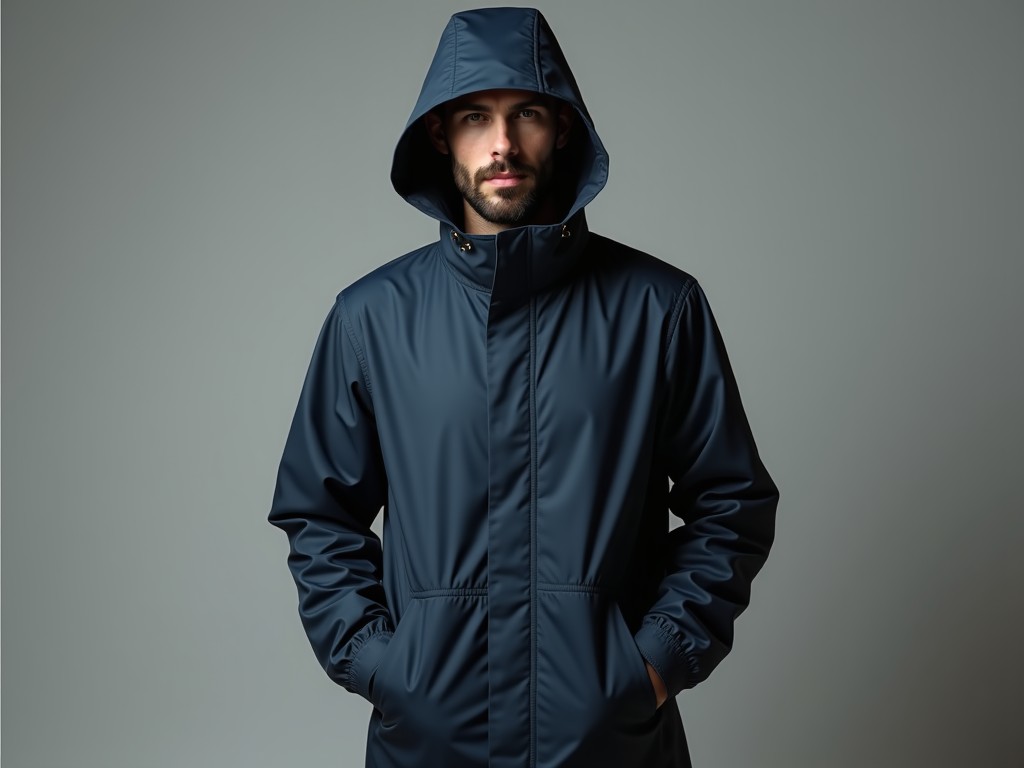
Mens Raincoat With Removable Liner
Mens Raincoat with Removable Liner
A mens raincoat with removable liner combines weather protection with adaptable thermal management through a two-piece construction system. The outer shell provides waterproof and wind-resistant barrier properties, while the detachable liner allows independent adjustment of insulation levels based on ambient temperature and activity intensity. This modular approach enables users to configure the garment for three distinct conditions: shell-only for mild rain, liner-only for cool dry weather, or combined for cold wet environments.
Unlike fixed-liner raincoats that force a single thermal profile, this design separates moisture protection from heat retention functions. The liner attaches via secure snap or zipper interfaces positioned at critical junctions—neck, cuffs, waist, and hem—to maintain thermal continuity when combined and prevent air infiltration. When detached, both components can be cleaned, stored, or used independently, extending service life and improving hygiene management in industrial or outdoor work settings.
Material Composition and Performance Characteristics
The outer shell typically utilizes a 2.5-layer or 3-layer laminate construction where a waterproof polyurethane or PTFE membrane is bonded to a nylon or polyester face fabric. Face fabric denier ranges from 70D to 150D, balancing abrasion resistance with packability, while membrane hydrostatic head ratings commonly exceed 10,000 mm to resist prolonged rain exposure. Durable water repellent (DWR) finishes applied to the outer surface reduce surface wetting, maintaining breathability by preventing fabric saturation that would otherwise impede moisture vapor transfer.
Removable liners are frequently constructed from synthetic fleece (100% polyester) or insulated panels using synthetic fiberfill such as PrimaLoft® or Thinsulate™. Fleece liners offer consistent warmth when damp and dry rapidly, with typical fabric weights between 200 gsm and 400 gsm. Insulated liners use fiberfill with clo values ranging from 0.8 to 2.0, providing adjustable thermal resistance; higher clo values correspond to greater insulation efficiency per unit thickness. Both liner types incorporate low-bulk designs to minimize added volume when combined with the shell.
Seam construction on the shell employs fully taped or welded techniques using waterproof tape or ultrasonic bonding to prevent leakage at stitch holes. Zippers feature storm flaps with water-resistant coatings or inverted coil designs to minimize water ingress points. Cuffs and hems often include adjustable hook-and-loop closures or elastic drawcords to seal against wind-driven rain, while adjustable hoods with laminated brims maintain visibility during precipitation.
Thermal Management and Environmental Adaptability
The removable liner system enables precise thermal regulation across a temperature range typically spanning -10°C to 15°C when combined, depending on liner insulation value and user metabolic rate. Shell-only configuration suffices for active work in temperatures above 5°C with light rain, preventing overheating during exertion. Liner-only use provides sufficient warmth for stationary tasks in dry conditions down to -5°C, while the combined system maintains core temperature in wet, cold environments down to -10°C for moderate activity levels.
Breathability is quantified by moisture vapor transmission rate (MVTR), with shell membranes commonly achieving 5,000–15,000 g/m²/24h to manage perspiration during physical labor. When the liner is detached, MVTR increases significantly as the insulating layer no longer impedes vapor diffusion. Combined configuration balances protection and breathability, though total system MVTR decreases proportionally to liner density; manufacturers often specify MVTR values for both shell-alone and combined states to inform layering decisions.
Condensation management relies on the shell’s ability to transport moisture vapor outward while blocking liquid ingress. In high-humidity environments, improper layering can trap moisture between shell and liner, reducing effective insulation. Users are advised to adjust liner attachment based on exertion level—removing the liner during high activity prevents sweat accumulation, while reattaching during rest periods maintains warmth. This dynamic adjustability reduces the risk of conductive heat loss from damp clothing compared to fixed-insulation raincoats.
Design Features for Industrial Use
Industrial variants prioritize durability in high-abrasion zones through reinforced nylon or polyester oxford fabrics in shoulders, elbows, and seat areas. Reinforcement patches typically use 500D–1000D ballistic nylon or Cordura® with abrasion resistance ratings exceeding 20,000 cycles on the Martindale tester. These reinforcements are bonded or sewn with UV-stabilized thread to maintain integrity under prolonged sun exposure, common in outdoor utility, construction, and telecommunications work.
Pocket configuration includes internal and external compartments with water-resistant zippers or storm flaps. Internal pockets often feature mesh lining for ventilation and are positioned to avoid interference with harnesses or tool belts. External chest pockets may incorporate radio ports with strain-relief grommets for antenna routing, while lower pockets provide drainage grommets to prevent water accumulation. Reflective trim compliant with ANSI/ISEA 107 standards is available on high-visibility versions, using retroreflective material with minimum luminance coefficients specified for nighttime work safety.
Adjustability extends beyond cuffs and hems to include adjustable hood volume via rear drawcords and brim stiffeners that maintain shape in wind. Some designs incorporate pit zippers—underarm zippers with storm flaps—for rapid ventilation during high exertion without compromising rain protection. Hood compatibility with hard hats or helmets is engineered through increased circumferential depth and adjustable tension systems, ensuring proper fit and coverage when worn over head protection.
Typical Specifications and Customization Options
| Parameter | Typical Value / Option |
|---|---|
| Outer Shell Fabric | 70D–150D nylon/polyester with PU or PTFE laminate |
| Hydrostatic Head | ≥10,000 mm (standard), ≥20,000 mm (enhanced) |
| MVTR (Shell Only) | 5,000–15,000 g/m²/24h |
| Liner Type | Fleece (200–400 gsm) or Synthetic Insulated (0.8–2.0 clo) |
| Combined Temperature Range | -10°C to 15°C (moderate activity) |
| Reinforcement Areas | Shoulders, elbows, seat (500D–1000D ballistic nylon) |
| Closure Type | Water-resistant zipper with storm flap; snap or zipper liner attachment |
| Customization | Logo embroidery, color matching, pocket configuration, hood compatibility, reflective trim levels |
Specifications vary based on intended use case, with lightweight versions emphasizing packability (shell weight <300g) and heavy-duty variants prioritizing abrasion resistance and seam strength. Customization options include adjustable liner attachment points—such as removable snap systems versus permanent zippers—to accommodate different maintenance workflows. Color options extend beyond standard black or navy to include high-visibility yellows and oranges compliant with occupational safety regulations, while liners may be sourced in neutral tones to minimize visible wear.
Quality Control and Manufacturing Considerations
Seam integrity is verified through hydrostatic testing of taped or welded joints, typically requiring resistance to at least 5,000 mm water pressure without leakage. Visual and tactile inspections confirm uniform tape adhesion and absence of wrinkles or bubbles that could compromise waterproofing. Zipper functionality undergoes cycle testing—commonly 500–1,000 repetitions—to ensure smooth operation and storm flap effectiveness after prolonged use. Liner attachment mechanisms are assessed for shear and peel strength to prevent detachment under load while allowing intentional removal.
Fabric lot testing confirms dimensional stability after washing, with shrinkage typically controlled to <3% for both shell and liner to maintain fit consistency. Colorfastness to light and laundering is evaluated using AATCC or ISO standards, with ratings of 4 or higher on the gray scale indicating minimal fading. DWR reapplication readiness is considered during design, ensuring the outer shell can be retreated after multiple wash cycles to restore surface water beading. All testing follows recognized protocols for outdoor apparel, such as those outlined by ASTM F1868 for rain resistance or ASTM D751 for coated fabrics.
Manufacturers often provide traceability through batch numbering and material certificates, enabling users to verify compliance with specific performance criteria. Quality control philosophy emphasizes preventing defects at the source—such as membrane delamination or seam misalignment—through in-line monitoring during lamination and sealing processes. For industrial buyers, this reduces the risk of premature failure in critical applications where garment performance directly affects worker safety and comfort in adverse weather.
For technical inquiries regarding material selection, customization options, or application-specific configurations, please contact our engineering team.
Request Technical Specifications