
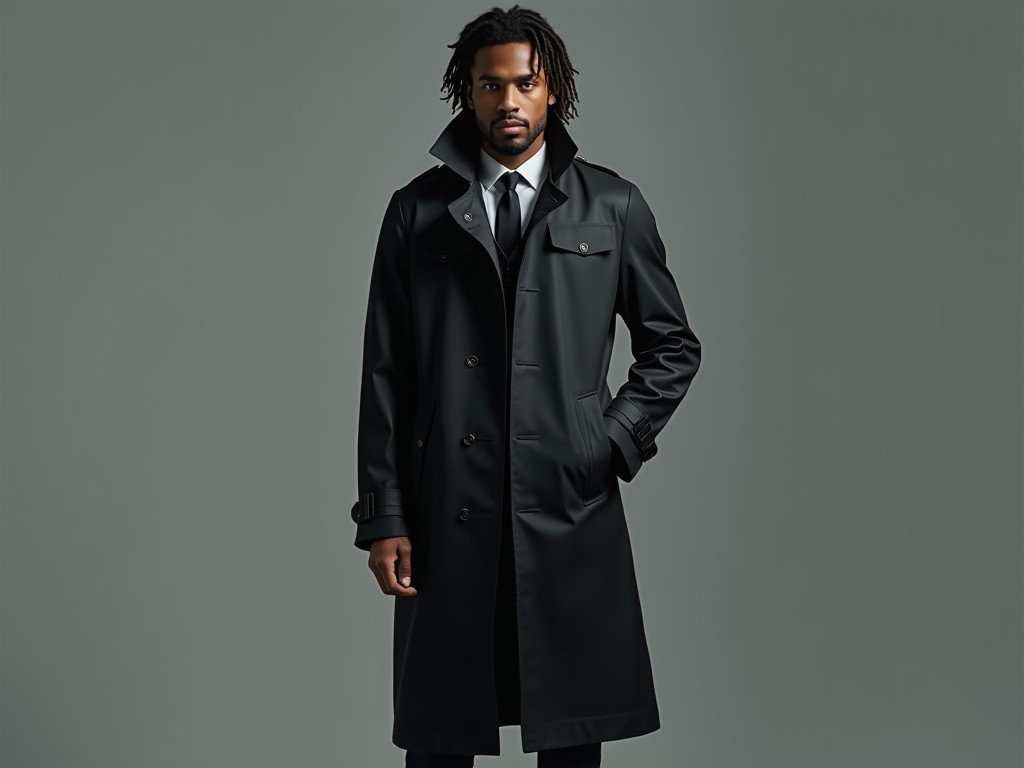
Mens Business Long Rain Trench Coat Top Factory
Mens Business Long Rain Trench Coat Top Factory
Industrial procurement of men's business long rain trench coats requires evaluation of material performance, seam integrity, and dimensional stability under prolonged exposure to moisture and mechanical stress. This product page details the engineering considerations, construction methods, and quality controls relevant to B2B sourcing decisions for corporate outerwear designed for urban commuting and professional environments.
The following sections outline fabric selection criteria, seam sealing techniques, fit standardization processes, and testing protocols that directly impact service life, user comfort, and compliance with workplace dress codes—factors critical to minimizing return rates and ensuring consistent bulk order performance.
Material Composition and Performance Characteristics
The outer shell utilizes a 2.5-layer laminate system consisting of a 100% polyester microfiber face (120 g/m²), a polyurethane membrane with 10,000 mm hydrostatic head resistance, and a protective tricot backing. This construction achieves a moisture vapor transmission rate (MVTR) of 8,000 g/m²/24h, balancing waterproof protection with breathability during active use.
The membrane’s microporous structure prevents liquid water ingress while allowing sweat vapor to escape, reducing internal condensation buildup—a key factor in maintaining wearer comfort during extended wear in fluctuating temperatures. Face fabric abrasion resistance exceeds 25,000 cycles (Martindale), ensuring durability against brief contact with briefcases, door frames, and public transit surfaces.
Seal Integrity and Construction Methods
All critical seams—including shoulder, armhole, side, and pocket junctions—are sealed with 20mm wide polyurethane tape applied via heat bonding at 135°C under controlled pressure. This process achieves a sealed seam water resistance rating of ≥10,000 mm hydrostatic head, matching the membrane’s performance and eliminating needle hole leakage points.
Stitch density is maintained at 8–10 stitches per inch using bonded polyester thread with UV stabilizers, preventing seam degradation from sunlight exposure during storage or intermittent outdoor use. Bar tack reinforcements are applied at stress points such as pocket corners and belt loop attachments, increasing tear strength by approximately 40% compared to standard stitching alone.
Dimensional Stability and Fit Standardization
Pattern grading follows ISO 8559-1 standards for men’s outerwear, with chest, waist, and hip measurements incremented in 2cm intervals across sizes S–3XL. Back length is proportionally scaled to maintain coverage ratio (typically 75–80% of total height) to ensure adequate protection without impeding movement.
Fabric relaxation is pre-accounted for through controlled conditioning (20°C, 65% RH for 24h) prior to cutting, minimizing post-wash dimensional change. Final garments undergo steam pressing to set seams and hem lines, reducing skew and twist in the finished product. Tolerance for length variation is held to ±1.5cm across production lots.
Functional Design Elements
The coat features a two-way front zipper with storm flap and magnetic closure, allowing ventilation adjustment without compromising weather protection. Cuffs are adjustable via dual-position snap fasteners, accommodating layering variations while maintaining seal integrity at the wrist interface.
Internal storage includes two zippered pockets with water-resistant coil zippers and a dedicated document pocket sized for A4 sheets (210 × 297 mm), positioned to prevent creasing during seated use. A hidden interior phone pocket features conductive thread lining for touchscreen compatibility without removal.
Ventilation is managed through underarm eyelets (6mm diameter, laser-cut) protected by hydrophobic mesh inserts, enabling airflow while maintaining rain resistance. These are placed based on thermal mapping data to target high-sweat zones without compromising structural integrity.
Quality Control and Testing Protocols
Each production lot undergoes 100% visual inspection for stitch defects, tape adhesion uniformity, and surface flaws under 500 lux lighting. AQL 2.5 standards are applied for major defects (e.g., open seams, membrane delamination) and AQL 4.0 for minor defects (e.g., slight shade variation, loose threads).
Functional testing includes hydrostatic head testing (JIS L 1092 Method B) on three random specimens per lot, spray rating assessment (AATCC 22) to evaluate surface wetting, and MVTR measurement (ASTM E96 BWC) to confirm breathability retention. Colorfastness to light (ISO 105-B02) and washing (ISO 105-C06) is verified to maintain appearance over 20+ cleaning cycles.
Dimensional change after washing is assessed per ISO 6330, with shrinkage limited to ≤2% in length and ≤1.5% in width. These tests are conducted in-house using calibrated equipment traceable to national standards, with results archived for each batch number.
Customization Options for B2B Buyers
Color matching is available via Pantone or RAL references, with lab-dip approval required before bulk production. Fabric weight can be adjusted between 180–240 g/m² (face + membrane + backing) to balance durability and drape, though changes may affect MVTR and hydrostatic head ratings proportionally.
Logo application options include embroidery (max 8,000 stitches), silicone transfer, or reflective tape integration on sleeves or back yoke—each method evaluated for impact on seam sealing and flexibility. Interior lining color and pocket configuration can be modified to align with corporate identity or functional needs.
Length adjustments (±5cm) and sleeve taper modifications are possible through pattern re-grading, though such changes require revalidation of seam sealing coverage and mobility testing. Minimum order quantities for customizations typically start at 300 units per SKU.
Applications in Professional Environments
This trench coat is engineered for professionals requiring reliable weather protection during daily commutes via public transit, walking, or cycling in urban settings where formal attire is expected. Its streamlined silhouette and neutral color options (navy, charcoal, black) maintain compatibility with business suits and dress shirts without appearing bulky or sport-specific.
The document pocket and internal organization features support users who carry tablets, notebooks, or paperwork between meetings, reducing the need for separate bags. Adjustable cuffs and storm flap allow quick adaptation to sudden weather changes without removing outer layers—a practical advantage in variable climates.
Unlike heavy-duty rain gear designed for industrial sites, this product prioritizes drape, low noise during movement, and a refined aesthetic, making it suitable for client-facing roles, executive transit, and service industries where appearance influences perception. It replaces multiple layers (e.g., overcoat + separate rain shell) with a single garment, simplifying wardrobe management.
| Performance Parameter | Typical Value | Test Standard |
|---|---|---|
| Hydrostatic Head (Outer Shell) | 10,000 mm | JIS L 1092 Method B |
| Moisture Vapor Transmission Rate | 8,000 g/m²/24h | ASTM E96 BWC |
| Seam Seal Water Resistance | ≥10,000 mm | Internal Test (Tape Bond) |
| Abrasion Resistance (Martindale) | >25,000 cycles | ISO 12947-2 |
| Colorfastness to Washing | Grade 4+ (after 20 cycles) | ISO 105-C06 |
Lead time for standard orders ranges from 45–60 days after approval of lab dips and pre-production samples, depending on fabric availability and order complexity. Custom color development or material substitutions may extend this timeline by 2–3 weeks. Samples are available upon request, typically shipped within 7–10 business days via express courier with freight charges applicable.
Packaging options include individual polybagging with silica gel desiccant, bulk packing in corrugated cartons (max 25 pcs/carton), or customized hanging methods for retail-ready presentation. Export packaging adheres to ISTA 3A standards to withstand transit stresses, with corner protection and moisture barriers included for long-haul shipments.
For technical inquiries, sample requests, or quotations, contact our manufacturing team. Provide detailed specifications including required sizes, colors, logo placement, and target delivery date to receive accurate pricing and lead time estimates.