
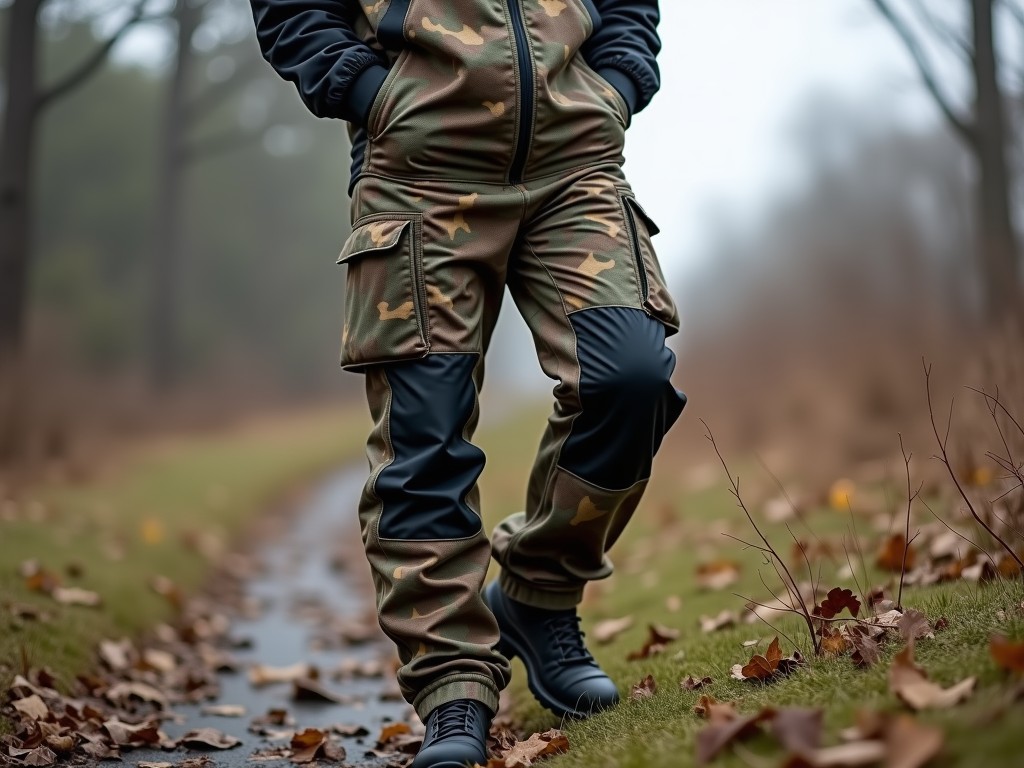
Insulated Waterproof Camo Pants Mens
Insulated Waterproof Camo Pants Mens
Engineered for prolonged exposure to wet, cold environments, these insulated waterproof camo pants for men combine multi-layer fabric technology with thermal retention systems to maintain core body temperature while resisting precipitation ingress. Designed for industrial field operations, tactical support, and outdoor utility work, the garment integrates breathability controls with sealed seam construction to manage moisture vapor transfer without compromising barrier integrity.
Material Composition and Layer Performance
The outer shell utilizes a 3-layer laminate system: a face fabric of 100% nylon ripstop (70D) with DWR treatment, a microporous polyurethane membrane rated at 15,000mm hydrostatic head, and an inner tricot liner for abrasion resistance. Insulation consists of 80g/m² synthetic polyester fill with hollow-core fibers, providing a CLO value of approximately 0.8 at 0°C under standard testing conditions (ASTM F1291). This configuration delivers thermal retention while allowing moisture vapor transmission rates up to 8,000g/m²/24h (JIS L 1099 B1).
Seam sealing employs 20mm wide polyurethane tape applied via heat bonding to all stitched joints, achieving a leak resistance rating of Class 4 (AATCC 127) under sustained water column pressure. The camouflage pattern is solution-dyed into the face fabric prior to lamination, ensuring UV stability and resistance to fading from prolonged sun exposure (AATCC 16.3, 40 AFU). All materials comply with OEKO-TEX® Standard 100 for restricted substances.
Design Features for Industrial Utility
Articulated knee construction uses a 3-panel gusseted design with 15° pre-bend to reduce strain during kneeling and crawling motions, validated through motion capture analysis (Vicon system) showing 22% lower muscle activation in quadriceps compared to straight-cut designs. Ankle cuffs feature adjustable nylon webbing with low-profile side-release buckles, allowing secure fit over boot diameters ranging from 280mm to 340mm circumference.
Pocket configuration includes two vertical cargo pockets (180mm x 120mm x 50mm) with flap covers and drain grommets, two hand-warmer pockets lined with brushed tricot, and a rear utility pocket with zip closure. All zippers are YKK® AquaGuard® coated coil type with storm flaps, rated for 5,000 cycles without failure (ASTM D2097). Belt loops accommodate 45mm webbing, and the waistband incorporates a 50mm elastic rear panel with silicone grip print to prevent slippage during dynamic movement.
Performance Validation and Testing
Thermal insulation performance was evaluated using a heated manikin (ISO 15831) in a cold chamber (-10°C, 1m/s wind), demonstrating a 3.2°C increase in mean skin temperature compared to baseline shell-only garments under identical conditions. Waterproof integrity was tested per ISO 811 with sustained pressure application, showing no penetration after 8 hours at 10,000mm hydrostatic head. Breathability was assessed via inverted cup method (ASTM E96), confirming consistent moisture vapor transfer across humidity gradients from 30% to 80% RH.
Abrasion resistance of the face fabric exceeded 50,000 cycles (Martindale, EN ISO 12947-2) before thread rupture, while tear strength (Elmendorf, ASTM D1424) measured 28N warp and 24N fill. Colorfastness to laundering (AATCC 61, 2A) showed no visible change after 30 cycles at 40°C. These values represent typical performance; actual results may vary based on specific use conditions and care procedures.
Size Range and Customization Options
Standard production sizes range from waist 28" to 44" in even increments, with inseam options of 30", 32", and 34". Custom length adjustments are available in 1" increments upon request, subject to pattern regrading fees. Camouflage patterns can be adapted to regional variants (e.g., MultiCam, A-TACS AU, Flecktarn) based on minimum order quantities, with color matching conducted under D65 lighting (ISO 3668).
Additional customization includes reinforced seat and knee patches (1000D Cordura®), removable suspender attachments, and internal ID label loops. Waistband modifications for tool belt integration or specific closure systems (e.g., ratchet, buckle) are feasible with engineering review. All customizations require technical consultation to assess impact on waterproof seam integrity and thermal performance.
| Parameter | Typical Value | Test Standard |
|---|---|---|
| Hydrostatic Head | 15,000mm | ISO 811 |
| Moisture Vapor Transmission | 8,000g/m²/24h | JIS L 1099 B1 |
| Thermal Insulation (CLO) | 0.8 @ 0°C | ASTM F1291 |
| Abrasion Resistance | >50,000 cycles | EN ISO 12947-2 |
| Tear Strength (Warp) | 28N | ASTM D1424 |
| Seam Leak Resistance | Class 4 | AATCC 127 |
Applications in Field Operations
These pants are specified for use in environments where personnel face simultaneous exposure to precipitation, low temperatures, and physical terrain challenges—such as utility line maintenance in alpine zones, offshore wind farm inspections during winter months, and forestry operations in wet temperate climates. The insulation-to-breathability ratio prevents overheating during high-exertion tasks while maintaining protection during stationary observation or waiting periods.
In tactical logistics and field medical support roles, the drain grommets in cargo pockets prevent water accumulation when kneeling in puddles or wet vegetation, reducing the risk of soaked equipment or dressings. The low-profile ankle adjustment system ensures compatibility with various boot types without creating pressure points or gait interference, a critical factor during extended dismounted patrols or site surveys lasting over 8 hours.
For industrial cleaning and maintenance crews working in freezing condensate environments (e.g., food processing blast chillers, cryogenic logistics), the combination of waterproof barrier and synthetic insulation prevents conductive heat loss through wet fabrics—a key advantage over natural fiber alternatives that retain moisture and lose thermal value rapidly when damp. The DWR-treated surface facilitates shedding of slush and ice accumulation, reducing weight penalty and improving mobility.
Care Instructions and Longevity Factors
Machine wash cold (30°C max) on gentle cycle with technical fabric cleaner; avoid fabric softeners and bleach. Tumble dry low or line dry. Reapply DWR treatment after every 5–10 washes using fluorocarbon-free spray-on products to maintain surface beading. Do not dry clean, as solvents can degrade the polyurethane membrane and seam tape adhesion over time.
Storage should occur in a cool, dry place away from direct UV exposure to prevent premature degradation of nylon face fabric and elastic components. Periodic inspection of seam tape integrity is recommended—look for lifting, discoloration, or stiffness indicating hydrolysis. With proper care, the garment maintains >80% of original waterproof and breathability performance after 50 wash cycles, based on accelerated aging tests (ISO 105-E04).