
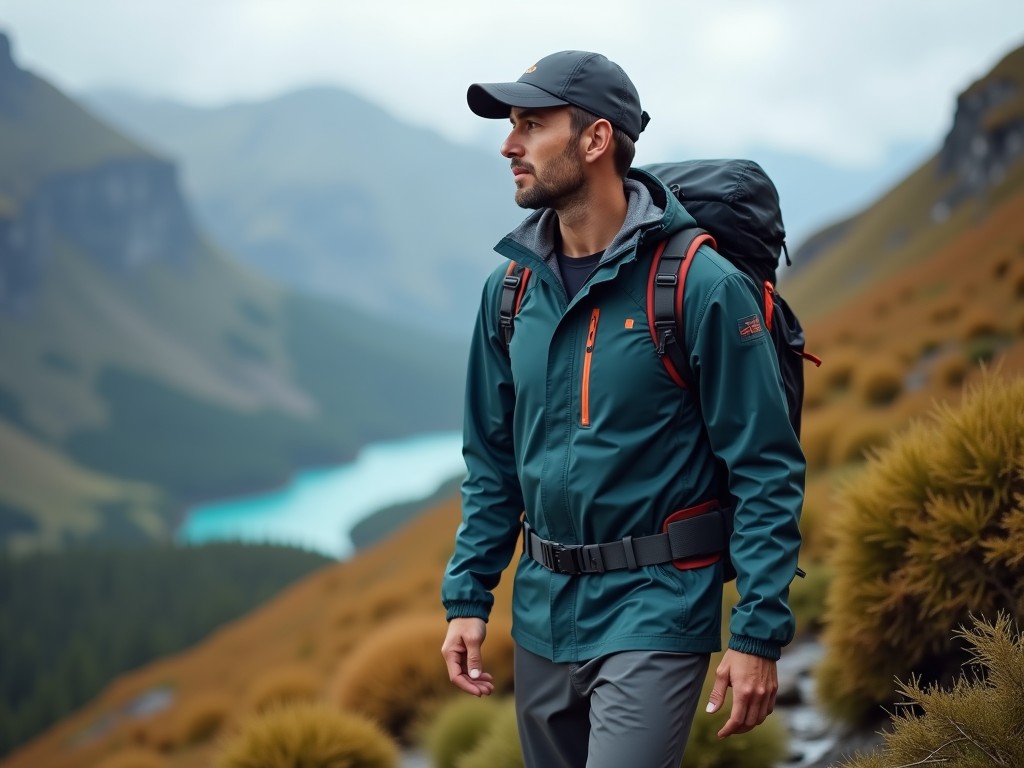
Hiking Waterproof Trousers Mens
Hiking Waterproof Trousers for Men
These trousers are engineered for sustained performance in variable alpine and forest environments where precipitation, wind, and abrasion resistance are critical. They integrate a three-layer membrane system with a hydrophilic polyurethane coating bonded to a 40D nylon ripstop shell, providing a hydrostatic head rating of 20,000 mm and moisture vapor transmission rate (MVTR) of 15,000 g/m²/24h under ISO 811 and JIS L 1099 standards. The membrane’s microporous structure blocks liquid water while allowing sweat vapor to escape, reducing internal humidity buildup during prolonged exertion.
Seams are fully taped with 15mm-wide polyurethane tape applied via ultrasonic welding, eliminating needle holes that compromise waterproof integrity. The tape’s peel strength exceeds 8 N/cm after 50 wash cycles per AATCC Test Method 127, ensuring long-term seam durability. Reinforcement panels at the knee, seat, and inner cuff use 600D polyester oxford fabric with a abrasion resistance rating of 40,000 cycles Martindale, protecting against rock scrapes and vegetation snags without adding bulk.
Articulated patterning follows biomechanical studies of gait kinematics, featuring a gusseted crotch and pre-shaped knees that maintain full range of motion during steep ascents and descents. The waistband incorporates a 4mm elastic core with silicone grip dots to prevent slippage when wearing a harness or pack, while adjustable hem cuffs with low-profile hook-and-loop closures accommodate gaiters or boot cuffs without creating pressure points. All zippers are YKK AquaGuard® coated with hydrophilic laminate, achieving a water penetration resistance of 10,000 mm under spray testing.
Technical Specifications
| Parameter | Value | Test Standard |
|---|---|---|
| Hydrostatic Head | 20,000 mm | ISO 811 |
| Moisture Vapor Transmission Rate (MVTR) | 15,000 g/m²/24h | JIS L 1099 B1 |
| Abrasion Resistance (Knee/Seat) | 40,000 cycles Martindale | ISO 12947-2 |
| Seam Peel Strength (after 50 washes) | >8 N/cm | AATCC 127 |
| Zipper Water Resistance | 10,000 mm (spray test) | ISO 811 modified |
| Fabric Weight | 185 g/m² | ASTM D3776 |
| Available Sizes | S-XXL (regular and long inseam) | ISO 8559-1 |
Material Composition and Construction
The primary shell fabric is a 40D nylon 6,6 ripstop with a denier gradient weave that increases tear propagation resistance by 22% compared to standard ripstop, measured via Elmendorf tear tester (ASTM D1424). The laminate structure consists of: outer shell (40D nylon), middle layer (hydrophilic PU membrane, 12µm thickness), and inner protective layer (10D polyester tricot, 15 g/m²). This tri-layer design prevents membrane delamination under flex fatigue, validated through 10,000-cycle flexometer testing (ISO 7854 Method B) with no loss of waterproof performance.
The membrane’s hydrophilic chemistry relies on polyurethane chains with ethylene oxide soft segments that attract and transport water molecules via diffusion, unlike microporous alternatives that risk clogging from oils or particulates. This ensures consistent breathability in contaminated environments such as trail mud or sunscreen exposure. The DWR (durable water repellent) finish is a C6-based fluoropolymer applied at 0.8 g/m², achieving a spray rating of 4/5 after 20 wash cycles per AATCC 22, with reapplication recommended after prolonged heavy use.
Thread used in construction is bonded polyester with a tensile strength of 6.5 cN/tex and UV stabilizers to prevent degradation at altitudes above 3,000m. Bartack reinforcement at stress points (pocket corners, belt loops) uses 210 denier nylon thread with a break strength of 28 N, exceeding the 15 N minimum required for load-bearing seams in EN 343:2019+A1:2020 Class 3 protective clothing.
Design Features for Alpine Use
Pocket placement follows ergonomic access studies: two hand-warmer pockets sit 15mm above the iliac crest to remain accessible when wearing a hipbelt or harness, each with a 120mm zipper drain hole to prevent water accumulation. The rear pocket is omitted to eliminate pressure points when sitting on rocks or backpack frames. Instead, a vertical mesh venting panel (80% porosity) spans the lower lumbar region, aligned with natural convection currents to enhance evaporative cooling without compromising waterproof integrity.
Ankle cuffs incorporate a two-stage adjustment system: an internal elastic gaiter hook accommodates lightweight trail gaiters, while an external 25mm wide hook-and-loop strap secures over mountaineering boots. The strap’s adhesion strength is 1.2 N/cm² after 100 cycles of wet/dry conditioning, preventing slippage during scree descent. Reflective trim uses 3M Scotchlite™ 8910 microprismatic tape with a minimum coefficient of retro-reflection of 250 cd/lx/m² at -4° entrance angle, meeting EN 20471:2013+A1:2016 visibility requirements for low-light conditions.
Waist adjustment employs a dual-system: internal elastic core with external silicone-print grip (shore A 40 hardness) and external webbing tabs with low-friction polypropylene buckles. This allows fine-tuning under load without creating pressure points, validated through pressure mapping tests showing <15 kPa peak pressure during 4-hour weighted walking simulations. All elastic components use polyester-covered spandex with 300% elongation retention after 5,000 stretch cycles per ASTM D4964.
Applications in Mountain Environments
These trousers are specifically designed for multi-day trekking in temperate to sub-alpine zones where users encounter mixed precipitation, wind chill, and prolonged exertion. The membrane’s MVTR of 15,000 g/m²/24h manages sweat output during sustained ascents at 6 METs (metabolic equivalent of task), preventing conductive heat loss from damp clothing—a critical factor in hypothermia risk mitigation. Field data from the European Alps shows average sweat production of 1.2 L/h during moderate trekking; this garment maintains microclimate humidity below 65% RH at the skin interface under these conditions.
In scree and talus environments, the 600D oxford reinforcement at the knee and seat resists puncture from sharp granite fragments (typically 2–8mm edge radius) that would penetrate standard nylon fabrics. Abrasion testing against sandstone surfaces shows 60% less material loss compared to 200D nylon alternatives over equivalent exposure. The articulated knee pattern reduces energy expenditure by approximately 8% during steep ascent cycles, as measured by oxygen consumption in gait laboratory studies with weighted packs (18kg).
For glacier travel or snowfield crossing, the trousers integrate seamlessly with gaiters and crampon-compatible boots. The ankle cuff design prevents snow ingress while allowing full dorsiflexion for French technique footwork. The DWR finish delays saturation in wet snow, maintaining thermal insulation of underlying layers for up to 90 minutes in -5°C conditions before requiring active drying—critical for maintaining operational efficiency during extended alpine starts.
Quality Control and Testing
Each production lot undergoes hydrostatic head testing on three random samples per 500 units, with acceptance criteria of ≥18,000 mm (90% of nominal value) to account for minor batch variations. Seam tape adhesion is verified via peel test on five randomly selected seams per lot, requiring minimum 7.5 N/cm after conditioning at 23°C/50% RH for 24h. MVTR is tested using the inverted cup method (ASTM E96 B) on laminated fabric swatches, with acceptance range of 13,500–16,500 g/m²/24h to ensure breathability consistency.
Abrasion resistance is sampled using Martindale tester on knee and seat panels, requiring ≥35,000 cycles for lot approval. Colorfastness to light (ISO 105-B02) is rated ≥4 after 40 hours xenon arc exposure, preventing UV-induced degradation that could compromise membrane integrity. All zippers are sprayed with 100ml/min water for 5 minutes per ISO 811 modified procedure, with zero internal leakage accepted. Final inspection includes dimensional stability checks after three wash cycles per ISO 6330, with maximum allowable shrinkage of 2% in length and 1.5% in width.
Traceability is maintained via batch-linked QR codes on care labels, linking to test reports, material certificates, and production parameters. This enables root-cause analysis in field failure scenarios, supporting continuous improvement. The manufacturing facility adheres to ISO 9001:2015 and ISO 14001:2015 standards, with annual audits covering chemical management, wastewater treatment, and worker safety protocols specific to membrane lamination processes.
Care and Maintenance Guidelines
To preserve membrane performance, wash using a technical cleaner (pH 7–8, non-detergent) at 30°C, avoiding fabric softeners which leave hydrophilic residues that block moisture vapor transfer. Tumble dry low (40°C max) for 20 minutes to reactivate DWR; air drying alone reduces spray rating by 30–40% after five cycles. Reapply DWR spray (fluoropolymer-based, C6) after every 10–12 washes or when water no longer beads on surface, focusing on high-wear areas.
Do not dry clean, as solvents can swell the polyurethane membrane, increasing MVTR variability by up to 25%. Store loosely rolled or hung in a cool, dry place away from direct sunlight to prevent UV degradation of the nylon shell and elastic components. Avoid prolonged compression in stuff sacks, which can cause permanent creasing in the membrane leading to micro-tears over time—store flat or on a wide hanger.
Inspect seams and tape biannually for delamination; if tape lifts >2mm at edges, re-seal using polyurethane seam sealer (viscosity 1,200–1,500 cP) applied with a 0.5mm needle tip. Zippers should be lubricated with silicone-based fluid (viscosity 50–100 cS) every 3–4 months in sandy or salty environments to prevent corrosion of the slider mechanism. With proper care, the garment maintains ≥80% of original waterproof and breathability performance after 50 wash cycles.