
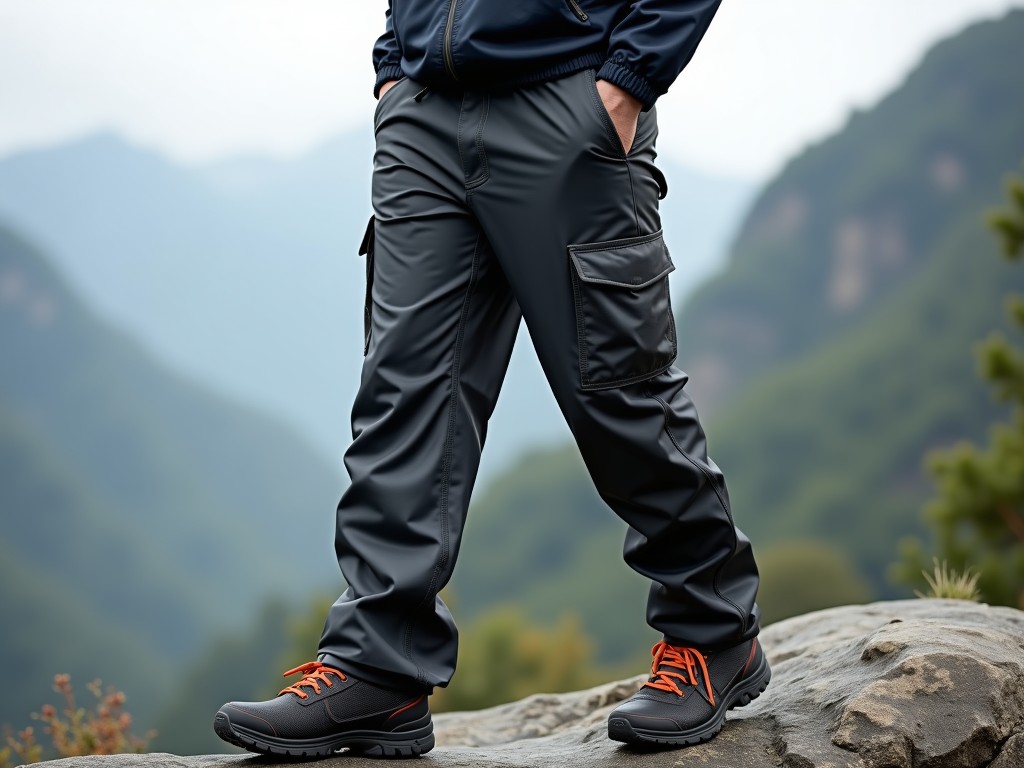
Direct Factory Mens Rain Pants For Hiking
Direct Factory Men's Rain Pants for Hiking
Direct factory men's rain pants for hiking are engineered as a lightweight, packable barrier against precipitation while maintaining mobility and breathability during extended trail use. These garments are manufactured without intermediary markups, allowing specifications to be tailored to performance requirements such as water column rating, seam sealing methodology, and fabric weight—critical factors for procurement teams evaluating technical apparel for outdoor operations or workforce deployment in variable climates.
Unlike retail-focused designs, industrial-grade rain pants prioritize functional durability over aesthetic trends, utilizing materials and construction methods validated for repeated use in demanding conditions. This approach reduces long-term replacement risk and supports consistent performance across teams or distribution channels requiring reliable wet-weather protection.
Material Selection and Performance Characteristics
The primary fabric is typically a 2.5-layer or 3-layer nylon or polyester laminate with a polyurethane (PU) or polytetrafluoroethylene (PTFE) membrane, selected based on the required balance between waterproofness, vapor permeability, and abrasion resistance. Water column ratings commonly range from 5,000 mm to 20,000 mm, with higher values indicating greater resistance to water penetration under static pressure—critical for prolonged exposure to heavy rain or snowmelt.
Breathability is measured via moisture vapor transmission rate (MVTR), often expressed in grams per square meter over 24 hours (g/m²/24h). Industrial specifications frequently target MVTR values between 5,000 and 15,000 g/m²/24h to manage perspiration during aerobic activity without causing internal condensation buildup.
Face fabric denier typically falls between 40D and 70D, offering a trade-off between tear strength and pack weight. Reinforcements in high-wear areas such as the seat, knees, and inner cuffs may use higher denier nylon (e.g., 100D–200D) or abrasion-resistant coatings to extend service life in brush-heavy or rocky terrains.
Construction and Seam Integrity
Fully taped seams are standard in technical rain pants, where waterproof tape is applied over stitched seams using heat activation to prevent capillary leakage. The tape width and adhesion strength are calibrated to match the fabric’s flexibility and expected flex cycles—typically rated for a minimum of 500 flex cycles without delamination in laboratory testing.
Stitching uses polyester or nylon thread with a minimum tensile strength of 4.5 N/tex, selected for UV resistance and minimal moisture absorption. Stitch density ranges from 8 to 12 stitches per inch, balancing seam strength with needle hole minimization to preserve the membrane’s integrity.
Zippers are typically coil-type with polyurethane coating or laminated flaps, featuring water-resistant sliders and drain holes to mitigate water ingress. YKK® or equivalent brands are commonly specified due to documented cycle life exceeding 10,000 operations, though exact specifications are customized based on end-use duration and environmental exposure.
Design Features for Hiking and Mobility
Articulated knee construction involves pre-bending the fabric pattern during cutting to reduce strain when walking or climbing, improving range of motion by up to 15% compared to flat-cut patterns in dynamic movement simulations. Gusseted crotch inserts, typically diamond-shaped and made from the same laminated fabric, prevent binding and reduce seam stress during wide strides or squatting motions.
Ankle closures use adjustable hook-and-loop straps or elastic cord locks with barrel stops, allowing users to seal the pant cuff over boot tops or tighten it to prevent snow or debris entry. Adjustment range typically spans 25mm to 40mm of effective circumference change, accommodating variations in boot shaft height and gaiter use.
Waist systems incorporate partial or full elasticization with internal drawcords, often featuring low-profile cord locks to minimize snagging. Rise height is designed to overlap with jackets or midlayers, typically measuring 28cm to 32cm in the rear to prevent exposure during reaching or lifting motions—critical for maintaining thermal efficiency in layered systems.
Packability and Storage Considerations
Packability is a key procurement factor for distributed teams or emergency kits, where volume and weight directly impact logistics. These rain pants are designed to compress into a stuff sack or internal pocket, with typical packed dimensions ranging from 10cm × 15cm × 5cm to 15cm × 20cm × 8cm depending on fabric thickness and insulation layer presence.
Weight specifications generally fall between 180g and 350g for size M, measured without accessories. Ultralight variants under 200g use thinner face fabrics and minimal hardware, while models exceeding 300g often include added reinforcement, longer zippers, or insulated liners for colder climates—trade-offs that must be evaluated based on mission profile and expected weather severity.
Stuff sacks are typically made from the same face fabric or a lighter nylon ripstop, featuring a coated cord lock closure. Some designs integrate the sack into a zippered pocket, reducing the risk of loss and simplifying deployment during sudden weather changes—a feature valued in field operations where response time is critical.
Customization Options for Industrial Buyers
Direct factory sourcing enables specification adjustments beyond standard catalog offerings, including custom waterproof-breathable membrane types, seam tape colors for team identification, and tailored inseam lengths in 25mm increments to accommodate diverse anthropometric data. Pocket configurations can be modified—such as adding internal mesh pockets for gloves or external flap-covered pockets for map storage—based on operational workflows.
Color options extend beyond standard neutrals to include high-visibility tones (e.g., ANSI/ISEA 107-compliant fluorescent yellow or orange) with optional retroreflective tape patterning for low-light safety compliance. Custom Pantone matching is available for corporate branding, though colorfastness testing under UV exposure and repeated washing is recommended to ensure long-term appearance stability.
Additional customizations include articulated seat panels for kneeling tasks, reinforced kick patches made from Cordura® or equivalent nylon for abrasion resistance in rocky terrain, and integrated snow gaiter hooks for alpine use. All modifications are subject to minimum order quantities and tooling considerations, which are discussed during the quotation phase to align cost with performance requirements.
Quality Control and Testing Protocols
Factory quality control includes inline inspections at cutting, sewing, taping, and final assembly stages, with AQL (Acceptable Quality Level) standards typically set at 2.5 for major defects and 4.0 for minor defects per ISO 2859-1. Critical checkpoints include seam tape adhesion strength (measured in N/cm using peel tests), waterproofness verification via hydrostatic head testing, and functional assessment of zippers and closures.
Final audit testing may involve dynamic spray testing (e.g., ISO 105-E04) to simulate wind-driven rain, wear abrasion testing using Martindale or Taber methods, and dimensional stability checks after multiple wash cycles at 30°C or 40°C. Reports are available upon request, detailing batch-specific results for traceability in supply chain audits or regulatory compliance.
Traceability systems track raw material lot numbers, production line assignments, and operator IDs, enabling rapid isolation of non-conforming batches. Third-party certifications such as bluesign® or OEKO-TEX® Standard 100 may be available depending on material selection and are verified through documentation rather than assumed—industrial buyers are advised to confirm specific certification status during sourcing discussions.
| Parameter | Typical Range | Notes |
|---|---|---|
| Water Column Rating | 5,000 – 20,000 mm | Higher values = better resistance to water penetration |
| MVTR (Breathability) | 5,000 – 15,000 g/m²/24h | Measures moisture vapor transmission; higher = better breathability |
| Fabric Weight (Face) | 40D – 70D nylon/polyester | Denier affects tear strength and pack weight |
| Packed Weight (Size M) | 180g – 350g | Varies with features and insulation |
| Seam Tape Adhesion | ≥ 1.5 N/cm (peel strength) | Measured after heat activation and aging |
For procurement teams evaluating technical rain pants, requesting a sample lot with documentation of material test reports, seam integrity data, and sizing charts is recommended before full production commitment. This allows validation of performance claims under expected environmental conditions and verification of fit across target user groups.
Lead times typically range from 4 to 8 weeks after sample approval and tooling confirmation, depending on fabric availability and order complexity. Shipping terms are flexible, with options for FOB factory, CIF port, or DDP delivery to named destinations—details confirmed during quotation to align with logistics planning and inventory turnover goals.