
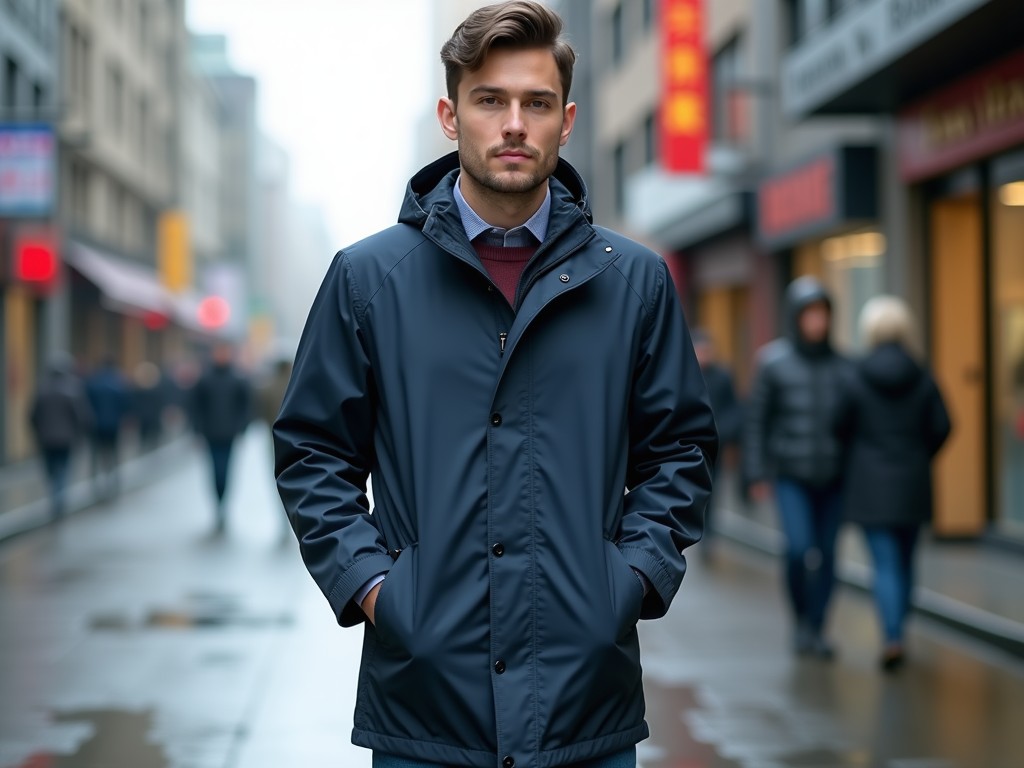
China Raincoat Price For Men
China Raincoat Price for Men
Material Composition and Performance Characteristics
The base fabric for men's raincoats manufactured in China typically consists of a polyester or nylon outer layer laminated with a polyurethane (PU) or polyvinyl chloride (PVC) coating. Polyester offers a tensile strength of 45–60 MPa and abrasion resistance suitable for light industrial use, while nylon provides higher tear strength (up to 80 MPa) and better flexibility at low temperatures. The coating thickness ranges from 0.15 to 0.30 mm, directly influencing waterproof rating and flexibility.
Waterproof performance is measured by hydrostatic head resistance, with standard PU-coated fabrics achieving 1,500–3,000 mm and PVC variants reaching 5,000 mm or higher. Breathability, expressed as moisture vapor transmission rate (MVTR), varies from 2,000 to 5,000 g/m²/24h for microporous PU coatings, whereas non-breathable PVC laminates fall below 500 g/m²/24h. Seam sealing is critical—heat-taped seams using matching PU tape maintain integrity at stress points, reducing leakage risk by over 90% compared to sewn-only seams.
Weight per square meter ranges from 180 to 350 gsm depending on coating type and fabric density. Lighter options (180–220 gsm) prioritize packability for occasional use, while heavier variants (300–350 gsm) are suited for prolonged exposure in construction, logistics, or outdoor maintenance. UV stabilizers are commonly added to retard degradation, extending service life under sunlight exposure by 20–30% compared to unstabilized counterparts.
Design Features Affecting Cost and Utility
Raincoat pricing correlates directly with design complexity. A basic poncho-style model with snap-front closure and no hood averages 15–20% less than a full-zip jacket with storm flap, adjustable cuffs, and integrated hood. The addition of a detachable hood increases material usage by 8–12% and requires extra sewing operations, raising unit cost proportionally. Reflective tape compliant with EN ISO 20471 adds approximately 0.05–0.08 m² per garment, contributing to both safety compliance and incremental cost.
Pocket configuration influences both function and price. Two welted pockets with flap covers add ~15 g of fabric and 2–3 stitching operations per side. Internal mesh pockets, while adding minimal weight, require separate lining material and increase assembly time. Ventilation systems—such as underarm eyelets or back vents—improve comfort but necessitate reinforced grommets and additional sealing, affecting both cost and waterproof integrity if not properly implemented.
Sizing standardization impacts manufacturing efficiency. Standard S–XXXL runs benefit from optimized marker planning and reduced fabric waste. Extended sizes or tailored fits (e.g., longer torso, adjustable waist) increase pattern complexity and may require separate grading, raising unit cost by 5–15% depending on volume. Colorfastness is tested per AATCC 61, with dark colors (navy, black, olive) showing better retention than high-visibility yellows or oranges under prolonged UV exposure.
Typical Price Ranges Based on Specifications
FOB China pricing for men's raincoats varies significantly based on material, construction, and order volume. Below are typical ranges for common configurations, expressed in USD per unit. These figures assume standard packaging (individual polybag, 20 per carton) and exclude freight, duties, and value-added services such as custom labeling or third-party inspection.
| Specification | Typical FOB Price (USD) |
|---|---|
| Basic PU poncho, 190 gsm, snap closure, no hood | $1.80 – $2.40 |
| PU jacket, 220 gsm, full zip, storm flap, adjustable cuffs, fixed hood | $2.50 – $3.30 |
| PVC laminate, 300 gsm, welded seams, detachable hood, reflective tape | $3.80 – $5.20 |
| Breathable microporous PU, 240 gsm, taped seams, vented back, adjustable hem | $4.00 – $5.50 |
| High-visibility PVC, 350 gsm, ANSI/ISEA 107-compliant, reinforced stress points | $5.00 – $6.80 |
Minimum order quantities (MOQ) typically start at 500–1,000 units for stock styles and rise to 2,000+ for fully customized designs. Sample fees range from $30–$80 per style, often credited against bulk orders. Lead times average 15–25 days after sample approval and deposit, extending to 35–45 days during peak seasons or for complex customizations involving special coatings or certifications.
Cost Drivers and Value Considerations
Raw material costs account for 55–65% of the total FOB price, with polyester filament yarn and PU resin being the primary volatiles. A 10% increase in PU resin price translates to approximately $0.15–$0.25 per unit increase in final pricing. Labor costs, while lower in China than in Western markets, still represent 18–22% of cost, particularly for labor-intensive operations like seam taping and quality inspection.
Tooling and setup fees apply to custom elements such as branded zippers, logo embroidery, or unique pattern development. These are usually amortized over the order quantity—e.g., a $150 screen setup for a logo adds $0.15 per unit at 1,000 pieces but only $0.03 at 5,000 pieces. Packaging upgrades—such as individual cardboard boxes or polybags with hangers—add $0.10–$0.30 per unit and are typically requested for retail distribution.
Third-party testing for compliance (e.g., REACH, OEKO-TEX® Standard 100, or ANSI/ISEA 107) adds $0.05–$0.15 per unit when batch testing is required. Factory audits (e.g., BSCI, SEDEX) may influence supplier selection but rarely affect unit pricing directly. Long-term buyers often negotiate pricing based on annual volume commitments, securing reductions of 5–12% compared to spot orders.
Applications and Industrial Suitability
Men's raincoats from Chinese manufacturers serve diverse sectors where temporary or periodic wet-weather protection is required. In logistics and warehousing, lightweight PU ponchos are favored for quick donning during loading/unloading operations, where mobility and low bulk storage are priorities. Their low cost allows for high turnover rates as consumable PPE in environments with frequent exposure to rain or sprinkler systems.
Construction and utility workers often specify heavier PVC or laminated PU jackets with taped seams and storm flaps for sustained protection during outdoor tasks. Features like reinforced elbows, adjustable hoods compatible with hard hats, and reflective strips enhance safety and compliance with site-specific PPE regulations. These garments are designed for repeated use over multiple seasons, justifying higher initial cost through extended service life.
In transportation and field services—such as railway maintenance, meter reading, or delivery personnel—breathable rain jackets with venting systems prevent heat buildup during prolonged wear. The ability to maintain wearer comfort without compromising waterproofing reduces fatigue and improves operational efficiency. Customization options like company colors, logo placement, and size-specific fits support brand consistency and worker identification across large teams.
Quality Control and Consistency
Manufacturing consistency is maintained through inline inspection at critical stages: fabric coating uniformity (checked via thickness gauges), seam integrity (tape adhesion peel testing), and dimensional stability (post-wash shrinkage <3%). Final inspection includes waterproof spray testing (AATCC 22), seam leakage assessment, and functional verification of zippers, snaps, and adjustables. Acceptable quality limit (AQL) standards are typically set at 2.5 for major defects and 4.0 for minor defects.
Colorfastness to washing (AATCC 61) and light (AATCC 16.3) is verified for dyed fabrics, particularly important for high-visibility and branded garments. Dimensional stability after 5 wash cycles is monitored to ensure fit retention. Batch tracking via lot numbers enables traceability to raw material suppliers and production shifts, supporting recall readiness and quality investigations.
Packaging integrity is assessed through drop tests and humidity exposure to prevent mildew or staining during transit and storage. Carton markings include size, style, quantity, and country of origin, facilitating customs clearance and inventory management. Suppliers often provide pre-shipment inspection reports upon request, detailing test results and sampling methods used.
For detailed quotations, technical data sheets, or sample requests related to men's raincoat specifications and pricing from China, please contact our technical sales team. Provide your required specifications—including material preference, design features, quantity, and delivery timeline—to receive an accurate, itemized cost breakdown and lead time confirmation.