
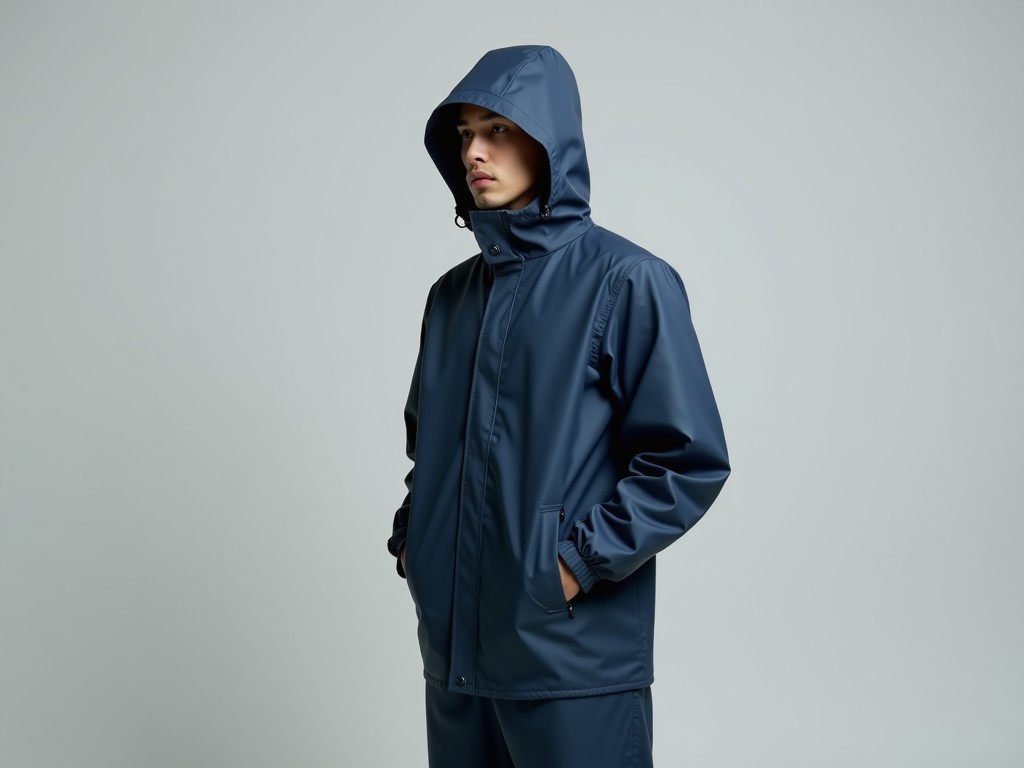
China One Piece Rain Suit For Men
China One Piece Rain Suit for Men
A one piece rain suit for men provides full-body protection against precipitation through a single integrated garment combining jacket and trousers. This design eliminates gaps at the waistline, reducing water ingress during prolonged exposure to rain, wind, or splashes in industrial environments. For procurement engineers evaluating protective workwear, understanding the construction, material properties, and application limits of such suits is essential to minimize risk and ensure worker comfort.
Material Composition and Performance Characteristics
The primary material used in these rain suits is typically PVC-coated polyester or PU-coated nylon, selected for its balance of waterproofing, flexibility, and durability. PVC coatings offer high resistance to water penetration (often exceeding 5,000 mm hydrostatic head) and good chemical resistance to oils and mild acids, while PU coatings provide better flexibility at low temperatures and reduced stiffness. The base fabric, usually 200D–300D polyester or nylon, contributes tear strength ranging from 20–35 N in warp and weft directions, measured per ASTM D5034.
Seams are thermally welded or taped with waterproof tape to maintain continuity of the barrier; stitching alone is avoided as it creates capillary pathways for water. The coating thickness generally ranges from 0.15–0.25 mm, influencing both weight (typically 180–250 g/m²) and flexibility. Breathability is limited in these materials, so designs often include vented back flaps or mesh-lined underarms to manage internal moisture buildup during physical exertion.
Design Features for Industrial Use
The one piece construction features a continuous torso section with attached trousers, connected via a durable, waterproof zipper covered by a storm flap with hook-and-loop closure. This flap prevents water from migrating along the zipper teeth. The hood is integrated into the collar and designed to accommodate a hard hat, with adjustable drawcords at the face opening and rear to secure fit without obstructing vision.
Cuffs at the wrists and ankles are typically elasticized or fitted with adjustable snap closures to seal against water ingress while allowing movement. Reinforced patches are commonly added at high-wear areas such as the knees, seat, and elbows, using additional layers of coated fabric or abrasion-resistant overlays (e.g., 420D nylon) to extend service life in rough environments.
Typical Applications in Industrial Settings
These suits are commonly used in industries where workers face intermittent or prolonged exposure to rain, such as maritime operations, offshore wind maintenance, wastewater treatment plant inspections, and outdoor utilities work. In maritime contexts, the suit protects crew during deck operations in heavy spray or rain, where separating jacket and trousers could allow water entry at the waist during bending or climbing.
For wastewater personnel, the suit provides a barrier against contaminated runoff and splashes during manhole access or pipe repair, with the one piece design preventing wicking of liquids into inner clothing. In utility work, such as power line maintenance during storms, the suit’s wind resistance and full coverage help maintain core temperature and reduce fatigue from wind chill and dampness.
Comparison with Two-Piece Rain Ensembles
Compared to separate jacket and trousers, the one piece suit reduces potential leakage points by eliminating the waist interface. In two-piece systems, even with overlapping designs, water can penetrate during prolonged bending, squatting, or when external pressure is applied (e.g., leaning against a wet surface). The integrated design maintains a continuous hydrophobic barrier across the torso.
However, two-piece systems offer greater flexibility in layering and ventilation, as users can remove the jacket independently in warmer conditions. One piece suits may retain more heat due to reduced airflow at the waist, making them less suitable for high-intensity work in mild rain unless equipped with vents. Sizing is also more critical in one piece designs, as improper fit in the torso or crotch cannot be compensated by adjusting separate components.
Quality Control and Manufacturing Considerations
Production involves cutting the coated fabric to pattern, followed by assembly using either heat-sealing or sewing with subsequent tape application over seams. Heat-sealing is preferred for continuous filament materials as it maintains coating integrity, while sewing requires specialized waterproof thread and post-seam taping to prevent leakage. Each seam is typically inspected visually and via water spray testing (e.g., AATCC 35) to verify resistance.
Dimensional stability is checked after coating curing to ensure minimal shrinkage (<2%) that could affect fit. Colorfastness to light and washing is evaluated per ISO 105-B02 and ISO 105-C06, particularly for high-visibility variants using fluorescent yellow or orange coatings. Final inspection includes checking zipper functionality, storm flap adhesion, and elastic recovery of cuffs after 100 stretch cycles.
Customization Options
Manufacturers commonly offer adjustments to suit specific operational needs. Hood dimensions can be modified to accommodate different hard hat models or to include integrated face shields. Sleeve and trouser lengths are adjustable in 5 cm increments to fit diverse worker statures without requiring full pattern changes.
Reinforcement patches can be relocated or resized based on identified wear points from field feedback. Reflective tape compliant with EN ISO 20471 can be added to shoulders, sleeves, and legs for low-visibility conditions. For chemical resistance requirements, the base coating can be switched from PVC to specialized PU formulations or fluoropolymer blends upon request, with corresponding adjustments to seam sealing methods.
| Feature | Typical Range | Notes |
|---|---|---|
| Hydrostatic Head | 5,000–10,000 mm | Measures water penetration resistance |
| Fabric Weight | 180–250 g/m² | Influences durability and flexibility |
| Tear Strength (Warp/Weft) | 20–35 N | Per ASTM D5034 on base fabric |
| Coating Thickness | 0.15–0.25 mm | Affects stiffness and waterproofing |
| Available Sizes | S–3XL | Custom sizing available upon request |
Selecting the appropriate rain suit requires matching material properties and design features to the specific environmental hazards and physical demands of the job. Engineers should consider not only the waterproof rating but also the suit’s flexibility, seam integrity, and compatibility with other PPE such as hard hats, gloves, and safety boots. A well-chosen one piece suit reduces the likelihood of skin exposure to water or contaminants, contributing to both comfort and safety compliance.
For technical specifications, sample requests, or to discuss customization for your operational environment, contact our engineering team.
Request Technical Consultation