
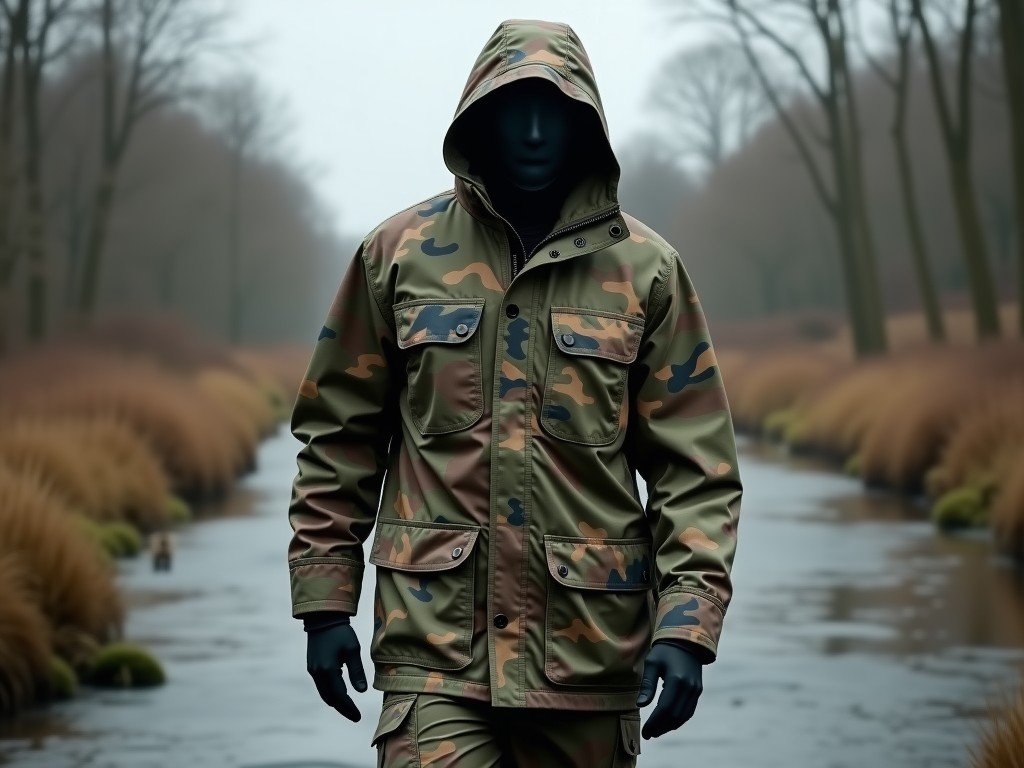
Camo Waterproof Over Trousers
Camo Waterproof Over Trousers
Camo waterproof over trousers are designed as an external protective layer worn over standard work or tactical trousers to provide resistance against precipitation, wind, and abrasion while maintaining camouflage effectiveness in field environments. Unlike integrated waterproof trousers, over trousers are intended for intermittent use—deployed when weather conditions deteriorate and stowed when not needed—making them suitable for operations where weight, packability, and rapid deployment are critical. Their primary function is to prevent saturation of underlying layers, which can lead to heat loss, reduced mobility, and degradation of camouflage patterns due to water-induced darkening or gloss. Effective over trousers balance waterproof integrity with breathability to manage moisture vapor from perspiration, avoiding internal condensation that compromises comfort and thermal regulation.
Material selection focuses on laminated or coated fabrics where a waterproof membrane (such as polyurethane or PTFE-based films) is bonded to a durable outer shell, typically nylon or polyester ripstop, treated with a durable water repellent (DWR) finish. The camouflage pattern is either printed directly onto the outer layer or integrated into the fabric during manufacturing to ensure it remains visible and effective even when wet. Seams are sealed using tape or welding to prevent water ingress through stitch holes, a critical detail often overlooked in lower-spec garments. Design features such as full-length side zippers with storm flaps, adjustable waistbands, and ankle cuffs enable quick donning over boots and gear without removing footwear or load-bearing equipment, minimizing exposure time during deployment.
Technical Construction and Performance Characteristics
The waterproof performance of over trousers is quantified by hydrostatic head resistance, typically measured in millimeters of water column (mmH₂O). A rating of 5,000 mmH₂O indicates the fabric can withstand the pressure of a 5-meter water column before leakage occurs, suitable for moderate rain and snow. For prolonged exposure or high-moisture environments, ratings of 10,000 mmH₂O or higher are common, achieved through thicker membranes or multi-layer lamination. However, increased waterproofing often reduces vapor permeability, measured as moisture vapor transmission rate (MVTR) in grams per square meter per 24 hours (g/m²/24h). Effective over trousers for active use target an MVTR of 5,000 g/m²/24h or higher to allow sweat evaporation, preventing internal dampness during sustained wear.
Abrasion resistance is evaluated using the Martindale test, where fabric samples are rubbed against a standard abrasive until failure. Over trousers intended for rugged use typically exceed 20,000 Martindale cycles on high-wear areas such as knees and seat, achieved through reinforcement with nylon 6,6 or Cordura® blends in these zones. Tear strength, measured via the trapezoid tear test (ASTM D5587), is critical at stress points like pocket corners and cuff openings; values above 25 N in both warp and weft directions indicate resistance to propagation from small cuts or snags. These mechanical properties ensure the garment maintains integrity when navigating dense vegetation, rocky terrain, or confined spaces where snagging hazards are prevalent.
Breathability is not merely a comfort feature but a safety requirement in active operations. Internal moisture accumulation reduces the insulating value of underlying layers by up to 60% when wet, significantly increasing the risk of hypothermia in cold environments. To mitigate this, over trousers incorporate micro-porous membranes or hydrophilic coatings that transport water vapor via diffusion or adsorption-desorption mechanisms. Ventilation options such as mesh-lined thigh vents with waterproof zippers allow active users to increase airflow during high-exertion phases without compromising waterproof integrity, a feature particularly valuable in temperate climates where exertion levels fluctuate.
Design Features for Operational Utility
Side-entry zippers are a defining feature of over trousers, enabling rapid deployment over boots and tactical gear. These zippers typically run from ankle to thigh or waist, allowing the garment to be opened fully like chaps. To maintain waterproof integrity, zippers are covered by storm flaps secured with hook-and-loop or snap closures, preventing water migration through the zipper teeth or slider. The zipper tape itself is often coated or laminated, and the slider includes a drainage hole to prevent water pooling. Some models use waterproof zippers with molded polyurethane teeth and sealed tape backing, eliminating the need for external flaps but requiring precise alignment during closure to avoid leakage points.
Adjustment systems at the waist and ankles accommodate layering variations and boot types. Waist adjustments may include internal elastic cords with cord locks, external webbing straps with buckles, or a combination, allowing users to tighten the garment over a belt and holster system without restricting respiration. Ankle cuffs employ similar adjustment methods—elastic drawstrings, hook-and-loop straps, or snap closures—to seal over boot tops and prevent water, snow, or debris ingress. Reinforced patches at the ankle, often made from abrasion-resistant nylon, protect against wear from boot laces and crampon points. Knees may feature articulated cuts or removable foam inserts to enhance mobility and comfort during prolonged kneeling or crawling.
Pocket design balances accessibility with waterproofing. External pockets are rare on over trousers due to the risk of water ingress; instead, access is typically provided to the underlying trousers’ pockets via slit openings covered by storm flaps. Internal mesh pockets may be included for small, non-essential items, but they are not relied upon for critical gear storage. The absence of external pockets reduces potential leak points and simplifies the outer shell geometry, enhancing durability. Some models include a small, zippered internal pocket near the waist for maps or communication devices, constructed with waterproof zippers and sealed seams to maintain overall integrity.
Camouflage Pattern Integration and Environmental Adaptation
The effectiveness of camouflage is not solely dependent on the pattern design but on its contrast, texture, and spectral properties relative to the operational environment. Over trousers must maintain these properties when wet, as water absorption can alter reflectance in the near-infrared (NIR) spectrum, making the wearer more visible to night-vision devices. To counter this, many modern camouflage patterns incorporate NIR-reflective dyes or treatments that minimize spectral shift when damp. The fabric base is often selected for low moisture retention to reduce darkening, and DWR finishes are reapplied periodically to maintain surface tension and prevent wetting out.
Pattern printing methods vary in durability. Sublimation printing infuses dye into synthetic fibers, resulting in excellent fade resistance and minimal impact on fabric hand or breathability. Pigment-based printing sits on the surface and may crack or peel over time, especially with frequent flexing or abrasion, though it allows for more complex color blends. Some manufacturers use solution-dyed yarns where color is added during polymer extrusion, offering the highest UV and wash stability but limiting pattern complexity. The choice depends on the expected service life, cleaning frequency, and environmental exposure—solution-dyed fabrics are preferred for long-term field use, while sublimation suits intermittent deployment with regular maintenance.
Environmental adaptation extends beyond visual concealment to include thermal and moisture management. In arid environments, lighter-colored patterns with high solar reflectance reduce heat gain, while in woodland settings, darker, low-contrast patterns minimize silhouette. Some over trousers feature reversible designs—one side optimized for woodland, the other for arid or urban terrains—allowing users to adapt without carrying multiple garments. This reversibility requires symmetrical construction and identical performance characteristics on both sides, including waterproofing, seam sealing, and abrasion resistance, which increases design complexity but reduces logistical burden.
Comparison of Common Configuration Options
| Feature | Standard Configuration | Enhanced Configuration |
|---|---|---|
| Waterproof Rating | 5,000 mmH₂O | 10,000–15,000 mmH₂O |
| Breathability (MVTR) | 3,000 g/m²/24h | 6,000–8,000 g/m²/24h |
| Primary Fabric | 200D nylon ripstop with PU coating | 400D nylon ripstop with PTFE membrane |
| Reinforcement Zones | Seat only | Seat, knees, ankles, inner thigh |
| Zipper Type | Standard coated zipper with storm flap | Waterproof molded zipper with sealed backing |
| Adjustment System | Elastic waist, drawstring ankles | Webbing waist buckles, hook-and-loop ankles |
| Packability | Stuff sack included | Compression sack with waterproof liner |
Typical values shown; actual specifications vary based on material selection, coating thickness, and sealing methods. Enhanced configurations prioritize durability and environmental protection for extended field use.
Quality Control and Manufacturing Considerations
Seam integrity is a primary focus in quality assurance, as even minor flaws in tape application or welding can compromise the entire waterproof barrier. Each seam is inspected visually and tactilely for uniform tape adhesion, absence of bubbles or wrinkles, and complete coverage over stitch lines. Hydrostatic testing is conducted on sealed seam samples using a standardized test jig, applying water pressure until leakage is observed. Acceptance criteria typically require no leakage below the rated hydrostatic head (e.g., 10,000 mmH₂O) for a minimum of 5 minutes. Batch testing is performed on randomly selected units from each production lot, with frequency based on historical defect rates and material variability.
Fabric inspection precedes cutting and includes checks for coating uniformity, DWR effectiveness, and pattern alignment. Coating thickness is measured using magnetic or eddy current gauges to ensure consistent waterproofing performance across the roll. DWR performance is evaluated via spray rating tests (AATCC 22), where water droplets are sprayed onto the fabric surface and the wetted area is assessed after a set time. A rating of 90 or above (indicating minimal wetting) is required for acceptance. Pattern repeat alignment is verified to prevent mismatched seams that could create visible lines or reduce camouflage effectiveness, particularly in digital patterns where precision is critical.
Final product testing simulates real-world conditions to validate performance beyond laboratory metrics. This includes a rain tunnel test where garments are subjected to controlled rainfall while worn over a moisture-absorbent underlayer, with internal humidity and temperature monitored to assess breathability and leakage. Abrasion resistance is tested on high-wear areas using a Martindale machine with standard abrasives, and tear strength is verified via grab test methods. Packability is evaluated by measuring the volume and weight of the folded garment in its storage sack, ensuring it meets stated dimensions for gear integration. All test results are documented and retained for traceability, supporting warranty claims and continuous improvement initiatives.
Applications Across Operational Environments
In dismounted infantry operations, over trousers are carried in the assault pack or attached to the load-bearing system for rapid deployment during precipitation events. Their ability to be donned over boots and knee pads without removing the weapon system or helmet reduces exposure time during tactical pauses or movement to covered positions. In woodland environments, the camouflage pattern must maintain effectiveness against both visual and near-infrared detection when wet, as moisture can increase reflectance in the NIR spectrum, potentially negating the concealment benefit. Users prioritize low noise during movement—fabrics with a brushed or soft-hand finish reduce rustling, which is critical during surveillance or ambush scenarios.
For cold-weather operations in snow or sleet, over trousers prevent saturation of insulating layers, which would otherwise conduct heat away from the body rapidly. The combination of waterproof exterior and breathable interior allows perspiration to escape while blocking external moisture, maintaining the microclimate within the clothing system. In such conditions, features like reinforced instep patches protect against wear from snowshoe or ski bindings, and extended ankle zippers accommodate bulky winter boots. Some designs include internal suspension systems to prevent the garment from sagging or binding during movement with heavy loads.
In maritime or riverine environments, resistance to saltwater and rapid drying are key considerations. Saltwater can degrade certain coatings and adhesives over time, so materials with proven corrosion resistance—such as PTFE membranes or specific polyurethane formulations—are preferred. Quick-drying fabrics reduce the risk of mold and mildew during storage and minimize added weight when wet. For naval boarding operations or river patrols, the ability to deploy over trousers rapidly when transitioning from vessel to shore, often while wearing boots and personal flotation devices, is essential. Side zippers with large pulls allow operation with gloved hands, and storm flaps are designed to resist flapping in high winds or rotor wash.
Engineers and procurement specialists seeking detailed specifications, material options, or customization proposals for camo waterproof over trousers are invited to submit technical requirements. Our team will provide a formal response including feasibility assessment, lead time estimates, and pricing based on order volume and configuration complexity.
Submit Technical Inquiry