
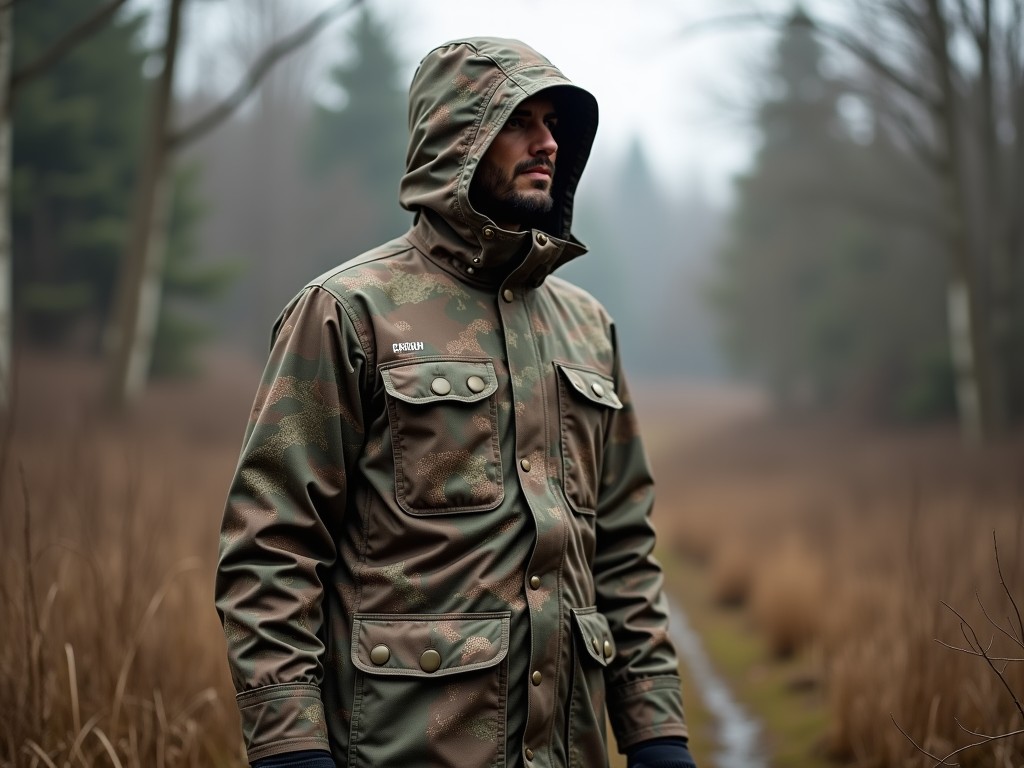
Camo Rain Gear For Hunting
Camo Rain Gear for Hunting
Hunting in variable weather demands apparel that manages moisture, maintains concealment, and withstands abrasion from brush and terrain. Camouflage rain gear designed for hunting must balance waterproof performance with breathability, durability, and pattern effectiveness across seasons and environments. This page explains the technical considerations for selecting rain gear suited to hunting applications, focusing on material properties, construction methods, and functional design elements that reduce user uncertainty in the field.
Understanding how these factors interact helps procurement professionals specify gear that performs reliably without compromising stealth or comfort during extended use.
Material Composition and Waterproofing Technology
Effective hunting rain gear typically uses a three-layer laminate system: an outer face fabric for abrasion resistance, a waterproof-breathable membrane, and an inner protective layer. The face fabric is often nylon or polyester with a denier range of 70D to 150D, providing tear strength between 20N and 40N depending on weave and coating. The membrane layer, commonly polyurethane or expanded polytetrafluoroethylene (ePTFE), delivers hydrostatic head ratings from 10,000mm to 28,000mm, indicating resistance to water penetration under pressure.
Breathability is measured by moisture vapor transmission rate (MVTR), with hunting-specific gear targeting 8,000g/m²/24h to 15,000g/m²/24h to manage perspiration during active pursuit. Durable water repellent (DWR) finishes applied to the outer surface cause water to bead and roll off, preventing saturation of the face fabric; these finishes are rated for 20 to 50 wash cycles before reapplication is needed. Seams are sealed using thermoplastic polyurethane tape or ultrasonic welding to maintain waterproof integrity at stitch points.
Camouflage Pattern Effectiveness and Environmental Adaptation
Camouflage performance depends on pattern disruption, color matching, and texture replication relative to the hunting environment. Patterns are designed using spectral analysis to match the reflectance characteristics of foliage, soil, and shadow across visible and near-infrared spectra, reducing detection by both ungulates and predators. Common patterns include woodland, marsh, snow, and transitional zones, each optimized for specific vegetation types and seasonal conditions.
Pattern scaling is critical: micro-patterns work best at close range (<50m), while macro-patterns disrupt outlines at longer distances. Fabric weave and finish affect how light scatters; matte coatings reduce glare, while certain textures mimic natural surfaces like bark or leaf litter. Some manufacturers incorporate infrared (IR) reflective treatments to minimize detection by night-vision equipment, though effectiveness varies by generation of imaging device.
Design Features for Functional Utility in Hunting Scenarios
Hunting rain gear incorporates specific design elements to enhance utility without compromising concealment. Adjustable hoods with laminated brims maintain visibility while shedding rain; many feature stiffened peaks that resist collapse under water weight. Cuffs and hems use hook-and-loop closures or elastic drawcords to seal against water ingress, often laminated to prevent delamination. Pit zips with waterproof zippers allow ventilation during high-exertion periods, positioned to minimize exposure when arms are raised for shooting.
Pocket placement avoids interference with harnesses or belt systems; chest pockets are often angled for access while wearing a backpack, and hand-warmer pockets are lined with fleece for thermal comfort. Reinforcement patches at high-wear areas—such as elbows, knees, and seat—use abrasion-resistant fabrics like Cordura® or ballistic nylon, typically rated for 5,000 to 10,000 cycles on the Martindale test. YKK® AquaGuard® or equivalent zippers are standard for main closures and pockets, providing water resistance through coiled tooth design and hydrophobic coating.
Comparison of Common Rain Gear Constructions for Hunting
| Construction Type | Typical Hydrostatic Head (mm) | MVTR (g/m²/24h) | Abrasion Resistance (Cycles) | Best Suited For |
|---|---|---|---|---|
| 2-Layer Laminate | 10,000 - 18,000 | 5,000 - 10,000 | 3,000 - 6,000 | Light hunting, occasional use |
| 3-Layer Laminate | 15,000 - 28,000 | 8,000 - 15,000 | 6,000 - 12,000 | Active hunting, variable conditions |
| Coated Non-Breathable | 5,000 - 12,000 | < 2,000 | 4,000 - 8,000 | Static blinds, short duration |
Quality Control and Manufacturing Considerations
Consistent performance relies on precise manufacturing controls. Fabric inspection includes checking for coating uniformity, delamination resistance, and dimensional stability after humidity cycling. Hydrostatic head testing is performed on full panels and seams according to ISO 811 or AATCC 127 standards, with acceptance criteria typically requiring no leakage at specified pressure for 5 minutes. MVTR is measured using ASTM E96 or JIS L 1099 methods, ensuring breathability meets design targets after conditioning.
Seam seal integrity is verified through pressure or dye penetration tests. Pattern alignment is checked during cutting to maintain camouflage effectiveness across garment pieces, especially at shoulders, sleeves, and side seams. DWR performance is evaluated via spray rating (AATCC 22) and angle of contact measurements, with reapplication thresholds defined based on use cycle expectations. Final inspection includes functional testing of zippers, closures, and adjustment systems under simulated field conditions.
Applications Across Hunting Disciplines
Different hunting methods impose distinct demands on rain gear. Stand hunting, involving prolonged periods of minimal movement, prioritizes insulation compatibility and noise reduction; gear often features quiet-face fabrics and roomier cuts to accommodate insulating layers underneath. Spot-and-stalk hunting requires high mobility and rapid ventilation, favoring lightweight 3-layer designs with extensive pit zipping and articulated knees for unrestricted movement.
Waterfowl hunting in marshes or flooded timber demands enhanced abrasion resistance from cattails, reeds, and submerged logs, often specifying reinforced lower legs and waist areas. Cold-weather big game hunting may integrate rain gear as an outer shell over insulated layers, requiring compatibility with harness systems and sufficient cut to avoid compression of underlying insulation. Upland bird hunting benefits from shorter jacket lengths and brush-resistant fabrics to prevent snagging and seed accumulation.
Request Technical Specification Sheet
For detailed material data, customization options, or application-specific guidance.