
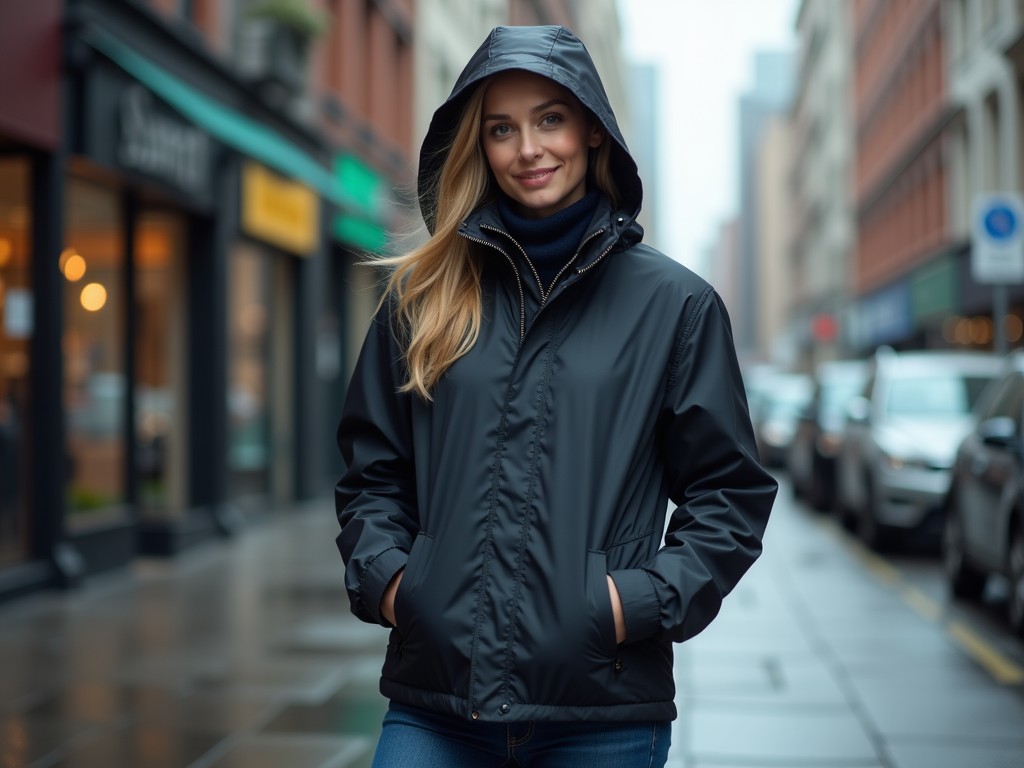
Business Casual Rain Jacket
Business Casual Rain Jacket
A business casual rain jacket is designed to provide weather protection while maintaining a professional appearance suitable for office environments, client meetings, and light industrial settings. Unlike traditional rainwear, it integrates water-resistant fabrics with tailored cuts and subdued aesthetics to align with workplace dress codes.
Material Composition and Performance
The outer shell typically uses a 2.5-layer laminate consisting of a polyester face fabric bonded to a microporous polyurethane membrane. This construction achieves a hydrostatic head rating of 5,000 mm to 10,000 mm, resisting moderate rainfall while allowing moisture vapor transmission rates (MVTR) of 5,000 to 8,000 g/m²/24h to reduce interior condensation.
Face fabrics are often treated with a durable water repellent (DWR) finish, commonly fluoropolymer-free to meet evolving environmental regulations. The DWR causes water to bead and roll off the surface, delaying saturation of the underlying membrane. Reapplication of DWR after multiple washes maintains performance over the garment’s lifecycle.
Design Features for Professional Use
Cut and silhouette follow standard business attire proportions—slightly tapered at the waist, with shoulder seams aligned to the natural shoulder point to avoid a bulky appearance. Sleeve length accommodates dress shirt cuffs, typically ending at the wrist bone when arms are relaxed.
Closure systems use concealed zippers with storm flaps to maintain a clean front profile. Snap or magnetic closures at the neck reduce bulk compared to traditional collars. Interior finishes include soft-faced seams and tagless labels to prevent irritation during extended wear.
Functional Details
- Zippered hand pockets positioned to avoid interference with trouser pockets, with drainage grommets to prevent water accumulation.
- Adjustable hem via internal drawcord or snap tabs, allowing tightening without altering the jacket’s external drape.
- Ventilation options include underarm gussets or back yoke vents covered with water-resistant flaps to enhance breathability during active use.
Comparison: Business Casual vs. Technical Rain Jackets
| Feature | Business Casual Rain Jacket | Technical Rain Jacket |
|---|---|---|
| Primary Use Case | Office, meetings, light travel | Outdoor pursuits, heavy rain, alpine conditions |
| Hydrostatic Head | 5,000–10,000 mm | 10,000–20,000+ mm |
| MVTR | 5,000–8,000 g/m²/24h | 10,000–15,000 g/m²/24h |
| Aesthetic | Tailored, subdued colors, minimal branding | Performance-focused, bold accents, technical detailing |
| Packability | Moderate (fits in briefcase) | High (compresses to small stuff sack) |
Care and Maintenance
Machine wash cold on gentle cycle using a technical fabric cleaner—avoid detergents with fabric softeners or bleach, which can degrade the DWR and membrane. Tumble dry low for 10–15 minutes to reactivate the DWR finish. Ironing is not recommended; if necessary, use a cool setting with a pressing cloth between the iron and fabric.
Store the jacket on a wide hanger to maintain shoulder shape. Avoid long-term compression in tight spaces, which can crush the membrane’s microstructure over time. Periodic inspection of seam tape integrity ensures continued waterproof performance.
Customization Options
Color palettes are typically limited to neutral tones—navy, charcoal, black, and olive—to align with business attire. Custom logo placement is available on the left chest or sleeve via embroidery or heat transfer, with minimum order quantities applying. Lining materials can be specified as brushed polyester for added comfort or left unlined for layering flexibility.
Sleeve and body length adjustments are possible in 1-inch increments to accommodate varying proportions. Reflective trim can be added to seams or logos for low-visibility environments, though this may affect the garment’s formal appearance and is generally reserved for industrial or field service variants.