
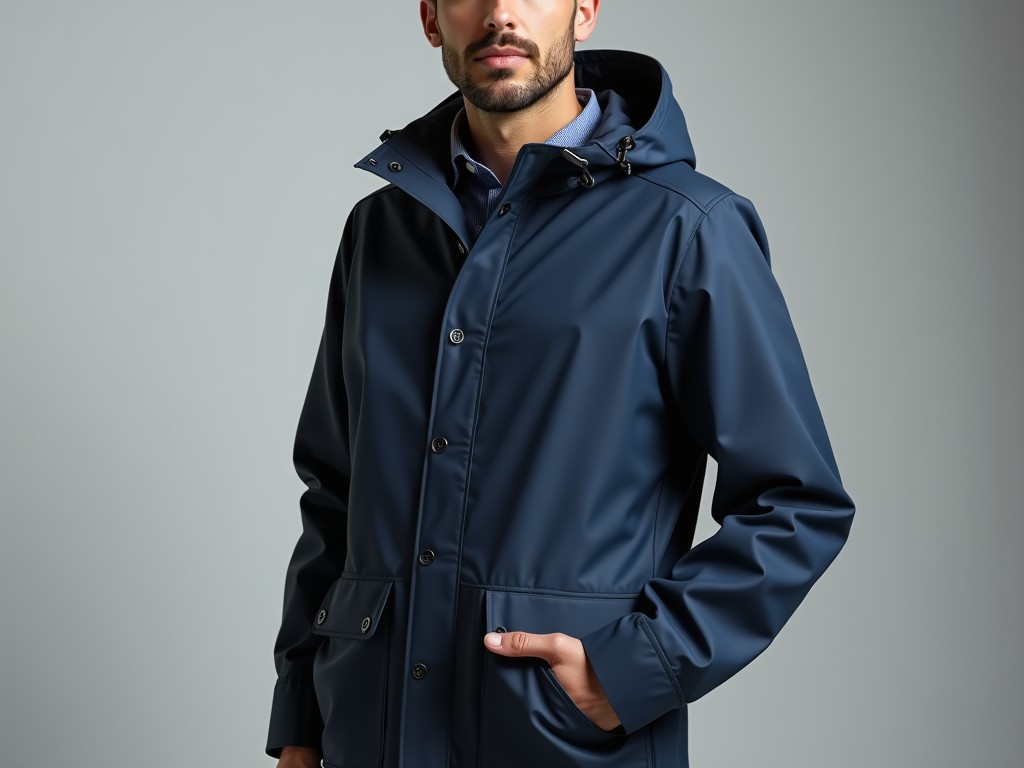
Breathable Rain Suits For Men
Breathable Rain Suits for Men
Industrial workers exposed to wet conditions require protective apparel that prevents water ingress while allowing moisture vapor to escape. Standard non-breathable rain gear traps sweat, leading to discomfort, reduced mobility, and increased risk of heat stress during prolonged use. Breathable rain suits address this by integrating microporous membranes or coated fabrics that block liquid water but transmit water vapor, maintaining thermal regulation without compromising protection.
Material Construction and Performance Characteristics
The outer shell typically uses nylon or polyester with a denier range of 70D to 210D, coated with a polyurethane (PU) or polytetrafluoroethylene (PTFE) microporous membrane. These membranes feature pore sizes between 0.1 and 0.5 micrometers—small enough to block liquid water droplets (20+ μm) but large enough to allow water vapor molecules (0.0004 μm) to pass. Water resistance is measured via hydrostatic head testing, with industrial suits commonly rated between 5,000 mm and 20,000 mm, ensuring protection against heavy rain and wind-driven spray. Moisture vapor transmission rate (MVTR) ranges from 3,000 to 15,000 g/m²/24h, directly influencing wearer comfort during physical exertion.
Seams are sealed using heat-activated tape or ultrasonic welding to prevent leakage at stitch points, a critical failure zone in non-taped garments. Zippers and storm flaps are designed with overlapping covers and water-resistant zippers (e.g., YKK AquaGuard®) to maintain integrity at closures. Reinforcement patches at high-wear areas—knees, seat, elbows—use abrasion-resistant fabrics like Cordura® nylon (500D–1000D) to extend service life in rugged environments.
Design Features for Industrial Use
Ergonomic patterning includes articulated knees and gusseted underarms to maintain range of motion when bending or reaching. Adjustable cuffs, ankles, and hoods use hook-and-loop closures or elastic drawcords to seal against wind and rain without restricting movement. Ventilation zippers under the arms or along the back allow users to increase airflow during high-activity periods, supplementing the fabric’s inherent breathability. Reflective trims compliant with ANSI/ISEA 107-2020 standards are available for low-visibility environments, enhancing safety without adding bulk.
Pocket design prioritizes functionality: chest pockets with storm flaps protect radios or documentation, while internal mesh pockets store gloves or liners. All pockets are positioned to remain accessible when wearing harnesses or belts. The suit’s cut allows layering over insulated liners or fleece in cold conditions, enabling year-round use across temperature ranges from -10°C to +30°C when paired with appropriate base layers.
Typical Applications Across Industries
In utility work, crews repairing power lines or water mains in sustained rain rely on breathable suits to prevent hypothermia and maintain dexterity for tool handling. Maritime operations—deck maintenance, fishing, port logistics—benefit from suits that resist saltwater spray while allowing sweat to escape during physical tasks like net hauling or cargo securing. Construction crews working on exposed scaffolding or concrete pours use these suits to stay dry without overheating during prolonged shifts in variable weather.
Agricultural workers applying pesticides or harvesting in wet conditions require suits that resist chemical splash (when treated with appropriate coatings) while preventing heat buildup. Mining and tunneling crews in damp underground environments use breathable rain gear as an outer layer over thermal liners, managing condensation from exertion without trapping moisture against the skin. Emergency responders deploying in flood zones or storm aftermath prioritize suits that don’t impede movement during rescue operations while keeping personnel dry and visible.
Comparison of Key Performance Metrics
| Property | Typical Range | Industrial Relevance |
|---|---|---|
| Hydrostatic Head | 5,000–20,000 mm | Higher values ensure protection in heavy rain and wind-driven conditions; |
| MVTR | 3,000–15,000 g/m²/24h | Directly correlates with wearer comfort during physical exertion; |
| Abrasion Resistance (Martindale) | 20,000–50,000 cycles | Determines durability in high-wear zones like knees and seat; |
| Tear Strength (ISO 9073-4) | 15–40 N | Resists propagation of rips from snags or sharp edges; |
| Weight (per suit, L) | 400–700 g | Affects mobility and fatigue during extended wear; |
Customization and Configuration Options
Fabric selection can be adjusted based on environmental exposure: higher PU coating weights increase water resistance for offshore or chemical-exposed roles, while lighter coatings prioritize breathability for high-activity indoor/outdoor transitions. Seam sealing methods vary—fully taped seams offer maximum protection, while critically taped seams (shoulders, chest, hood) balance cost and performance for intermittent use. Closure systems can be upgraded to water-resistant zippers with storm flaps or simplified to hook-and-loop for rapid donning/doffing in emergency scenarios.
Sizing follows standard industrial charts (S–3XL) with options for tall or short lengths based on inseam and torso measurements. Custom logo placement is available via heat transfer or embroidery on chest, back, or sleeves, using reflective or high-visibility thread to maintain compliance. Additional features include removable hoods, insulated liners compatible via zip-in systems, and reinforced cargo pockets sized for specific tools or devices.
Quality Control and Testing Protocols
Each production lot undergoes hydrostatic head testing on sealed fabric samples per ISO 811, with acceptance criteria tied to the specified rating (e.g., 10,000 mm minimum). MVTR is measured using ASTM E96 BW (inverted cup) method to verify breathability claims. Seam integrity is validated via spray testing (ISO 9151) and dynamometer pull tests on taped seams to ensure adhesion strength exceeds 5 N/mm. Dimensional stability is assessed after multiple wash cycles (ISO 6330) to confirm minimal shrinkage (<3%) and retention of protective properties.
Colorfastness to light (ISO 105-B02) and washing (ISO 105-C06) is checked for high-visibility components to ensure long-term compliance with safety standards. Abrasion resistance is tested on high-wear zones using Martindale apparatus (ISO 12947-2). Final inspection includes functional checks of zippers, closures, and pocket placement, with random pull tests on stitching to verify seam strength. Non-conforming items are segregated for rework or scrap based on defect severity and location.