
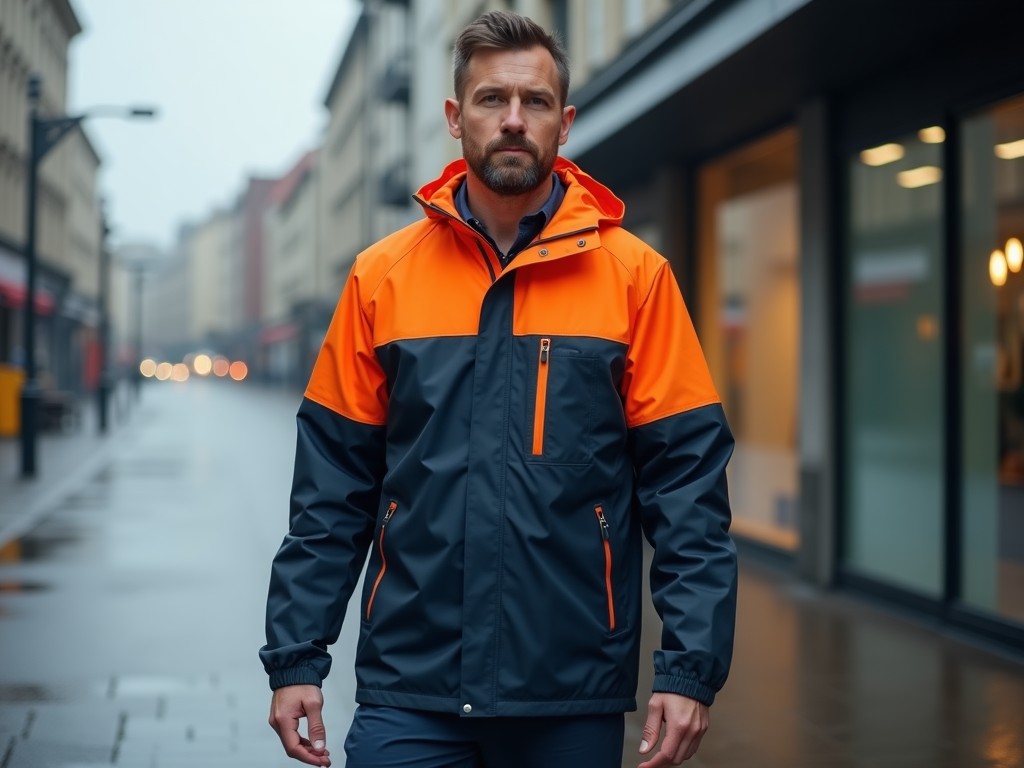
Best Waterproof Work Jacket For Men
Best Waterproof Work Jacket for Men
Selecting a waterproof work jacket requires understanding how material construction, seam sealing, and breathability interact under prolonged exposure to wet conditions and physical exertion. This page explains the technical characteristics that determine real-world performance, helping industrial buyers evaluate options based on measurable engineering properties rather than marketing claims.
Core Waterproofing Technologies
Waterproof performance in work jackets depends on either a microporous membrane (e.g., ePTFE) or a hydrophilic coating applied to the fabric’s inner layer. Microporous membranes block liquid water while allowing vapor transmission through pores smaller than water droplets but larger than moisture vapor molecules. Hydrophilic coatings absorb and disperse moisture via molecular diffusion, requiring a humidity gradient to function effectively. Both systems rely on durable water repellent (DWR) finishes on the outer fabric to prevent surface saturation, which would otherwise reduce breathability by blocking vapor escape routes.
Seam integrity is equally critical; even the most waterproof fabric fails if stitch holes remain unsealed. Fully taped seams apply polyurethane tape over all stitched joints using heat and pressure, creating a continuous barrier. Critically taped seams only seal high-exposure areas (shoulders, chest, hood), leaving lower-risk zones vulnerable to leakage under sustained pressure or flexing. Industrial applications involving kneeling, overhead work, or prolonged rain exposure demand fully taped construction to maintain protection across all stress points.
Breathability and Moisture Management
Breathability is quantified by moisture vapor transmission rate (MVTR), measured in grams of water vapor passing through one square meter of fabric in 24 hours (g/m²/24h). For high-intensity work, MVTR values below 8,000 g/m²/24h risk interior moisture buildup from sweat, leading to discomfort and reduced thermal efficiency. Values above 15,000 g/m²/24h typically indicate membranes optimized for aerobic activity, though such fabrics may sacrifice abrasion resistance. The ideal balance depends on work intensity: static tasks in wet conditions prioritize waterproofing over breathability, while active roles require MVTR >10,000 g/m²/24h to prevent microclimate saturation.
Fabric construction influences both durability and comfort. Outer shells commonly use nylon or polyester ripstop weaves with denier ratings between 60D and 150D; higher denier increases tear resistance but adds weight and stiffness. Inner linings may incorporate mesh panels for ventilation or brushed tricot for skin comfort, though these add complexity to layering. Jackets designed for layering over insulated mid-layers often feature articulated elbows and gusseted underarms to maintain range of motion when wearing additional garments, a consideration frequently overlooked in generic waterproof designs.
Material Selection and Environmental Resistance
Beyond waterproofing, industrial jackets must resist abrasion, UV degradation, and chemical exposure common in worksites. Nylon 6,6 offers superior abrasion resistance compared to polyester but absorbs more water, potentially increasing weight when wet unless treated with advanced DWR. Polyester retains strength better when wet and resists UV breakdown longer, making it suitable for outdoor utility or telecommunications work. Some fabrics incorporate ceramic or silicone additives into the coating to enhance scratch resistance without compromising flexibility, a trade-off critical in environments with frequent contact with rough surfaces or equipment edges.
DWR finishes degrade over time due to dirt, oils, and wash cycles, requiring periodic reactivation via heat (tumble drying) or reapplication. Fluoropolymer-based DWRs (C6) provide longer-lasting protection than older C8 formulations but may require specific care instructions to maintain performance. Buyers should verify whether the jacket’s DWR is renewable and whether care labels specify tumble drying temperatures compatible with industrial laundry processes, as excessive heat can delaminate membranes or damage tape adhesives.
Design Features for Work Environments
Functional design elements directly impact usability and safety. Storm flaps over zippers prevent water ingress through needle holes, ideally secured with snap or hook-and-loop closures that maintain seal integrity after repeated use. Adjustable cuffs with hook-and-loop or elastic seals prevent water runoff up the sleeves, while adjustable hems with cord locks or drawcords block drafts and water entry at the waist. Hood compatibility with hard hats is essential; designs should offer sufficient volume and adjustability to accommodate headgear without compromising peripheral vision or creating wind noise that impedes communication.
Pocket placement and accessibility matter when wearing harnesses, tool belts, or backpacks. Chest pockets should sit high enough to remain accessible over harness straps, ideally with water-resistant zippers or flap covers. Internal pockets for electronics or documents benefit from sealed zippers and soft lining to prevent condensation damage. Reflective trim compliant with ANSI/ISEA 107 standards enhances visibility in low-light conditions, though placement must avoid interfering with seam seals or creating snag hazards near moving machinery.
Performance Comparison Table
| Attribute | Standard Waterproof Jacket | Industrial Waterproof Work Jacket |
|---|---|---|
| Seam Construction | Critically taped seams | Fully taped seams |
| Outer Fabric Denier | 60D–100D polyester | 100D–150D nylon or polyester ripstop |
| MVTR (g/m²/24h) | 5,000–8,000 | 8,000–15,000 |
| Hood Compatibility | Fixed or basic adjustable | Helmet-compatible, volume-adjustable |
| Reinforcement Zones | None or minimal | Elbows, shoulders, cuff abrasion patches |
| Closure Protection | Zipper only | Zipper with storm flap and snap closure |
Selection Criteria for Procurement
When evaluating waterproof work jackets, request test reports for hydrostatic head (water resistance) and MVTR from the supplier. Hydrostatic head measures the pressure (in mm of water column) the fabric withstands before leakage; values below 5,000 mm indicate light rain protection only, while 10,000 mm+ is typical for sustained outdoor work. Confirm whether testing was performed on new fabric or after abrasion cycles, as wear significantly reduces performance. Additionally, inquire about DWR durability ratings (e.g., number of washes before 80% water beading loss) and whether seam tape adhesion has been tested under flexing and temperature extremes (-20°C to +40°C).
Consider the garment’s lifecycle cost, not just initial price. Jackets with removable liners offer versatility across seasons but add complexity to seam sealing. Those with reinforced wear zones may cost more upfront but extend service life in high-abrasion roles. Suppliers should provide care instructions compatible with industrial laundering; membranes damaged by high heat or harsh detergents lose waterproofing permanently. For bulk orders, ask about colorfastness testing and dimensional stability after multiple wash cycles to ensure uniformity and professional appearance over time.
Finally, verify compliance with relevant safety standards if applicable. While waterproof jackets themselves are rarely subject to specific industrial certifications, those used in high-visibility roles should meet ANSI/ISEA 107 for background and reflective materials. Flame-resistant (FR) treatments, if required, must be applied without compromising the membrane’s integrity—some FR additives can block pores or degrade hydrophilic coatings. Always confirm whether FR properties are inherent to the fabric or applied as a topical treatment, as the latter may wash out or degrade unevenly.