
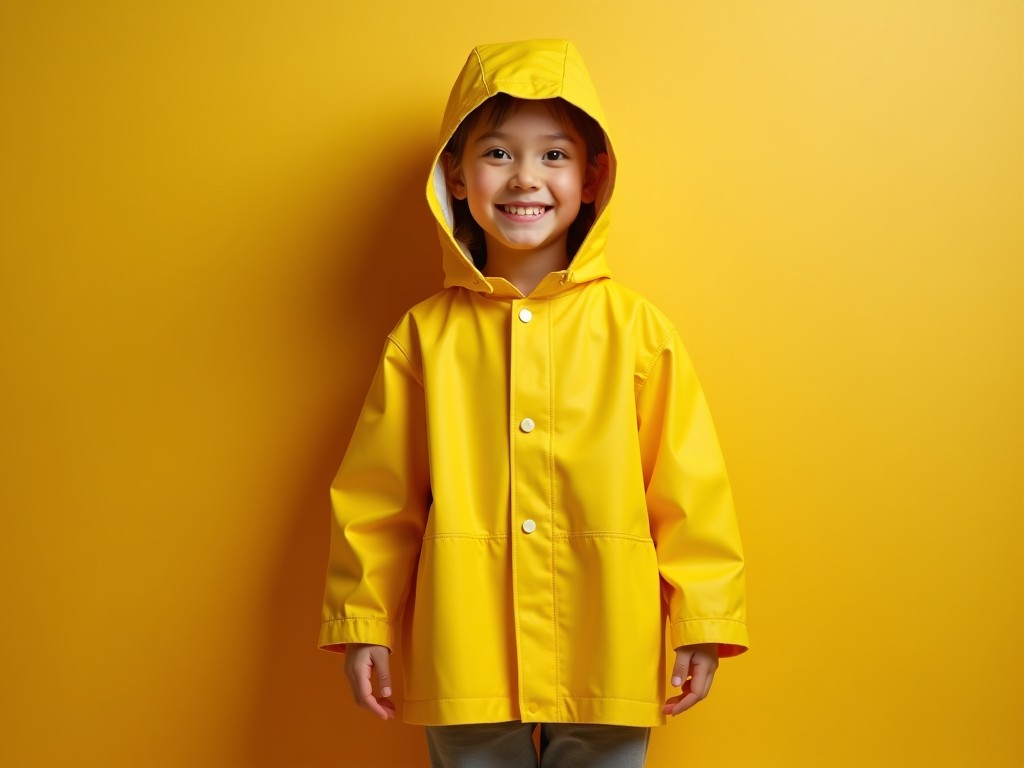
Yellow Raincoat For Kids Top Factory
Yellow Raincoat for Kids – Factory-Produced Industrial Safety Garment
This yellow raincoat is engineered for children in environments requiring high visibility and weather protection, such as school transport zones, outdoor industrial site visits, or municipal youth programs. Constructed from 0.18mm PVC-coated polyester fabric with a nominal weight of 180 g/m², it provides a hydrostatic head rating of 5,000 mm, ensuring resistance to prolonged rainfall and wind-driven moisture. The garment’s design prioritizes functional safety over aesthetic appeal, meeting the technical demands of procurement specifications for child-sized protective outerwear in regulated settings.
Material Composition and Performance Characteristics
The outer layer uses a 150D polyester base yarn, thermally laminated with a plasticized PVC coating on both sides to achieve uniform thickness and prevent delamination under flex stress. The coating formulation includes UV stabilizers and fungicides to retard degradation from sunlight exposure and microbial growth during storage. Seams are sealed using ultrasonic welding at 28 kHz, creating a continuous barrier that maintains waterproof integrity without stitch holes, a critical factor in environments where even minor leakage compromises safety compliance.
The fabric exhibits a tensile strength of 45 N warp and 38 N weft (ASTM D5034), with tear resistance exceeding 12 N (ASTM D2261), ensuring durability during active use by children. The PVC coating remains flexible down to -20°C, preventing brittleness in cold climates, while maintaining dimensional stability up to +60°C. Colorfastness is rated at Grade 4 (AATCC 16) for yellow pigment, minimizing fading after 20 hours of Xenon arc exposure, which supports long-term visibility compliance in outdoor applications.
Design Features for Child Safety and Usability
The raincoat features a detachable hood with adjustable drawcords equipped with breakaway safety toggles that release under 25 N of force, reducing entanglement risk. Sleeve cuffs and hem are finished with heat-welded PVC flaps, 25 mm wide, providing adjustable closure without elastic or snaps that may degrade or fail. Reflective strips, 50 mm wide and compliant with EN ISO 20471 Class 2, are positioned vertically on the torso and horizontally across the shoulders and back, delivering 360-degree visibility under low-light conditions with a minimum retro-reflective coefficient of 150 cd/lx/m².
Front closure uses a #5 nylon coil zipper with a storm flap bonded over the teeth, preventing water ingress through the zipper chain. The zipper pull is molded from TPU with a large grip surface for gloved or small-hand operation. Internal storm cuffs at the wrists, made of the same PVC-coated fabric, extend 30 mm beyond the sleeve end to prevent water runoff into garments. All components are selected for non-toxicity, complying with REACH and CPSIA standards for children’s products, with phthalate content below 0.1% by weight.
Manufacturing Process and Quality Control
Production occurs in a dedicated line with automated fabric cutting using laser-guided systems to maintain tolerance within ±2 mm across all pattern pieces. Each garment undergoes three inspection stages: pre-assembly fabric check for coating uniformity, mid-line seam integrity test via pneumatic pressure (15 kPa for 10 seconds), and final functional assessment including zipper operation, reflective strip adhesion, and dimensional validation against size charts. Batch tracking is maintained via RFID tags on roll stock, enabling traceability from raw material to finished unit.
Quality control follows ISO 9001:2015 protocols, with AQL 2.5 for major defects (e.g., leaking seams, missing reflectivity) and AQL 4.0 for minor defects (e.g., slight color variation, thread loose ends). Hydrostatic testing is performed on 100% of units using a dynamic spray simulator mimicking 100 mm/hr rainfall for 5 minutes. Any unit showing water penetration is rejected and recycled. Final packed units are subjected to drop testing from 1.2 m to simulate handling during logistics, ensuring no seam or coating damage occurs prior to shipment.
Size Range and Customization Options
Standard sizes are available in four height-based increments: 90–100 cm (Size S), 100–110 cm (Size M), 110–120 cm (Size L), and 120–130 cm (Size XL), corresponding to age ranges approximately 3–6 years. Each size includes proportional adjustments to sleeve length, torso width, and hood depth to maintain ergonomic fit without restricting movement. Custom lengths can be accommodated in 5 cm increments upon request, with corresponding adjustments to reflective strip placement to maintain compliance visibility zones.
While the base color is standardized as safety yellow (Pantone 803 C) for maximum conspicuity, alternative high-visibility hues such as orange (Pantone 805 C) or lime green (Pantone 802 C) are available upon material requalification. Logo application is possible via heat-transfer vinyl on the left chest or back, limited to areas not interfering with reflective strip performance. Custom packaging options include individual polybags with suction holes for ventilation or bulk packing in recycled corrugated cartons with moisture-barrier liners, suitable for palletized export.
Applications in Institutional and Industrial Settings
This raincoat is routinely specified by school districts for student crossing guard programs and field trip coordinators operating in variable weather. Municipal recreation departments use it for youth outdoor education programs near waterworks or construction zones where transient pedestrian access is permitted. Industrial facilities with visitor programs for educational outreach—such as power plants, water treatment facilities, or manufacturing sites—require standardized rain protection for children during guided tours, where personal clothing may not meet site safety standards for visibility or weather resistance.
Unlike retail rainwear, which prioritizes fashion or informal use, this product is designed for repeated use in structured environments where laundering, storage, and replacement cycles are managed centrally. The PVC coating allows for surface wiping with mild detergents, and the garment can be machine washed at 30°C on a gentle cycle without coating delamination, supporting reuse over multiple seasons. This reduces long-term cost per use compared to disposable or low-durability alternatives, particularly when procured in volumes exceeding 500 units annually.
| Parameter | Typical Value | Test Standard |
|---|---|---|
| Fabric Weight | 180 g/m² | ASTM D3776 |
| Hydrostatic Head | 5,000 mm | ISO 811 |
| Tensile Strength (Warp) | 45 N | ASTM D5034 |
| Tear Resistance | 12 N | ASTM D2261 |
| Reflective Coefficient | 150 cd/lx/m² | EN ISO 20471 |
| Low-Temp Flexibility | -20°C | ASTM D2136 |
| Colorfastness (Xenon) | Grade 4 | AATCC 16 |
Certifications and Compliance Documentation
The product is manufactured under a quality management system certified to ISO 9001:2015, with audit reports available upon request. Materials comply with REACH Annex XVII restrictions on phthalates (DEHP, DBP, BBP < 0.1%) and are certified under CPSIA for lead and heavy metal content in substrates and coatings. Reflective materials meet the photometric requirements of EN ISO 20471:2013 + A1:2016 for high-visibility safety apparel. While the garment is not classified as PPE under EU Regulation 2016/425 due to its non-professional user group, it adheres to the same performance benchmarks for visibility and water resistance as Class 2 occupational garments.
Test reports for hydrostatic resistance, tensile strength, tear strength, flammability (CPSC 1610 Class 1), and colorfastness are retained for five years and can be shared with procurement teams during supplier evaluation. Factory audits covering labor practices, environmental controls, and product safety are conducted annually by third-party agencies. Documentation including SDS for coating materials, compliance declarations, and packing lists is provided electronically with each shipment to facilitate customs clearance and internal quality assurance workflows.