
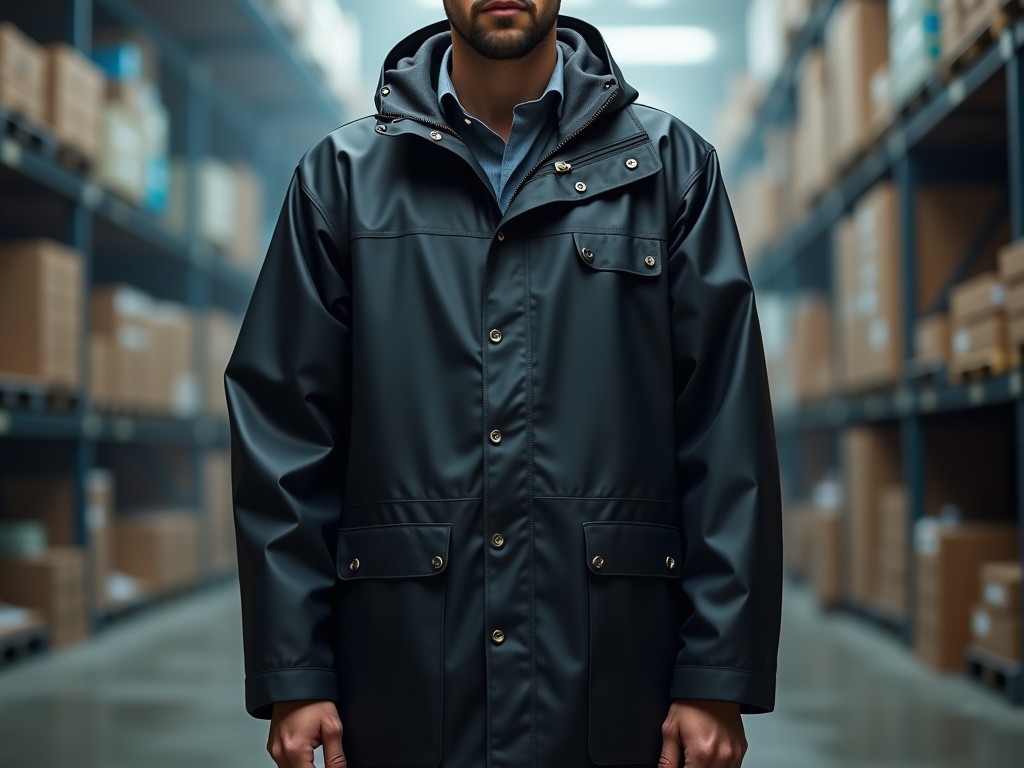
Tuxedo Bib With Sleeves Top Factory
Tuxedo Bib with Sleeves Top Factory
A tuxedo bib with sleeves top is a protective garment engineered for industrial environments where upper-body contamination control and mobility are critical. Unlike standard aprons or smocks, this design integrates full-length sleeves with a reinforced bib front to shield the torso and arms from splashes, particulates, and light abrasion while maintaining dexterity for precision tasks.
The garment is constructed from layered composite materials selected for chemical resistance, seam integrity, and wear durability. Industrial buyers select this configuration when processes involve intermittent exposure to liquids, powders, or debris that require containment without restricting arm movement—common in chemical handling, paint booths, food processing, and light assembly.
Each unit is manufactured to order based on specific operational parameters, including exposure type, duration of use, and required laundering cycles. The design avoids unnecessary bulk by tailoring sleeve length, bib width, and closure type to the user’s anthropometric data and task dynamics.
Material Composition and Performance Characteristics
The base fabric is typically a 65/35 polyester-cotton twill with a weight range of 200–280 gsm, chosen for its balance of tensile strength (>45 N warp, >35 N weft per ISO 13937-2) and dimensional stability after repeated washing. This blend minimizes shrinkage (<3% after 50 cycles at 60°C) while providing adequate breathability for extended wear.
For enhanced liquid resistance, a polyurethane (PU) coating is applied to the bib front and sleeve exteriors, achieving a hydrostatic head of 800–1200 mmH₂O (ISO 811) without compromising flexibility. The coating is formulated to resist common industrial solvents such as isopropyl alcohol, diluted acids, and alkaline cleaners for limited exposure periods.
Seams are sealed using ultrasonic welding or heat-activated tape to prevent liquid ingress at stitch points, a critical detail in environments where even minor seepage could lead to skin irritation or product contamination. Seam strength is validated to exceed 80% of the base fabric’s tensile capacity under ASTM D1683 testing.
Design Features and Functional Integration
The bib extends vertically from the sternum to the lower ribcage (typically 28–35 cm in height) and horizontally to cover the full anterior torso, overlapping at the sides by 5–7 cm to prevent gap formation during torso rotation. This coverage zone is calibrated to protect vital organs and clothing from splash trajectories common in overhead pouring or spraying operations.
Sleeves are set-in with a slight raglan taper to improve shoulder mobility, ending at the wrist with either a knit cuff (for particulate retention) or an adjustable snap closure (for liquid barrier continuity). Sleeve length is customizable in 2 cm increments to accommodate arm length variance while avoiding interference with gloves or tools.
Front closure options include a heavy-duty nylon zipper with storm flap, snap-button placket, or hook-and-loop fastener—each selected based on decontamination frequency and ease of donning/doffing. The storm flap on zipper variants prevents liquid migration along the teeth, maintaining barrier integrity under pressure.
Customization Parameters for Industrial Applications
Customization begins with a hazard assessment to determine the required protection level against specific substances, temperatures, and mechanical stresses. Clients provide SDS sheets or exposure logs, which inform material selection, seam treatment, and closure type decisions.
Sizing is derived from a standardized measurement protocol: chest circumference, sleeve length (shoulder to wrist), torso height (sternum to waist), and shoulder breadth. These inputs generate a 3D pattern adjusted for ease of movement—typically adding 8–12 cm to chest and 4–6 cm to sleeve length for unrestricted motion.
Additional features available upon request include: interior pocket for tool storage, reflective trim for low-visibility zones, antimicrobial treatment for food-contact environments, and detachable sleeves for hybrid use as a bib-only garment. All options are evaluated for impact on protection performance before implementation.
Quality Control and Manufacturing Consistency
Production follows a batch traceability system where each garment is linked to its material lot, seam test results, and dimensional inspection record. Critical control points include fabric coating uniformity (measured via FTIR spectroscopy), seam seal continuity (spark tested at 10 kV), and dimensional tolerance (±3% on all linear measurements).
Finished goods undergo a 100% visual inspection for defects such as staining, misalignment, or coating delamination, followed by AQL 2.5 sampling for hydrostatic resistance and seam strength. Garments failing any test are quarantined for root cause analysis before reprocessing or rejection.
Packaging is designed to prevent contamination during transit: each unit is folded flat, sealed in a low-particulate polyethylene bag, and packed in corrugated cartons with internal dividers to minimize creasing. Cartons are labeled with batch number, size, material code, and care instructions for seamless integration into client inventory systems.
| Parameter | Typical Range or Specification | Test Method or Basis |
|---|---|---|
| Base Fabric Weight | 200–280 gsm | ISO 3801 |
| Tensile Strength (Warp/Weft) | >45 N / >35 N | ISO 13937-2 |
| Hydrostatic Head (Coated Area) | 800–1200 mmH₂O | ISO 811 |
| Seam Strength Efficiency | >80% of base fabric | ASTM D1683 |
| Shrinkage (After 50 Washes) | <3% | ISO 6330 |
| Sleeve Length Tolerance | ±2 cm | Internal Measurement Protocol |
| Bib Coverage Height | 28–35 cm | Anthropometric + Task Analysis |
The tuxedo bib with sleeves top serves as a critical interface between worker safety and process integrity in environments where contamination control cannot compromise operational efficiency. Its value lies not in isolated protection metrics, but in the sustained reliability of its barrier function under real-world conditions—repeated flexing, exposure cycles, and laundering—without degradation in performance.
Industrial procurement teams evaluate this garment based on total cost of ownership: replacement frequency, laundering durability, and incident reduction potential. By aligning material science, ergonomic design, and traceable manufacturing, the product reduces uncertainty in protective equipment selection.
For technical consultation, sample requests, or quotation based on your specific exposure profile and usage requirements, contact our engineering team. We provide detailed material data sheets, seam test reports, and sizing guidance to support informed procurement decisions.