
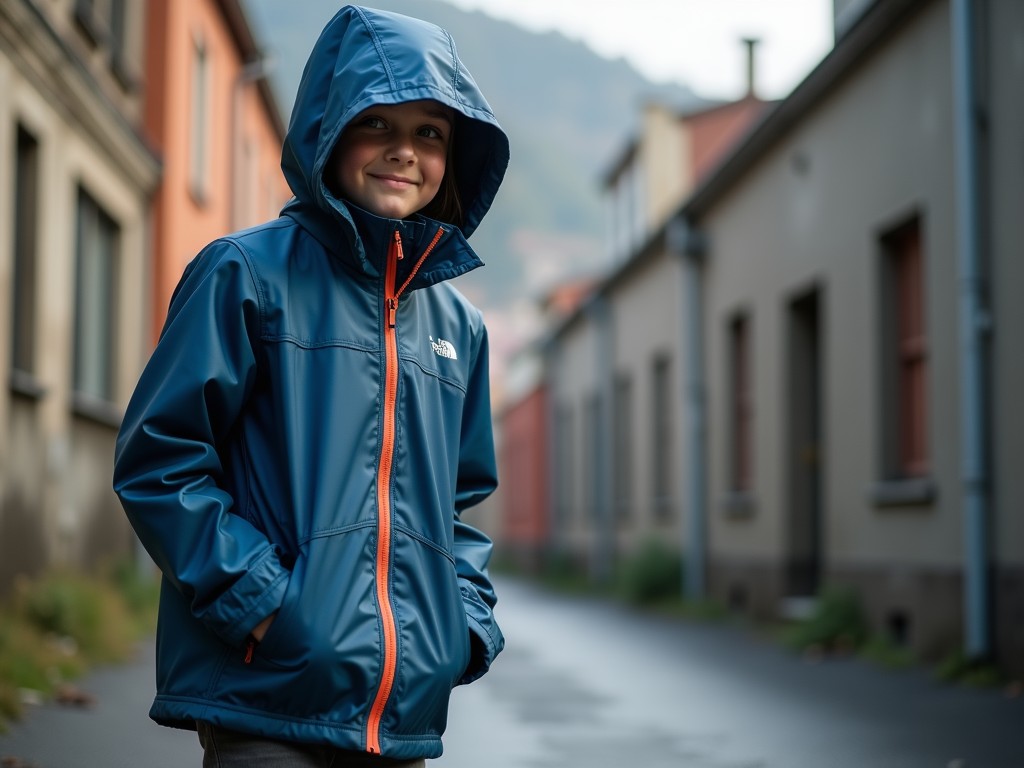
Sports Rain Jacket Junior Top Factory
Sports Rain Jacket Junior Top Factory
A sports rain jacket for juniors must balance waterproof protection with unrestricted movement during physical activity. Children’s bodies regulate temperature differently than adults’, requiring fabrics that prevent overheating while blocking external moisture. Factory production focuses on material consistency, seam integrity, and sizing accuracy to ensure reliable performance across size ranges from XS to XL for ages 6–14.
Unlike adult outerwear, junior jackets prioritize lightweight construction without sacrificing durability. Seam sealing must accommodate frequent flexing at elbows, shoulders, and knees. Fabric breathability is measured via moisture vapor transmission rate (MVTR), with target values exceeding 5,000 g/m²/24h to manage sweat during play. Waterproof ratings are specified in millimeters of water column (mm H₂O), where 5,000 mm provides protection against moderate rain, and 10,000 mm+ handles prolonged exposure.
Material Selection and Performance Criteria
The outer shell typically uses nylon or polyester with a polyurethane (PU) or thermoplastic polyurethane (TPU) coating. Nylon offers higher abrasion resistance, while polyester retains dimensional stability better when wet. Coating thickness directly affects both waterproofing and flexibility; a 0.15mm PU layer provides 5,000 mm H₂O resistance, whereas 0.25mm achieves 10,000 mm. TPU coatings maintain flexibility at low temperatures, critical for early morning or evening use.
Laminates are avoided in junior jackets due to added weight and reduced flexibility. Instead, a microporous coating allows vapor escape while blocking liquid droplets. The inner lining often features brushed polyester for comfort against skin, reducing chafing during extended wear. Zippers use coil-type nylon with water-resistant flaps and silicone-treated pulls for easy operation with gloves or cold hands.
Construction and Seam Integrity
Seams are the most vulnerable point in any rain jacket. Factory production uses taped seams with heat-activated polyurethane tape applied over stitched joints. Tape width is standardized at 20mm to ensure full coverage without adding stiffness. Seam strength is tested via ASTM D1683, with minimum requirements of 15N for shoulder seams and 10N for side seams to resist tearing under stress.
Stitch density is controlled at 8–10 stitches per inch (SPI) using polyester thread with UV resistance. Bar tacks reinforce high-stress points like pocket corners and hood attachments. The hood design includes a semi-rigid peak formed by heat-molded PE foam, adjustable via elastic cords with cord locks positioned to avoid snagging. Cuffs and hem use elastic binding with adjustable toggles to seal against wind and rain ingress.
Sizing and Fit Engineering
Junior sizing follows ISO 8559-1 standards for children’s wear, with chest, waist, and height measurements graded across six sizes. Pattern grading uses incremental increases of 2cm in chest and 1.5cm in sleeve length per size to maintain proportional fit. The jacket cut allows a 5cm ease over base layers to accommodate movement without excess fabric that could flap or collect water.
Length is proportionally scaled: back length increases by 1.5cm per size from XS (42cm) to XL (50cm). Sleeve length follows arm span ratios, ensuring cuffs sit at the wrist bone when arms are extended. The torso shape incorporates slight taper at the waist to reduce bulk while allowing room for mid-layers. All measurements are verified using digital pattern grading software before cutting.
Quality Control and Testing Protocols
Each batch undergoes hydrostatic head testing on coated fabric samples using a Suter tester. Results must meet or exceed the specified rating (e.g., 5,000 mm H₂O) with no more than 5% variation across samples. MVTR is tested per ASTM E96 using the desiccant method, with acceptable values above 5,000 g/m²/24h for active use.
Seam tape adhesion is tested by peeling at 180 degrees; minimum force must exceed 1.5N/mm to prevent delamination. Colorfastness to washing and light is evaluated per ISO 105-B02 and ISO 105-C06, with ratings of 4 or higher required. Final inspection includes visual checks for stitching defects, zipper alignment, and symmetry of reflective elements if present.
Customization Options for OEM Clients
Factories offer customization in color, branding, and functional details. Pantone matching ensures color accuracy across dye lots, with minimum order quantities typically starting at 500 units per color. Logos can be applied via screen printing, heat transfer, or embroidery, each selected based on durability needs and design complexity.
Functional options include adjustable hoods, zip-off sleeves for convertible use, and internal pockets for media or valuables. Reflective trims can be added using 3M Scotchlite or equivalent materials, positioned for 360-degree visibility. Packaging is customizable — individual polybags, bulk cartons, or retail-ready hangtag configurations — with labeling compliant to destination country regulations.
| Parameter | Typical Range | Test Standard |
|---|---|---|
| Waterproof Rating | 5,000 – 10,000 mm H₂O | ISO 811 |
| Breathability (MVTR) | 5,000 – 8,000 g/m²/24h | ASTM E96 |
| Seam Tape Adhesion | >1.5 N/mm | ASTM D903 |
| Chest Size Range (Junior) | 60 – 80 cm | ISO 8559-1 |
Lead time for standard orders ranges from 25 to 35 days after sample approval and deposit receipt. This includes fabric sourcing, cutting, sewing, quality checks, and packaging. Rush orders may reduce lead time to 18–22 days with priority scheduling, subject to factory capacity. Sample production takes 7–10 days, allowing clients to verify fit, function, and appearance before full-scale production.
Shipping is typically arranged via FOB or CIF terms from major ports such as Ningbo, Shanghai, or Shenzhen. Cartons are designed to withstand stacking pressure of up to 1.5 tons, with internal moisture barriers to prevent damage during transit. All export documentation includes commercial invoices, packing lists, and certificates of origin as required.