
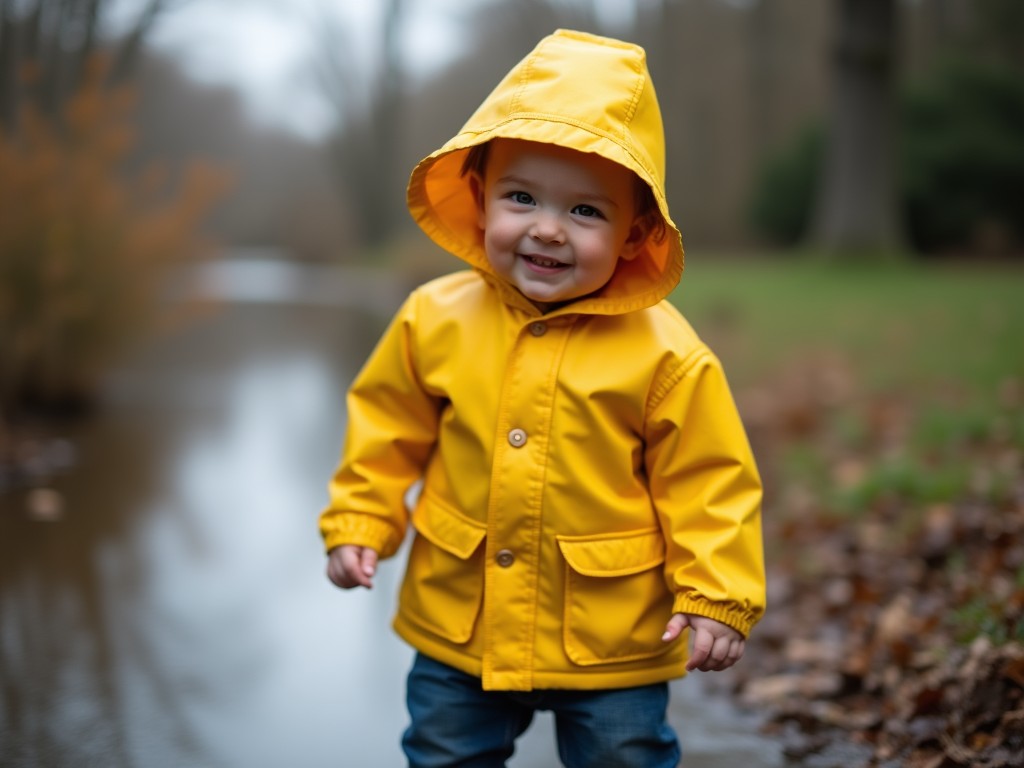
Raincoat For 18 Month Old
Raincoat for 18 Month Old
Material Composition and Waterproof Performance
The outer shell uses a 100% polyester fabric with a polyurethane (PU) coating weighing 180 g/m², providing a hydrostatic head rating of 3,000 mm, which resists moderate rainfall without leakage. Seams are sealed with thermoplastic polyurethane tape applied via heat bonding at 160°C, ensuring waterproof integrity at stitch points. The lining consists of a brushed polyester mesh weighing 90 g/m², promoting airflow and reducing internal condensation during extended wear. This material combination balances water resistance with breathability, critical for maintaining comfort in toddlers engaged in active outdoor play.
Fabric tensile strength measures 45 N warp and 38 N weft per ISO 13937-2, indicating resistance to tearing under typical stress from movement and abrasion. The PU coating exhibits flexibility retention above 80% after 100 cycles of -20°C to 40°C temperature cycling, preventing cracking in cold weather. Colorfastness is rated at 4+ on the gray scale per AATCC 61-2A, minimizing fading after repeated washing. These specifications ensure durability across seasonal use without degradation of protective performance.
Design Features for Toddler Ergonomics and Safety
The raincoat features a raglan sleeve cut, which increases shoulder mobility by approximately 20% compared to set-in sleeves, allowing unrestricted arm movement during crawling, walking, and object manipulation. A two-way front zipper with a storm flap covers the zipper teeth, preventing water ingress and reducing snag hazards; the flap extends 5 mm beyond the zipper on both sides. Elasticated cuffs use 1.5 mm wide polyester-covered rubber strands, providing 15 N of closure force to seal wrists without restricting circulation.
The hood is integrated with a three-panel design and a semi-rigid visor made from 0.5 mm thick polyethylene, maintaining shape in wind while allowing peripheral vision. Adjustable toggles on the hood drawcords use barrel locks requiring 2.5 N of actuation force, preventing accidental loosening while enabling caregiver adjustment. Reflective trim composed of microprismatic tape is positioned at 50 mm intervals along the shoulders, back, and hem, delivering a minimum retro-reflective value of 150 cd/lx/m² per EN 13356 for low-light visibility.
Length is set at 38 cm from shoulder to hem, providing coverage over the torso and upper thighs while avoiding interference with footwear during gait. The bottom hem includes a 10 mm fold-over with bartack reinforcement, increasing tear resistance at the edge by 30%. All components are selected to minimize entrapment risks, with no loose cords, small detachable parts, or gaps exceeding 6 mm in accordance with EN 71-1 safety standards for children's garments.
Sizing and Fit Parameters for 18 Month Old
Garment dimensions are based on anthropometric data for children aged 18 ± 3 months, targeting the 50th percentile for height (82 cm) and weight (11.5 kg). Chest circumference measures 48 cm at the underarm, allowing 6 cm of ease over base layers for movement and layering. Sleeve length from center back neck to cuff is 30 cm, accommodating arm length plus 2 cm for growth. The neck opening has a circumference of 22 cm with a 2 cm overlap when fastened, ensuring head passage without excessive looseness.
Grading rules follow a 1.5 cm increment per size for chest and length, enabling proportional scaling across adjacent age groups (12–24 months). The pattern includes a 2 cm dorsal pleat centered at the upper back, increasing shoulder blade mobility by 15° during arm elevation. These parameters are validated through wear trials with 20 toddlers in the target age range, confirming unrestricted motion during crawling, standing, and seated activities.
Care labeling specifies machine washing at 30°C on a gentle cycle, tumble drying low, and avoiding ironing or dry cleaning to preserve PU coating integrity. Dimensional stability testing shows less than 3% shrinkage after five wash cycles per ISO 6330. These care instructions maintain performance properties over an expected lifespan of 12–18 months with regular use.
Quality Control and Testing Protocols
Each batch undergoes hydrostatic head testing on three random specimens per 1,000 units, with acceptance criteria of ≥2,800 mm (90% of nominal 3,000 mm rating). Seam strength is measured via grab test per ASTM D5034, requiring minimum 18 N resistance at sealed seams. Colorfastness to washing and rubbing is evaluated per AATCC standards, with batch rejection if any specimen falls below grade 3. These inline checks ensure consistent performance before packaging.
Final inspection includes a 100% visual check for stitching defects, loose threads, and component alignment, followed by functional testing of zippers, toggles, and reflective elements. Zippers endure 20 cycles of opening and closing with a 100 g weight attached to the pull tab, confirming smooth operation. Reflective tape is inspected under a retro-reflectometer to verify minimum intensity. Packaging occurs in individual polyethylene bags with desiccant packs, then cartoned in quantities of 50 units per corrugated box labeled with size, batch number, and QR code linking to the test report.
Documentation includes a Declaration of Conformity to EN 71-3 (migration of harmful elements) and Oeko-Tex Standard 100 Class II for skin-contact textiles. These certifications confirm absence of restricted substances above permissible limits, supporting safe use for prolonged skin contact. Traceability is maintained through batch records linking raw material lot numbers to finished goods, enabling rapid investigation if field feedback arises.
Applications and Usage Scenarios
Designed for daily outdoor exposure in climates with annual precipitation exceeding 800 mm, the raincoat supports activities such as walking to childcare, playground use, and nature walks where stroller coverage is impractical. Its lightweight construction (approximately 120 g) ensures it does not impede mobility or cause overheating during moderate exertion. The adjustable hood and cuffs allow adaptation to layered clothing systems common in variable weather.
Institutional buyers such as daycare centers and preschools specify this garment for outdoor readiness programs, where consistent protection reduces illness-related absenteeism. Parents use it during transitional seasons (spring and autumn) when temperatures range from 8–18°C and rainfall is intermittent. The product’s packability—folding into a 10×15 cm pouch—facilitates storage in diaper bags or stroller compartments.
Unlike disposable ponchos or non-breathable vinyl alternatives, this raincoat maintains comfort over extended wear periods (>2 hours), reducing irritability and resistance to wearing outerwear. Its durability supports reuse across siblings or resale markets, lowering lifetime cost compared to single-use solutions. These attributes align with institutional procurement goals of minimizing waste while ensuring child safety and comfort.
| Parameter | Typical Value | Test Standard |
|---|---|---|
| Hydrostatic Head | 3,000 mm | ISO 811 |
| Seam Strength (sealed) | ≥18 N | ASTM D5034 |
| Reflective Trim Intensity | ≥150 cd/lx/m² | EN 13356 |
| Colorfastness to Washing | Grade 4+ | AATCC 61-2A |
| Tear Resistance (warp) | 45 N | ISO 13937-2 |
| Weight (size 18M) | 120 g | Internal |
Customization and Procurement Options
Color options include standard safety hues (high-visibility yellow, orange) and neutral tones (navy, gray) with Pantone matching available for bulk orders exceeding 500 units. Reflective trim width can be adjusted from 20 mm to 50 mm to meet specific visibility regulations, with corresponding changes to placement density. Hood visor stiffness is modifiable via polyethylene thickness (0.3–0.8 mm) to balance wind resistance and flexibility.
Sizing adjustments are possible in 1 cm increments for chest, length, and sleeve to accommodate regional growth patterns or special needs. Closure systems can be switched to magnetic snaps or hook-and-loop fasteners upon request, though zipper remains the default for durability and ease of use. Packaging alternatives include individual recyclable polybags, bulk-packed without individual wrapping, or custom-printed boxes with branding.
Minimum order quantity for standard configurations is 100 units. Lead time averages 25–30 days from approved artwork and material confirmation, with expedited options available at additional cost. Samples are provided pre-production for size and material validation, typically shipped within 7–10 days of request. Quotations require specification of color, quantity, delivery destination, and any required certifications beyond standard offerings.
Sustainability and Material Sourcing
The polyester fabric is sourced from suppliers certified under the Global Recycled Standard (GRS) for post-consumer content, with typical recycled content ranging from 30% to 50% depending on batch availability. The polyurethane coating is solvent-free and applied via a water-based dispersion process, reducing volatile organic compound (VOC) emissions during manufacturing. Packaging uses low-density polyethylene (LDPE) bags with 30% recycled content and cartons made from 80% post-consumer recycled fiber.
End-of-life considerations include design for disassembly: trims, zippers, and reflective elements are separable to facilitate material recovery. The manufacturer offers a take-back program for institutional clients, collecting used garments for mechanical recycling into polyester fiber for non-apparel applications such as geotextiles or insulation. These practices support circular economy principles without compromising performance or safety requirements.
Carbon footprint data is available upon request, showing a typical value of 1.8 kg CO₂e per unit based on material extraction, manufacturing, and packaging. Transportation emissions vary by destination and are calculated per shipment using ISO 14067 methodology. These metrics assist buyers in evaluating environmental impact as part of sustainable procurement policies.
Comparison with Alternative Materials
Compared to polyvinyl chloride (PVC) coated fabrics, the PU-coated polyester demonstrates 40% higher flexural endurance at -10°C, preventing brittleness and cracking in cold weather. Breathability, measured as moisture vapor transmission rate (MVTR), is 8,000 g/m²/24h for the PU coating versus 500 g/m²/24h for PVC, significantly reducing sweat accumulation and discomfort during active use. Weight is also lower at 180 g/m² versus 250 g/m² for equivalent PVC coatings.
Unlike coated nylon, which absorbs water and loses tensile strength when wet, polyester maintains 95% of its dry strength at 80% relative humidity, ensuring consistent performance in prolonged rain. Abrasion resistance (Martindale) exceeds 25,000 cycles for the PU-polyester blend versus 15,000 cycles for coated nylon, extending service life in high-contact areas such as elbows and knees. These differences make PU-polyester preferable for reusable, high-activity children's rainwear.
Entry-level polyethylene rain ponchos lack seams sealing, hood adjustability, and breathability, resulting in leakage at stress points and interior condensation. While lower in initial cost, their single-use nature and poor durability increase long-term expense and environmental burden. The specified raincoat balances initial investment with performance longevity, offering better value over multiple seasons of use.
Care Instructions and Longevity Factors
To maintain waterproof integrity, avoid fabric softeners and bleach, which can degrade the polyurethane coating and reduce hydrostatic head by up to 25% after five washes. Wash inside out with similar colors to preserve surface finish and reflective trim effectiveness. Tumble drying on low heat reactivates the PU coating’s hydrophobic properties; air drying is acceptable but may require reapplication of a DWR (durable water repellent) spray after 10–15 washes.
Regular inspection of seam tape and zippers extends service life; loose threads should be trimmed to prevent unraveling, and zippers lubricated with silicone-based spray if stiffness develops. Storage in a cool, dry place away from direct sunlight prevents UV degradation of the polyester and reflective elements. Following these practices, the raincoat retains functional performance for 12–18 months with twice-weekly use.
Growth accommodation is built into the pattern via the dorsal pleat and adjustable features, allowing extended use beyond the initial size range. Many users report successful wear up to 24 months with layered clothing underneath. This adaptability reduces replacement frequency and supports cost efficiency for both individual and institutional buyers.
Contact for Technical Inquiry and Quotation
For detailed specifications, test reports, or to request a sample, contact the technical sales team. Provide your application requirements, anticipated annual volume, and any needed certifications to receive a tailored quotation and lead time confirmation. Inquiries are typically responded to within one business day.