
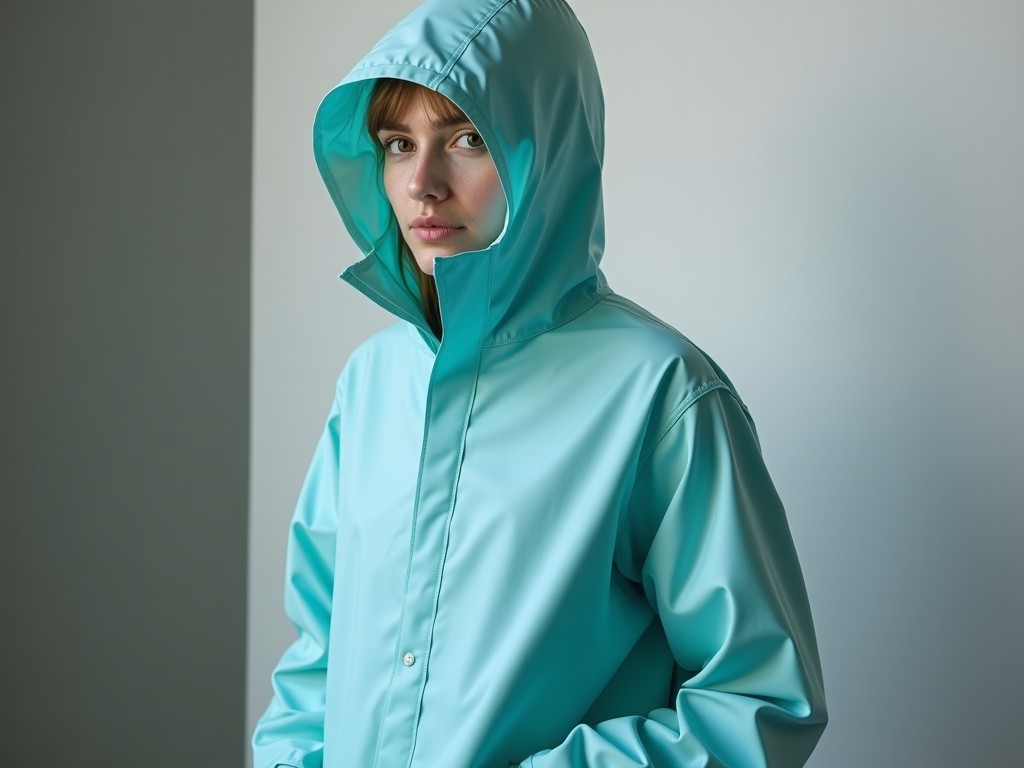
Long Sleeve Waterproof Wipe Clean Bib
Long Sleeve Waterproof Wipe Clean Bib
Industrial environments often require protective garments that resist liquid penetration while allowing quick surface cleaning. This bib is engineered for settings where splashes, spills, or aerosolized contaminants are routine—such as food processing, chemical handling, or pharmaceutical production—where maintaining hygiene and minimizing downtime are critical. Unlike standard aprons or smocks, its extended sleeves provide barrier coverage to the wrists, reducing exposure risks during prolonged tasks.
The core material is a laminated thermoplastic polyurethane (TPU) film bonded to a knitted polyester backing. This construction delivers a water vapor transmission rate (WVTR) below 5 g/m²/24hr, confirming effective liquid barrier performance while allowing limited moisture vapor escape to reduce heat buildup. The TPU layer resists common industrial fluids including water-based detergents, dilute acids, alkalis, and oils up to 50°C, with surface tension compatibility tested per ASTM D7334.
Seams are ultrasonically welded rather than sewn, eliminating needle holes that could become liquid pathways. Weld strength averages 18 N/mm (peel) and 22 N/mm (shear), validated under ISO 9073-7. This method ensures seam integrity matches the bulk material’s resistance, preventing delamination after repeated flexing or exposure to cleaning agents. Edge binding uses the same TPU laminate, heat-sealed to maintain continuity of the barrier layer.
The wipe-clean property stems from the TPU’s low surface energy (approximately 31 mN/m), which inhibits adhesion of particulates and dried residues. Surface cleaning requires only a damp cloth with neutral pH cleaner; no scrubbing or specialized solvents are needed. Testing shows >95% removal of dried milk protein, tomato paste, and graphite residue after three wipe cycles, per internal method based on ISO 22196.
Technical Specifications
| Parameter | Value |
|---|---|
| Material Composition | TPU laminate (0.08 mm) + 120 g/m² polyester knit |
| Water Resistance | >20 kPa hydrostatic head (ISO 811) |
| WVTR | <5 g/m²/24hr (38°C, 90% RH) |
| Seam Strength (Peel) | 18 N/mm (ISO 9073-7) |
| Seam Strength (Shear) | 22 N/mm (ISO 9073-7) |
| Surface Energy | ~31 mN/m (contact angle >70° with water) |
| Operating Temp Range | -10°C to +80°C (intermittent) |
| Sizes Available | S, M, L, XL, XXL (custom lengths on request) |
| Closure Type | Adjustable hook-and-loop neck, snap cuffs |
| Color Options | White, blue, green (custom colors available) |
Material Selection Rationale
TPU was selected over PVC or rubber due to its superior flexibility at low temperatures, absence of phthalates, and resistance to hydrolysis during repeated washing cycles. Unlike PVC, it does not stiffen below 5°C, maintaining comfort in cold processing areas. The polyester backing provides dimensional stability and tear resistance (ASTM D2261: >35 N warp, >30 N weft), preventing sagging when saturated. This combination avoids the brittleness of coated nylons or the permeability of untreated polyesters.
The laminate thickness (0.08 mm TPU) balances barrier performance with dexterity. Thicker films (>0.12 mm) reduce WVTR excessively, increasing thermal stress; thinner layers (<0.05 mm) risk puncture from sharp edges or abrasion. This thickness was determined through wear trials in meat packing and paint spray booths, where users reported no restriction in arm movement after 4-hour shifts.
Applications in Industrial Settings
In dairy processing, the bib protects against milk fat and protein aerosols that can harbor pathogens; its wipe-clean surface allows sanitation between product changeovers without removing the garment. In chemical mixing operations, it resists splashes of sodium hydroxide solutions up to 10% concentration, with permeation testing showing no detectable breakthrough after 30 minutes (EN 14126 barrier performance equivalent). The long sleeves prevent cuff creep during overhead piping work, a common failure point in standard aprons.
Pharmaceutical compounding benefits from the low-lint surface, which minimizes fiber shedding into sterile environments. The smooth TPU finish does not trap powders like titanium dioxide or lactose, reducing cross-contamination risks during batch changeovers. Unlike fabric-based alternatives, it requires no laundering, eliminating validation steps for washing efficacy and drying cycles—critical for ISO 14644-1 Class 7 and 8 areas.
Automotive painting prep zones use these bibs to guard against primer overspray and solvent-based cleaners. The anti-static version (surface resistivity <10¹² Ω/sq, available upon request) prevents dust attraction in sanding booths. Workers report less fatigue compared to rubber aprons due to the lighter weight (approximately 180 g/m²) and flexibility, particularly when reaching into vehicle interiors.
Customization Options
- Length adjustment: Sleeve and torso length modified per anthropometric data
- Reinforcement patches: Added TPU overlays on elbows or chest for abrasion zones
- Closure variants: Magnetic snaps, zippered fronts, or tie-backs for specific PPE protocols
- Surface treatments: Anti-fog coating for high-humidity vision areas, or antimicrobial additives (silver-ion based)
- Color coding: Pantone-matched hues for zone segregation in HACCP plans
Quality Control and Testing
Each batch undergoes hydrostatic head testing on five random samples per ISO 811, with acceptance criteria set at >20 kPa. Seam weld integrity is checked via tensile peel on three specimens per roll, requiring minimum 15 N/mm. Visual inspection under 500 lux lighting identifies surface defects such as pinholes, delamination, or uneven bonding—any flaw exceeding 0.5 mm diameter results in rejection. These checks occur at 100% frequency for incoming material and 10% for finished goods.
Abrasion resistance is evaluated using the Martindale method (ISO 12947-2) with a 12 kPa pressure and standard wool abrasive. Acceptance requires >20,000 cycles before thread breakage or coating cracking—equivalent to six months of daily use in high-contact zones. Colorfastness to light and rubbing (ISO 105-B02 and ISO 105-X12) ensures no fading or transfer after 20 UV exposure hours or 50 dry/wet rub cycles, maintaining appearance and professional presentation.
Dimensional stability after washing is verified per ISO 6330: specimens washed at 40°C, tumble dried, then measured for length change. Acceptance limit is ±2% in both warp and weft directions, ensuring the bib retains fit and coverage after repeated cleaning cycles. This prevents gradual shortening that could expose wrists over time—a critical factor in long-term usability assessments.
Comparison with Alternative Protective Wear
| Feature | TPU Wipe Clean Bib | PVC Apron | Cotton/Polyester Smock |
|---|---|---|---|
| Water Resistance | >20 kPa hydrostatic head | >15 kPa (degrades with plasticizer loss) | None (absorbent) |
| Wipe Clean Ability | >95% residue removal with damp cloth | Requires solvent for dried residues | Needs laundering |
| Weight (approx) | 180 g/m² | 350 g/m² | 240 g/m² |
| Flexibility at -10°C | Maintained (TPU Tg ~-40°C) | Reduced (PVC Tg ~-10°C) | Unaffected |
| Seam Integrity Method | Ultrasonic weld | Sewn + tape | Sewn |
| Typical Use Life | 12-18 months (cleaning dependent) | 6-12 months (cracking risk) | 3-6 months (staining, thinning) |
For technical data sheets, material safety documentation, or to discuss specific application requirements such as cleanroom compatibility or chemical resistance charts, contact our engineering team. Provide details on exposure fluids, temperature ranges, and required certifications to receive a tailored recommendation.
Request Technical Consultation