
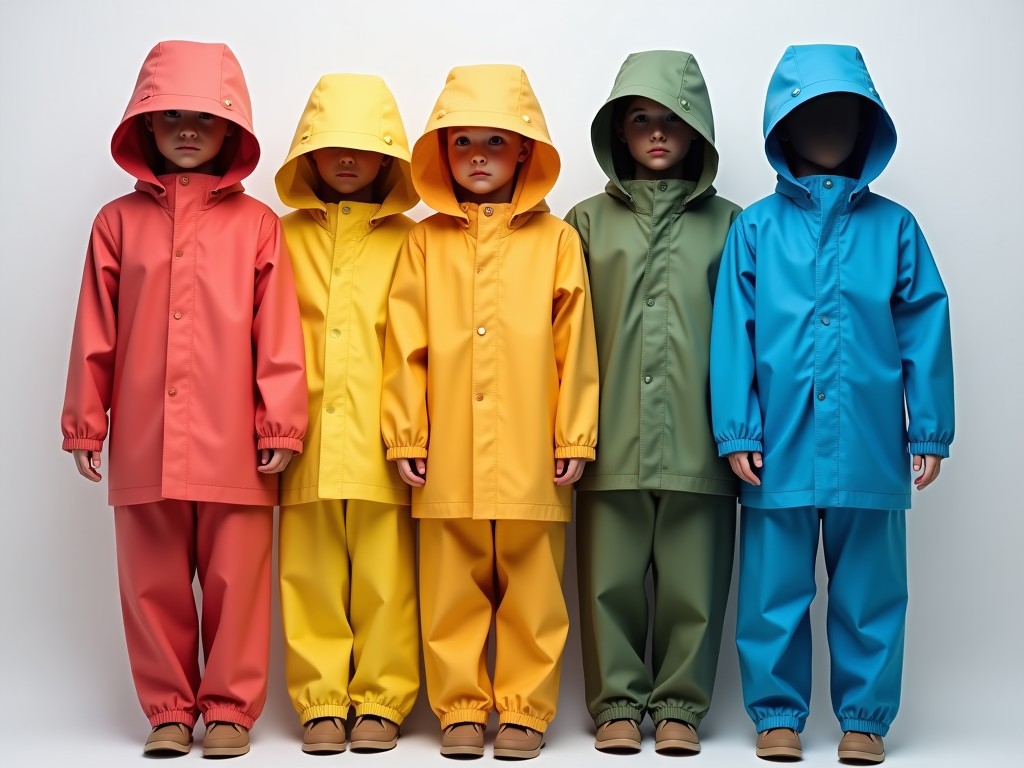
Kids Color Changing Raincoat Suppliers
Kids Color Changing Raincoat Suppliers
Industrial buyers seeking kids color changing raincoats require suppliers who understand the material science behind thermochromic pigments, the durability demands of children's outerwear, and the safety standards governing children's apparel. This page explains the technical considerations for sourcing these products, focusing on measurable characteristics that impact performance, compliance, and long-term value.
Thermochromic Pigment Technology in Raincoat Fabrics
The color change effect in these raincoats relies on leuco dye-based thermochromic pigments encapsulated in a polymer matrix. These pigments shift color at specific transition temperatures, typically between 25°C and 35°C, depending on the formulation. The encapsulation protects the dye from moisture, UV exposure, and mechanical abrasion—critical factors for rainwear subjected to frequent washing and outdoor use. Suppliers must specify the pigment's thermal stability, wash fastness (measured in ISO 105-C06 cycles), and resistance to cracking under flexing.
Base Fabric and Coating Specifications
The substrate is usually a lightweight polyester or nylon taffeta coated with a waterproof polyurethane (PU) or polyvinyl chloride (PVC) layer. For children's raincoats, the coating thickness typically ranges from 0.15mm to 0.25mm, balancing flexibility with water resistance (hydrostatic head >5000mm). The thermochromic layer is applied either as a topcoat or integrated into the coating matrix. Suppliers should provide data on adhesion strength (ASTM D3359), low-temperature flexibility (down to -20°C), and breathability (measured in g/m²/24hr via ASTM E96) to prevent moisture buildup inside the garment.
Safety and Compliance Considerations
Children's apparel is subject to strict regulations regarding chemical content, flammability, and small parts. Suppliers must confirm compliance with standards such as CPSIA (Consumer Product Safety Improvement Act) in the US, EN 71-3 in Europe for migration of hazardous elements, and Oeko-Tex Standard 100 for textile safety. The thermochromic pigments used should be non-toxic, phthalate-free, and certified for direct skin contact. Documentation of third-party testing for lead, cadmium, and formaldehyde content is essential for risk mitigation.
Design and Construction Features
Functional design elements include sealed seams (ultrasonic welded or taped), adjustable hoods with toggle cords (eliminating loose ends), and snap or zipper closures covered by storm flaps. Reflective trims, if present, must meet EN 13356 or ANSI/ISEA 107 standards for visibility. The color change area is often concentrated on high-visibility zones like the back, shoulders, or hood to maximize the interactive effect. Seam strength should exceed 15N/mm to withstand active use by children.
Customization Options for Industrial Buyers
Suppliers typically offer customization in base color (affecting the starting hue before activation), transition temperature range, and color shift (e.g., yellow to red, blue to purple). Minimum order quantities vary but often start at 500 units per design. Artwork files must be provided in vector format (AI, EPS) for screen printing or digital transfer of the thermochromic layer. Lead times depend on pigment availability and coating scheduling, commonly ranging from 4 to 8 weeks after sample approval.
| Parameter | Typical Range or Requirement | Test Standard |
|---|---|---|
| Thermochromic Transition Temp. | 25°C – 35°C | ASTM E2839 |
| Hydrostatic Head | >5000 mm | ISO 811 |
| Wash Fastness (Color Change) | Minimum 20 cycles | ISO 105-C06 |
| Adhesion (Thermochromic Layer) | 4B or better | ASTM D3359 |
| Flammability | Class 1 (CPSC 1610) | CPSC 1610 |
Quality Control and Inspection Protocols
Reputable suppliers implement incoming material checks for pigment dispersion uniformity and coating thickness. In-process inspections include seam integrity testing, color change activation verification at specified temperatures, and dimensional stability after washing. Final random inspections (per AQL 2.5) assess visual defects, functional performance (water resistance, color shift), and labeling accuracy. Buyers should request inspection reports and consider third-party pre-shipment verification for large orders.
Packaging and Logistics Considerations
To prevent damage during transit, raincoats are typically folded with acid-free tissue paper and packed in polybags before placement in export cartons. Carton dimensions are optimized for palletization (e.g., 60x40x40 cm), with gross weight kept under 15kg per carton for handling ease. Humidity indicators may be included inside cartons to monitor moisture exposure. Suppliers should provide fumigation certification for wooden pallets if required by destination country regulations (ISPM 15).
For technical inquiries, sample requests, or detailed specification sheets, contact our engineering team to discuss your project requirements.