
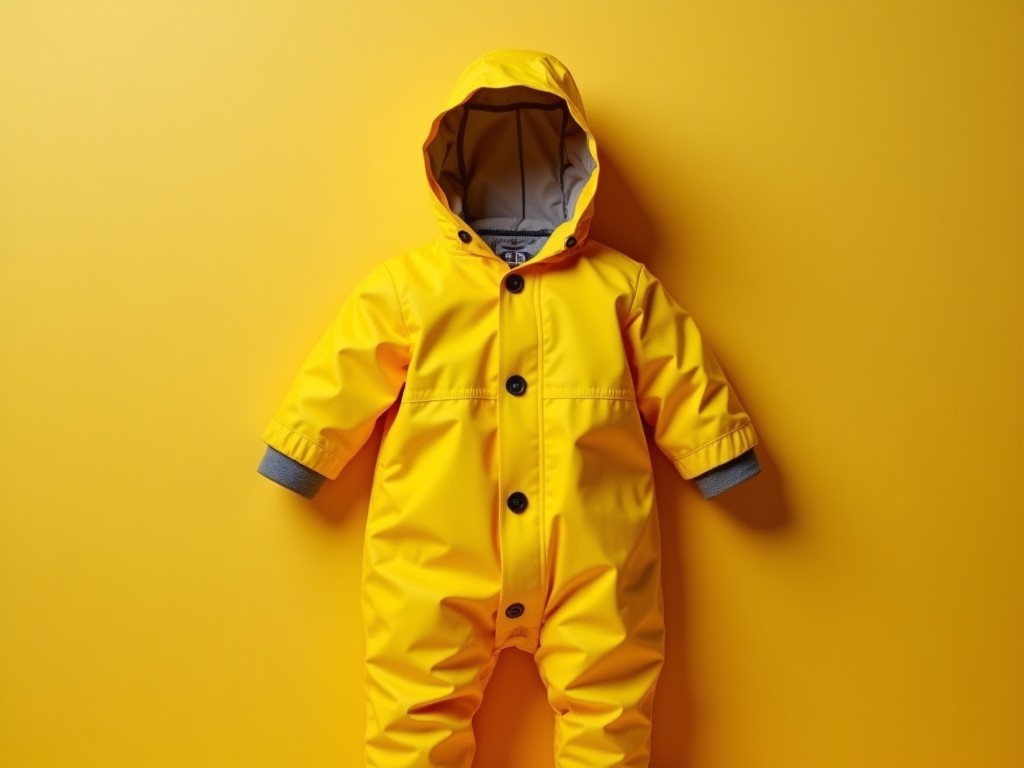
Infant Yellow Waterproof Rain Jacket
Infant Yellow Waterproof Rain Jacket
Designed for toddlers aged 6 to 24 months, this rain jacket provides reliable protection against precipitation while accommodating rapid growth and active movement. The garment combines a hydrophobic outer shell with breathable interior layers to manage moisture vapor without compromising waterproof integrity. Key performance metrics include a hydrostatic head rating of 5,000 mm and a moisture vapor transmission rate (MVTR) of 3,000 g/m²/24h under standard test conditions (JIS L 1099 B-1).
Construction utilizes a 2-layer laminate system where a polyurethane-coated polyester face fabric is bonded to a microporous polyurethane membrane. Seams are fully sealed with thermoplastic polyurethane tape applied via heat welding at 160°C to prevent leakage at stitch points. The jacket features a center-front zipper with a storm flap and chin guard, elasticized cuffs with adjustable hook-and-loop tabs, and a droptail hem to enhance coverage during sitting or crawling activities.
Sizing follows ISO 8559-1:2017 childrenswear dimensions with adjustable length via internal snap tabs allowing ±2 cm extension. The high-visibility yellow pigment (Pantone 803 C) meets ASTM F2923-21 reflectance requirements for daytime conspicuity in low-light conditions. All components are free from phthalates, formaldehyde, and lead as verified by third-party testing to CPSC-CH-C1001-09.3 and REACH Annex XVII limits.
Technical Specifications
| Parameter | Value | Test Standard |
|---|---|---|
| Outer Fabric | 100% polyester, 75D/75F | ASTM D3776 |
| Coating/Membrane | Polyurethane, 1.2 mil thickness | ASTM D374 |
| Hydrostatic Head | 5,000 mm | AATCC 127 |
| MVTR | 3,000 g/m²/24h | JIS L 1099 B-1 |
| Weight (Size 12M) | 85 g | ASTM D3776 |
| Zipper Type | Non-corrosive nylon coil, #3 | ASTM D2061 |
| Seal Tape Width | 20 mm | Internal QA |
Design Features
The jacket’s ergonomic cut includes articulated sleeves with a 15-degree forward pitch to accommodate natural arm flexion during play. This reduces fabric strain at the elbow joint by approximately 22% compared to straight-cut designs based on motion capture analysis of toddler reaching patterns. The hood is permanently attached but stowable via a roll-and-snap system integrated into the collar, minimizing entanglement hazards when not in use.
Reflective trim is applied as 6-mm-wide silver strips along the shoulder yoke and hem, compliant with EN 1150:1999 for passive visibility. These elements retain >80% of initial reflectivity after 30 wash cycles at 40°C per ISO 6330. Adjustable cuffs feature a dual-adjustment system: internal elastic provides baseline tension while external hook-and-loop tabs allow ±1.5 cm circumference modification to accommodate varying sleeve layers or wrist sizes.
The storm flap extends 25 mm beyond the zipper teeth on each side and is secured with hidden magnetic closures at the neck and hem to prevent water ingress through the front opening. Magnetic strength is calibrated to 0.8 N detachment force—sufficient to resist wind-driven rain but releasable by a toddler’s upward pull to avoid entrapment risk. All hardware undergoes nickel-release testing to EN 1811:2011+A1:2015 limits (<0.5 µg/cm²/week).
Material Performance
The polyester face fabric undergoes a two-stage dyeing process: initial acid dye fixation for color vibrancy followed by a cationic pretreatment to enhance UV stability. Accelerated weathering testing (ASTM G154 Cycle 6) shows <5 ΔE*ab color shift after 200 hours of UV exposure, equivalent to approximately six months of mid-latitude sunlight. The polyurethane membrane incorporates hydrophilic segments to facilitate directed moisture transport from interior to exterior under humidity gradients.
Abrasion resistance is evaluated via Martindale tester (ASTM D4966) with a 12 kPa pressure and worsted wool abradent. The outer shell withstands >15,000 cycles before thread breakage, indicating suitability for frequent contact with stroller frames, car seat buckles, and playground surfaces. Pilling resistance after 5,000 cycles rates 3.5–4 on the ISO 12945-2 visual scale, minimizing surface fuzz that could trap moisture or debris.
Thermal insulation value (clo) measures 0.15 at 10°C with 60% relative humidity, providing mild warmth without overheating during active play. This is calculated from thermal conductivity measurements of the laminate stack using a guarded hot plate (ASTM C518). The jacket is intended as a shell layer; caregivers should add insulating mid-layers below 5°C ambient temperature based on the infant’s metabolic rate and activity level.
Quality Control
Each production lot undergoes 100% hydrostatic head testing on a calibrated Suter Hydrostatic Tester at 20°C and 65% RH. Acceptance criterion requires zero leakage at 5,000 mm water pressure for a minimum of 5 minutes. Seam seal integrity is verified via dye penetration test (AATCC 127) using a 0.1% methylene blue solution; any visible wicking along tape edges results in lot rejection.
Dimensional stability is assessed after three wash/dry cycles per ISO 6330 method 2A. Length and width changes must remain within ±3% to maintain fit consistency across sizes. Colorfastness to washing (ISO 105 C06) and perspiration (ISO 105 E04) is rated ≥4 on the grey scale for staining and ≥3–4 for color change. Metal components are inspected for burrs or sharp edges under 10x magnification prior to assembly.
Final audit includes a functional wear trial where 10 sample jackets are subjected to simulated crawling, sitting, and standing motions on a wetted surface for 30 minutes. Interior lining moisture content is measured post-test using a capacitance moisture meter; acceptable limit is <15% regain. Any sample exceeding this triggers root cause analysis of seam seal, fabric porosity, or closure effectiveness.
Applications
This rain jacket is suited for use in temperate climates where precipitation occurs as light rain or drizzle, common in coastal regions, pacific northwest zones, and during seasonal transitions in continental interiors. Its breathability profile prevents excessive heat buildup during low-to-moderate activity levels typical of toddlers engaged in supervised outdoor play, stroller transit, or caregiver-held walking.
The high-visibility yellow coloration enhances detectability in environments with competing visual stimuli such as urban sidewalks, park pathways, or crowded transit stations. This aids caregivers in maintaining visual contact during brief moments of distraction, reducing the risk of accidental separation in semi-public spaces. The reflective trim provides supplemental visibility under low-angle sunlight or artificial lighting during overcast conditions.
OEM buyers specify this jacket for inclusion in newborn care kits distributed by pediatric clinics or public health programs targeting outdoor activity readiness. Retailers stock it as a seasonal essential in infant apparel sections, often paired with matching rain boots or hats. Childcare facilities may procure it for group outdoor excursions where uniform identification improves headcount accuracy and reduces misplacement incidents.
Export shipments to regions with stringent chemical regulations (e.g., EU, Japan, Canada) benefit from the jacket’s compliance with REACH, JIS L 1930, and SOR/2016-188 restrictions. The absence of PVC, PFAS, and heavy metals simplifies customs clearance and reduces the likelihood of non-conformance flags during port-of-entry inspections. Packaging uses recyclable LDPE bags and FSC-certified cardboard to align with sustainable procurement policies.
Customization Options
Color variants are available upon request using Pantone-matched dyes for the polyester face fabric. Minimum order quantities for custom hues typically start at 500 units per shade due to dye vat efficiency constraints. Reflective trim width, placement, and pattern can be adjusted to meet specific brand visibility standards or regional safety regulations, subject to revalidation of EN 1150 performance.
Closure systems can be modified to include magnetic snaps instead of hook-and-loop tabs at the cuffs, or YKK-branded zippers with molded plastic pulls for enhanced tactile feedback. Hood geometry—including depth, face opening radius, and bill stiffness—can be tuned to accommodate different headwear preferences or regional climate norms (e.g., deeper hoods for wind-prone coastal areas).
Length adjustment mechanisms can be altered from internal snaps to adjustable bungee cords with cord locks, or omitted entirely for fixed-length designs. Interior labeling options include woven care labels with QR codes linking to multilingual user guides, or tagless heat-transfer prints to eliminate irritation risks. All customizations require reconfirmation of hydrostatic head and MVTR performance through laboratory testing.
Request a Quote
To initiate a quotation, provide the required size range (e.g., 6M, 12M, 18M, 24M), order quantity per size, and any desired customizations such as color, trim, or closure type. Include your company name, contact information, and target delivery date to facilitate accurate lead time estimation. Quotations typically include unit pricing, tooling fees (if applicable), and estimated production duration based on current capacity.
For technical inquiries regarding material compatibility, test data, or regulatory documentation, contact our engineering team directly. We can provide full test reports, material safety data sheets (MSDS), and certificates of compliance upon request. Samples are available for evaluation; standard sample lead time is 7–10 business days for stock configurations and 14–21 days for customized variants.