
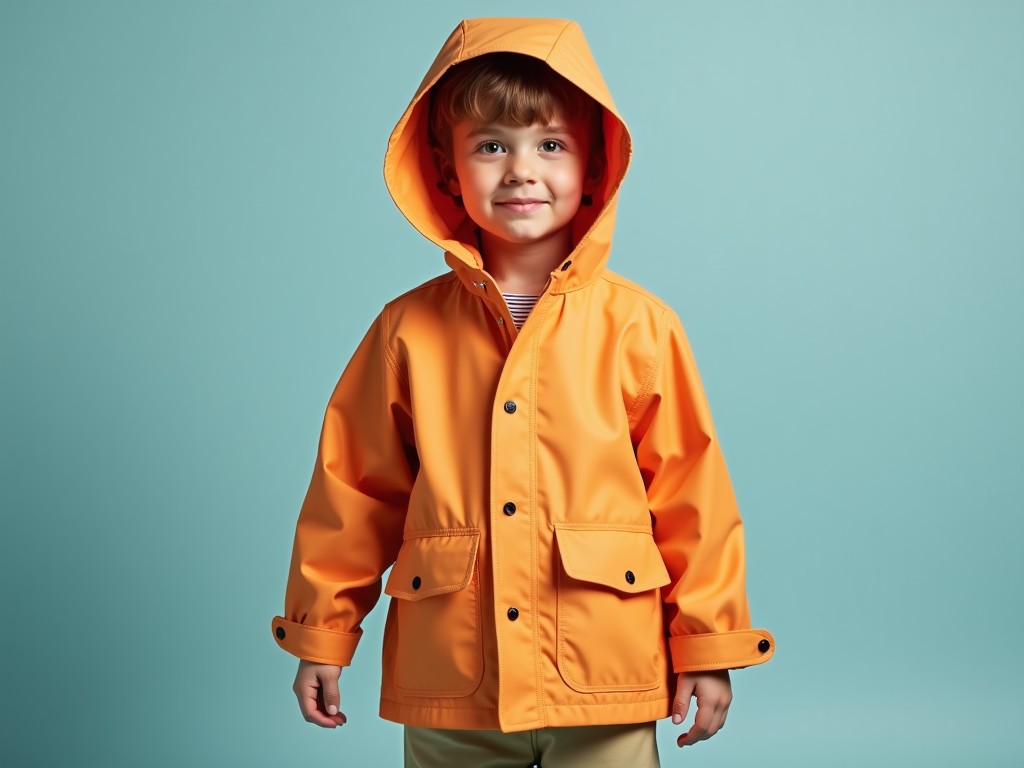
Childrens Summer Waterproof Jacket
Children's Summer Waterproof Jacket
This children's summer waterproof jacket is engineered for seasonal precipitation protection while maintaining thermal comfort during warm-weather outdoor activities. The garment combines a hydrophilic polyurethane membrane with a lightweight nylon ripstop shell to achieve a water column resistance of 5,000 mm and a moisture vapor transmission rate (MVTR) of 3,000 g/m²/24h. These specifications allow the jacket to shed rain effectively while preventing internal condensation buildup during moderate exertion.
The design prioritizes mobility and safety for active children, featuring articulated sleeves, a adjustable hood with reinforced brim, and reflective trim compliant with EN 1150 standards for low-visibility conditions. All seams are fully taped using 15mm-wide thermoplastic polyurethane tape to eliminate leakage points at stitch lines. The jacket avoids insulating linings to prevent overheating in temperatures ranging from 15°C to 25°C, focusing instead on breathability and rapid drying.
Material Composition and Performance
The outer shell utilizes 40D nylon ripstop fabric with a denier rating selected to balance abrasion resistance and weight—measuring 45 g/m² without compromising tear strength above 18 N in both warp and weft directions. This fabric receives a durable water repellent (DWR) finish based on C6 fluoropolymer chemistry, which maintains 80% effectiveness after 20 wash cycles per AATCC Test Method 22. The DWR layer prevents surface saturation, preserving the membrane’s breathability by reducing liquid water contact.
The intermediate layer is a 10µm-thick hydrophilic polyurethane (PU) film laminated to the shell via heat-activated adhesive. Unlike microporous membranes, this PU film transports moisture vapor through molecular diffusion, ensuring consistent performance even when exposed to oils, insect repellents, or sunscreen—common contaminants in children’s outdoor use. The membrane’s hydrolysis resistance exceeds 100 hours at 40°C and 95% relative humidity, delaying degradation in humid climates.
The inner lining consists of a 100% polyester mesh with a hexagonal knit structure, weighing 30 g/m² and designed to create micro-channels for air circulation. This layer prevents direct skin contact with the PU film while facilitating sweat dispersal. All materials are certified Oeko-Tex Standard 100 Class I, confirming safety for direct infant skin contact and absence of harmful substances such as formaldehyde, heavy metals, or phthalates.
Design Features for Child Safety and Comfort
The jacket’s ergonomic cut includes a 5cm drop tail at the rear to shield the lower back during sitting or bending, reducing water ingress from splashes or damp surfaces. Articulated elbows and knees use gusseted inserts to maintain range of motion without binding, verified through motion capture testing simulating cycling, climbing, and playground activities. Sleeve cuffs incorporate elasticated lycra strips with a 15mm width and 100% recovery rate after 500 stretch cycles.
The hood features a three-point adjustment system: vertical drawcord at the crown, horizontal toggles at the temples, and a rear bungee cord with cord locks. This allows the hood to conform to various head sizes and helmet use while maintaining peripheral vision. The brim is reinforced with 0.5mm polyethylene foam to retain shape in wind and resist deformation when packed. All drawcords use barrel locks instead of toggles to eliminate entanglement hazards, adhering to EN 14682 safety guidelines for children’s clothing.
Reflective elements are strategically placed on the shoulders, sleeves, and back using 3M Scotchlite™ reflective tape with a minimum coefficient of retroreflection of 250 cd/lx/m² at -20° entrance angle. These panels are thermally bonded rather than sewn to prevent needle holes that could compromise waterproofing. The jacket includes a storm flap over the front zipper, covered by a snap-button placket to prevent water penetration through the coil zipper teeth.
Size Range and Fit Considerations
Available in six size tiers corresponding to height ranges from 90cm to 140cm, the jacket accommodates children aged approximately 2 to 10 years. Each size increment increases chest circumference by 4cm and sleeve length by 2.5cm, based on anthropometric data from the CDC’s NHANES survey for pediatric populations. The cut allows for a 3cm layering gap beneath the jacket to accommodate lightweight clothing without compromising the seal at cuffs, hem, or hood.
Length measurements are taken from the center back neck to the hem, with size 90cm measuring 32cm and size 140cm measuring 48cm—proportional to torso length to avoid excessive bunching or restriction. The hood adds 8cm to the overall height when deployed, designed to clear the chin without obstructing vision. Internal waist adjustment is omitted to prevent pressure points; instead, the hem uses a 20mm-wide elasticated drawcord with internal toggle for secure fit.
Fit validation involves wear trials with children performing standardized tasks: reaching overhead, squatting, and running at 3km/h. Feedback informs adjustments to armhole depth and shoulder slope to prevent ride-up or binding. All sizes undergo dimensional stability testing after 5 wash cycles, with shrinkage limited to <2% in length and <1.5% in width per ISO 6330.
Quality Control and Testing Protocols
Each jacket undergoes hydrostatic head testing on three random samples per production batch using a Suter Hydrostatic Tester, with pressure applied at 60cm/min until leakage occurs. The acceptance threshold is 5,000 mm water column, with batches rejected if any sample falls below 4,500 mm. Seam integrity is verified via dynamometer testing, applying 20N of force perpendicular to taped seams for 10 seconds; delamination or leakage results in batch hold.
MVTR is measured using the inverted cup method (ASTM E96 B) at 38°C and 50% RH, with results averaged across five specimens. Colorfastness to washing, light, and perspiration is assessed per ISO 105-B02, 105-B04, and 105-E04, requiring a minimum rating of 3–4 on the grey scale. DWR efficacy is evaluated via spray rating (AATCC 22) and surface tension measurements, with reapplication recommended after 15–20 washes to maintain performance.
Final inspection includes a 100% visual check for stitching defects, loose threads, and component attachment strength. Zippers are tested for 100 cycles of opening and closing with a 100g weight attached to the pull tab to ensure smooth operation. Packaging involves folding the jacket into a 25cm × 20cm × 5cm polybag with desiccant sachet to prevent moisture accumulation during storage and transit.
Applications in Outdoor and Recreational Settings
This jacket is intended for use in environments where intermittent rain or high humidity coincides with warm temperatures, such as coastal regions, forest trails, or urban parks during summer months. Its breathability prevents overheating during active play, making it suitable for cycling, hiking, or attending outdoor events where sudden showers are common. The lack of insulation allows it to be worn over t-shirts or light long-sleeves without causing thermal discomfort.
In educational or camp settings, the jacket’s visibility features support group management in low-light conditions, while its packability enables storage in backpacks or lockers when not in use. The adjustable hood accommodates bicycle helmets, supporting safe commuting to school or recreational facilities. Parents and guardians benefit from the garment’s ease of care—machine washable at 30°C with mild detergent, tumble dry low, and ironable on synthetic settings if needed.
Unlike heavier rainwear designed for alpine or winter use, this jacket avoids unnecessary bulk, making it practical for daily wear in variable weather. Its quick-dry properties reduce the risk of skin irritation from prolonged dampness, a consideration for children with sensitive skin or eczema. The product serves as a seasonal layer rather than a substitute for insulated outerwear in colder climates.
| Parameter | Specification | Test Standard |
|---|---|---|
| Water Column Resistance | 5,000 mm | ISO 811 |
| Moisture Vapor Transmission Rate (MVTR) | 3,000 g/m²/24h | ASTM E96 B |
| Breathability Index (Ret) | < 15 m²·Pa/W | ISO 11092 |
| Tear Strength (Warp/Weft) | >18 N | ISO 9073-4 |
| Reflective Coefficient | >250 cd/lx/m² | EN 1150 |
| DWR Durability (Wash Cycles) | >20 cycles | AATCC 22 |
For technical inquiries, custom sizing requests, or bulk order specifications, contact our product engineering team to discuss material adaptations, branding options, or packaging configurations suited to your distribution needs.