
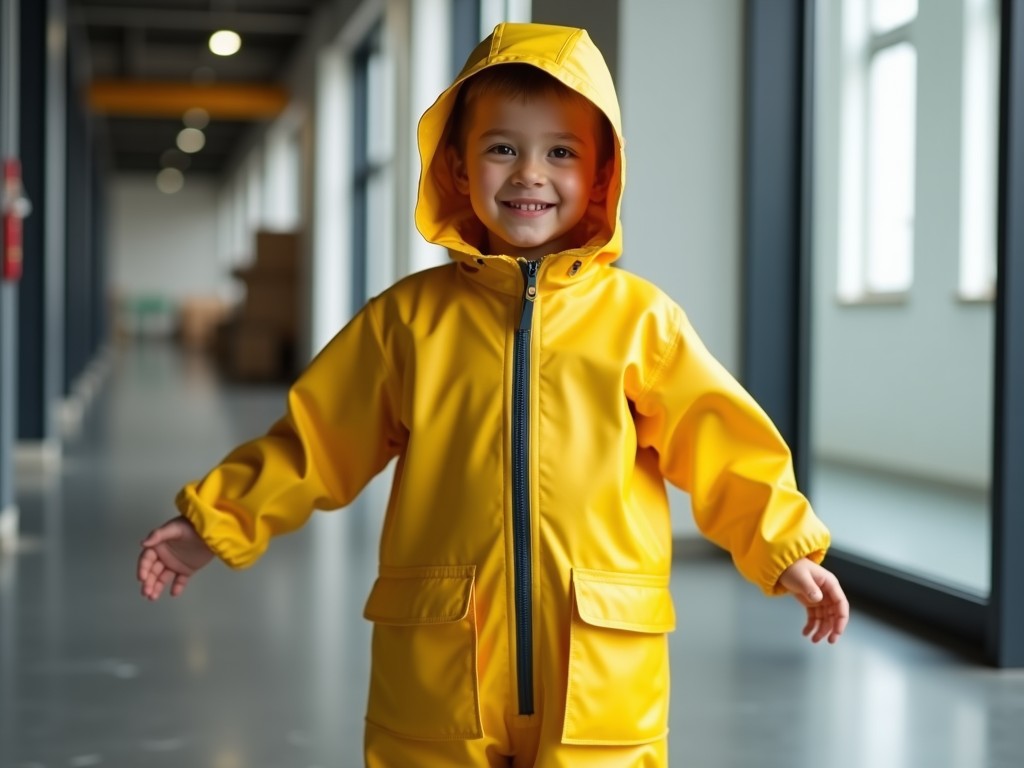
All In One Childrens Rain Suit Factory
All-in-One Children's Rain Suit Factory
When sourcing children's rainwear for bulk distribution, understanding the full manufacturing capability of an all-in-one factory is critical for supply chain reliability. This page details the technical specifications, production processes, and quality controls that define a factory equipped to produce integrated rain suits—combining jacket, pants, and often attached hood or boots—specifically engineered for children's active use in wet conditions.
Integrated Design and Pattern Engineering
An all-in-one rain suit minimizes leakage points by reducing seams between garment components. Pattern engineering focuses on ergonomic mobility for children aged 2–12, with articulated knees, gusseted crotches, and raglan sleeves to accommodate growth and movement. Critical design tolerances include:
• Hood attachment seam strength: minimum 15 N/mm peel resistance
• Sleeve-to-body junction: 300% elongation recovery after 1000 flex cycles
• Inseam gusset: 45° dart angle to prevent binding during sitting or crawling
Pattern grading follows ISO 8559-1 childrenswear standards, with size increments of 5 cm height and 3 cm chest circumference between sizes. Seam placement avoids high-flex zones; for example, side seams are shifted 10 mm posterior to the mid-axillary line to reduce abrasion during arm swing.
Material Selection and Lamination Technology
The outer shell typically uses 100% polyester filament yarn with a plain weave density of 180 T×120 F, coated with polyurethane (PU) at 0.12–0.18 mm thickness for waterproofing. Breathability is achieved through micro-porous PU layers yielding 3,000–5,000 g/m²/24h MVTR (Moisture Vapor Transmission Rate) under JIS L 1099 B1 conditions.
Lamination integrity is verified via peel adhesion testing (ASTM D903), with minimum values of 4.0 N/cm for shell-to-membrane bonds. Seam sealing employs hot-melt tape application at 140–160°C, with tape width of 20 mm and bond strength exceeding 8.0 N/cm after 5 wash cycles per AATCC TM135.
Production Line Capabilities
A dedicated children's rain suit factory operates integrated lines from fabric inspection to final packaging. Key throughput metrics include:
• Fabric inspection: 4-point system, max 40 points per 100 sq yd
• Cutting: CNC laser or die-cutting, tolerance ±1.0 mm on pattern pieces
• Sewing: 300–400 stitches/min lockstitch machines, 11–13 SPI (stitches per inch)
• Seam sealing: 12–15 m/min tape applicator speed
• Final inspection: AQL 2.5 for major defects, 4.0 for minor
Batch traceability is maintained via barcode scanning at each station, linking raw material lot numbers to finished garment SKOs. Production scheduling accommodates MOQs as low as 500 units per style/color, with changeover times under 45 minutes between size runs.
Quality Control and Testing Protocols
Quality assurance extends beyond visual inspection to functional validation. Standard test protocols include:
• Hydrostatic head: minimum 3,000 mm water column (JIS L 1092)
• Rain tower test: 30 min exposure at 50 mm/hr intensity, no internal wetting
• Flex cracking resistance: 15,000 cycles at -20°C (ISO 7854 Method B)
• Colorfastness to washing: minimum Grade 4 (ISO 105 C06)
In-line monitoring uses statistical process control (SPC) on critical dimensions—sleeve length, chest circumference, inseam—with control limits set at ±2 mm from nominal. Random sampling occurs every 200 units, with full lot hold if two consecutive samples fail any critical parameter.
Customization and Scalability
Factories offering true all-in-one production support customization without compromising lead times. Adjustable parameters include:
• Reflective trim width: 20–50 mm, compliant with EN ISO 20471 Class 2
• Closure type: coil zipper (YKK #5 or equivalent) or snap-front with storm flap
• Interior lining: brushed polyester (180 g/m²) or mesh (100 g/m²) for thermal regulation
• Packaging: individual polybag with cardboard hanger, or bulk pack 10–20 units per carton
Color matching uses Pantone Solid Chipped standards with spectrophotometer verification (ΔE < 1.5). Custom logos are applied via heat transfer or screen printing, with ink adhesion tested per AATCC TM8 (minimum 3.5 rating after 10 washes).
Packaging and Logistics Preparation
Finished suits undergo fold-and-bag processes designed to prevent creasing in high-flex zones. Standard carton dimensions are 40×30×25 cm (L×W×H), holding 20 units at 8.0 kg gross weight. Carton sealing uses 48 mm wide pressure-sensitive tape with tensile strength ≥ 110 N.
Export packaging includes corner guards, moisture barrier liners (LDPE 0.05 mm), and ISPM 15-compliant pallets. Labeling includes country of origin, fiber content per ISO 3758, care symbols (ISO 3758:2012), and SCC-14 barcodes for carton tracking.
| Parameter | Typical Range | Test Standard |
|---|---|---|
| Waterproof Rating | 3,000–5,000 mm | JIS L 1092 |
| Breathability (MVTR) | 3,000–5,000 g/m²/24h | JIS L 1099 B1 |
| Seam Seal Strength | >8.0 N/cm | AATCC TM135 |
| Flex Cracking Resistance | 15,000 cycles @ -20°C | ISO 7854 Method B |
| Colorfastness to Washing | Grade 4 minimum | ISO 105 C06 |
Partnering with a factory that controls the entire production chain—from yarn extrusion to final packaging—reduces variability in performance and ensures consistent compliance with children's safety regulations such as CPSIA and EN 71-3. Technical alignment on material specs, seam integrity, and dimensional tolerances is essential for minimizing returns and maintaining brand reputation in competitive markets.